Blog
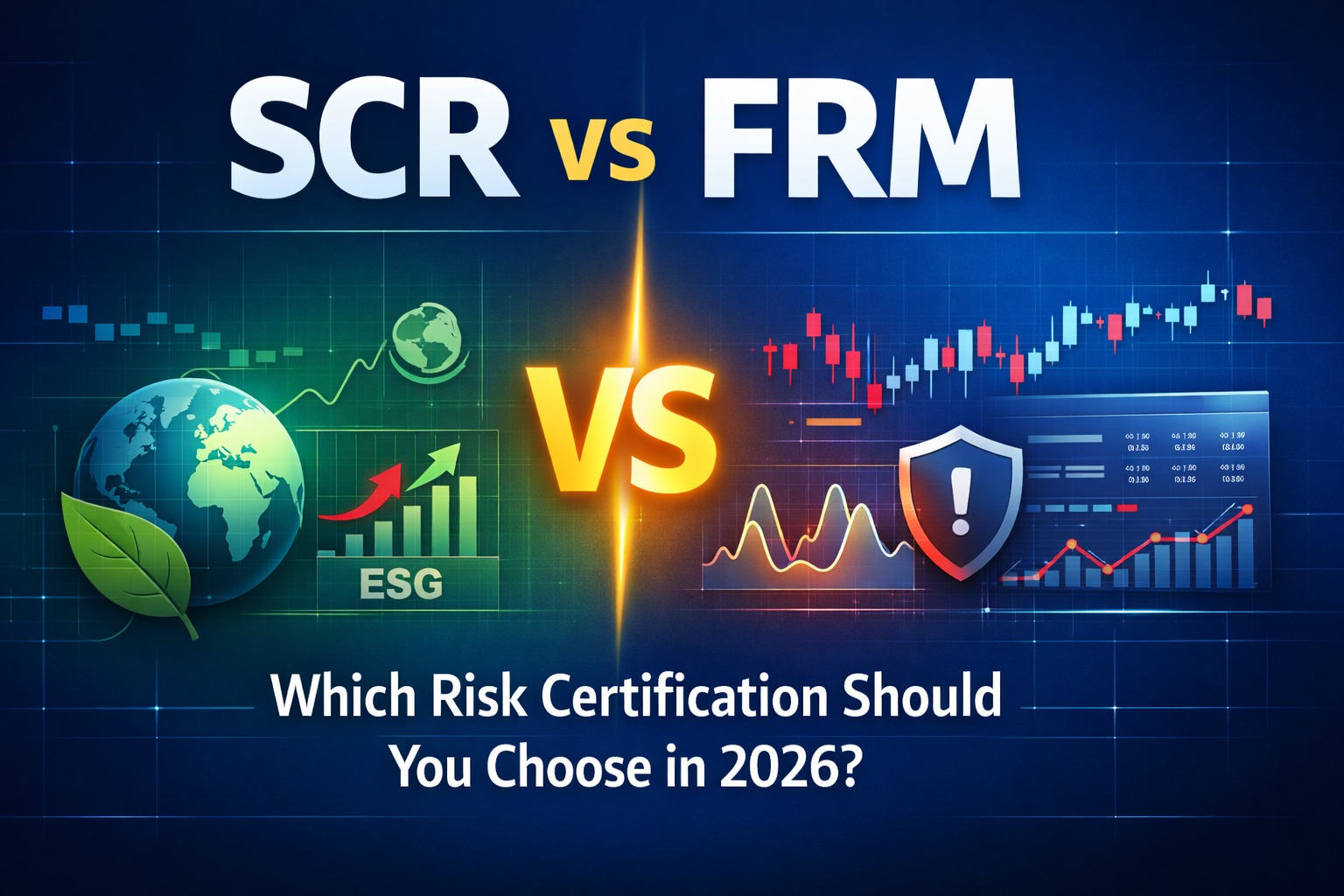
SCR vs FRM: Which Risk Certification Should You Choose in 2026?

Risk management is changing fast. In 2026, professionals are no longer judged only on how well they understand market or credit risk. Climate risk, sustainability, and ESG regulations now sit at the center of global decision-making.
That is why many early and mid-career professionals are confused about SCR vs FRM.
Both are respected risk management certifications. Both open strong career paths. But they serve very different goals.
If you are exploring the right risk management certification in 2026, this guide will help you decide clearly and confidently.
What Is the SCR Certification?
The SCR Certification, officially known as the GARP SCR certification, is a global credential focused on sustainability and climate-related risks.
SCR stands for Sustainability and Climate Risk. It is designed for professionals who want to understand how environmental, social, and governance risks affect financial institutions, businesses, and economies.
This certification fits perfectly within the growing demand for a sustainability risk certification, especially as regulators push climate stress testing and ESG disclosures.
Who is SCR designed for?
- ESG and sustainability professionals
- Risk managers working on climate risk
- Banking and finance professionals involved in ESG reporting
- Consultants advising on sustainability frameworks
The SCR exam covers topics such as climate science, sustainability risk drivers, scenario analysis, and climate risk integration into business decisions.
If you want deeper clarity on whether this path suits you, this detailed guide breaks it down well:
SCR career clarity guide: https://fintelligents.com/scr-certification-in-2026-who-should-actually-pursue-it/
You can also explore complete SCR Exam Details here:
https://fintelligents.com/scr-exam/
What Is the FRM Certification?
The FRM Certification, issued by GARP, is one of the most established credentials in global finance. The GARP FRM certification focuses on core financial risk management across institutions.
FRM stands for Financial Risk Manager. It is widely recognized as a benchmark qualification for professionals working in banking, investment firms, and risk functions.
This is a classic financial risk management certification with strong quantitative depth.
Key risk areas covered in FRM
- Market risk
- Credit risk
- Operational risk
- Liquidity and treasury risk
- Risk modeling and valuation
The FRM exam structure consists of two rigorous parts, often completed over 12 to 18 months.
It is ideal for professionals targeting roles in banks, financial institutions, asset management firms, and regulatory bodies.
For deeper insight, this resource is worth reading:
https://fintelligents.com/what-every-frm-student-needs-to-understand-in-2026/
You can also review complete FRM Course Details here:
https://fintelligents.com/frm-course/
SCR vs FRM: Key Differences at a Glance
Understanding the SCR vs FRM difference becomes much easier when you see them side by side.
| Factor | SCR | FRM |
| Focus | Climate and sustainability risk | Financial risk management |
| Industry Relevance | ESG, sustainability, climate risk teams | Banks, financial institutions, risk desks |
| Technical Depth | Moderate, concept-focused | High quantitative depth |
| Career Roles | ESG risk analyst, sustainability consultant | Risk analyst, market risk, credit risk |
| Exam Structure | 1 exam | 2-part exam |
| Demand Trend | Rapidly rising | Established global demand |
This comparison also reflects the broader shift in risk management certification 2026, where sustainability and financial risk now coexist.
SCR vs FRM Career Opportunities
Career outcomes are often the deciding factor when comparing SCR certification vs FRM.
SCR Certification Career Scope
The SCR certification career scope is expanding quickly due to ESG mandates and climate regulations worldwide.
Typical roles include:
- ESG risk analyst
- Climate risk specialist
- Sustainability consultant
- ESG reporting and compliance roles
These roles are growing fastest in banks, consulting firms, multinational corporations, and regulatory environments.
FRM Career Opportunities
FRM career opportunities remain strong and globally recognized.
Common roles include:
- Market risk analyst
- Credit risk manager
- Enterprise risk professional
- Treasury and ALM roles
FRM professionals often work in banks, hedge funds, asset managers, fintech firms, and central banks.
SCR vs FRM Salary Comparison
Instead of focusing on exact figures, it is more realistic to look at salary ranges by role type.
- FRM professionals typically earn higher salaries early in traditional finance roles due to technical specialization.
- SCR professionals see rapid salary growth in ESG and sustainability roles, especially as demand exceeds supply.
When comparing SCR vs FRM salary, FRM often leads in core banking roles, while SCR offers strong upside in ESG-focused leadership paths.
FRM vs SCR: Which Is Better for You?
The question many candidates ask is FRM vs SCR which is better. The honest answer depends on your career direction.
Choose FRM if:
- You want a core financial risk role in banking
- You enjoy quantitative analysis and models
- Your target roles are in market, credit, or treasury risk
Choose SCR if:
- You want to work in ESG or sustainability risk
- You are involved in climate risk or regulatory frameworks
- You want future-facing expertise aligned with global trends
For long-term leadership roles, many professionals pursue both FRM and SCR. This combination signals expertise across financial and sustainability risk, which is increasingly valuable.
Not sure which certification fits your career path?
Explore detailed guidance and structured preparation support:
FRM Course: https://fintelligents.com/frm-course/
SCR Program: https://fintelligents.com/scr-exam/
Choosing the right certification today can define your risk career for the next decade.
Frequently Asked Questions
1. Is SCR easier than FRM?
Yes. SCR is more concept-focused, while FRM involves deeper quantitative rigor and complex risk modeling.
2. Can I do SCR and FRM together?
Yes. Many professionals combine sustainability risk expertise with financial risk management to future-proof their careers.
3. Which certification has better career growth in 2026?
FRM remains established globally, while SCR is growing rapidly due to ESG regulations and climate risk requirements.
4. Is SCR only for sustainability professionals?
No. Bankers, consultants, and risk managers are increasingly pursuing SCR to stay relevant in evolving risk roles.
5. Who should choose FRM over SCR?
Professionals targeting core financial risk roles in banks and financial institutions should prioritize FRM.