Blog
RAI Certificate vs. FRM: Which GARP Certification Should Risk Professionals Pursue First in 2026?

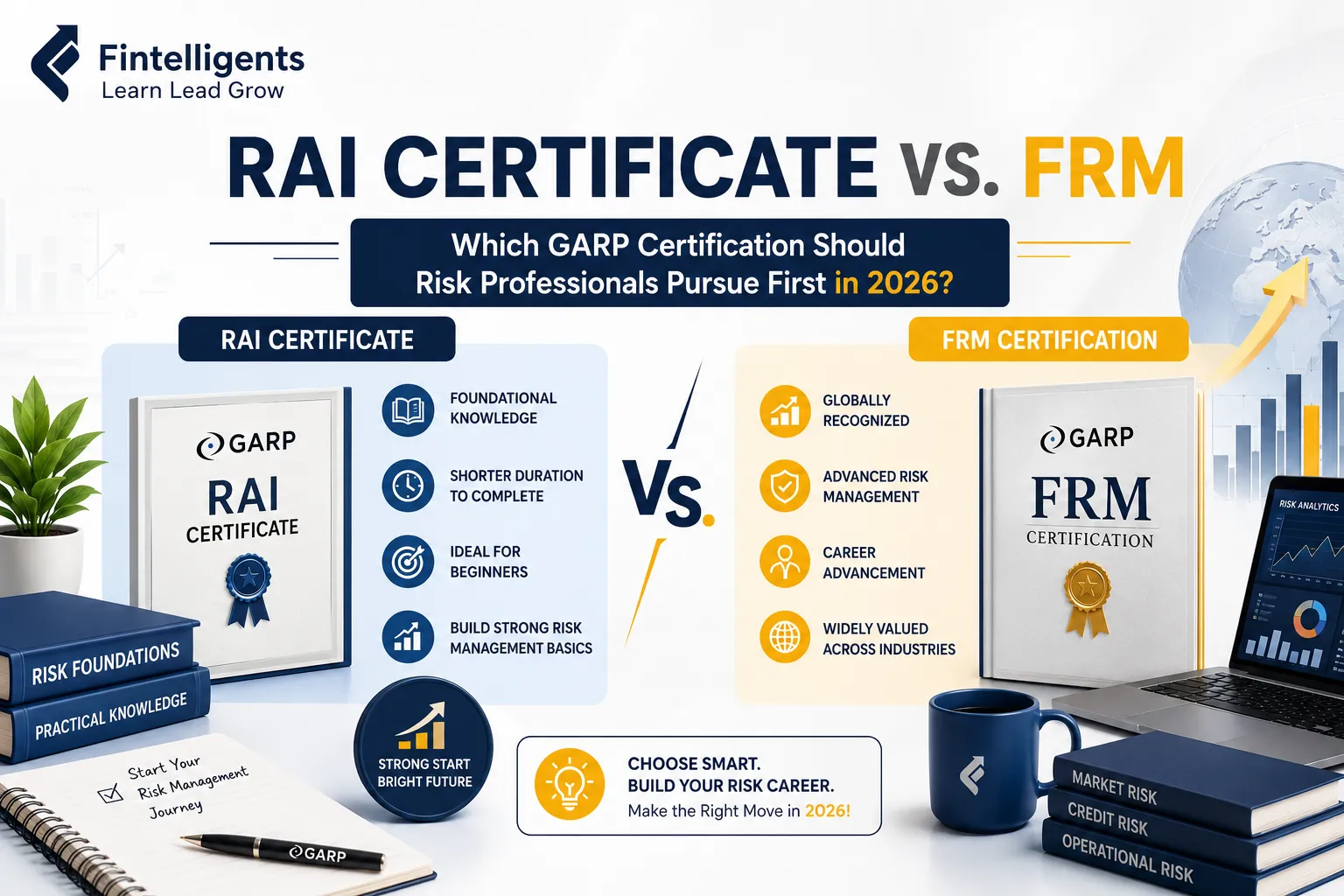
Both the RAI certificate and the FRM come from GARP, both deal with risk, and both are increasingly relevant for finance professionals in 2026. But they are built for very different purposes and very different career stages. The RAI vs FRM question has come up more frequently as the RAI gains traction in India, and the answer is not the same for everyone. This blog breaks down both certifications properly so you can make the right call for where you are in your career right now.
What Is the FRM?
The FRM, or Financial Risk Manager certification, is GARP’s flagship qualification. It is a two part exam covering quantitative analysis, financial markets and products, valuation and risk models at Part 1, and market risk, credit risk, operational risk, liquidity risk, and investment management at Part 2.
The FRM is widely recognised across risk management, investment banking, credit analysis, and financial services globally. It is a technically demanding qualification that most candidates take one to two years to complete and requires 200 to 300 hours of preparation per part.
What Is the RAI Certificate?
The RAI, or Risk and Artificial Intelligence certificate, is GARP’s newest credential. It is built specifically for finance and risk professionals who want to understand how AI is being used in financial decision making and how the risks that come with AI systems are identified, governed, and managed.
The RAI certificate covers AI and machine learning applications in financial services, model risk management for AI systems, data governance, algorithmic decision making, and the ethical and regulatory dimensions of AI in finance.
RAI vs FRM: Key Differences
Scope and Depth
The FRM goes deep into quantitative methods, risk modelling, and the full spectrum of financial risk across credit, market, operational, and liquidity functions. It requires strong mathematical and statistical grounding. The RAI is less quantitative and more focused on AI governance, model risk management for AI systems, and the regulatory framework around algorithmic decision making.
Who Each Is Built For
The FRM is designed for risk analysts, credit professionals, portfolio managers, and anyone targeting roles where technical risk measurement and modelling is central to the job. The RAI is built for professionals who work at the intersection of risk management and technology, including model risk teams, AI governance functions, and risk professionals whose organisations are deploying AI at scale.
Time and Effort
The FRM is a two part qualification that takes most candidates one to two years to complete. The RAI is a single level exam that most candidates prepare for in two to three months.
Career Impact
The FRM carries broader recognition across more industries and roles. The RAI is more specialised but targets one of the fastest growing areas in financial services right now.
For a broader view of how AI is reshaping traditional risk careers, Why FRM Certification Matters More Than Ever in an AI-Driven Finance World gives useful context on where the industry is heading.
Which One Should You Pursue First in 2026?
Start with FRM if you are in or targeting roles in risk management, credit analysis, treasury, or investment banking where technical risk expertise is the core requirement. The FRM gives you the foundational credibility that employers in these roles look for first.
Start with RAI if you are already working in a risk or technology function where AI systems are being deployed and your role involves overseeing, governing, or validating those systems. The RAI adds a layer of expertise that is immediately applicable and differentiating.
Pursue both if you want to build a profile that covers traditional financial risk management and the AI governance dimension. A candidate who holds both the FRM and RAI has a combination that very few professionals in India currently offer.
For a broader view of why the combination of FRM and AI skills is increasingly powerful, Why Risk and AI Will Be the Most Important Skill in FinTech by 2026 is worth reading before you decide.
Enrolling in FRM Online Classes at Fintelligents gives you structured preparation for the FRM with faculty support and regular mocks. For the RAI, the Risk and AI certification program at Fintelligents prepares you for both the technical and governance dimensions of the exam.
For a look at how these certifications fit into the broader landscape of risk credentials, FRM, CFA, or SCR? Choosing the Right Certification for Risk Management Careers helps you think through your longer term certification strategy.
Conclusion
The RAI vs FRM question does not have one universal answer. If you are building a career in traditional financial risk management, start with FRM. If you are already working in a function where AI governance and model risk are central, start with RAI. And if you want to be genuinely future proof in a risk career, the combination of both is the strongest position you can build toward in 2026.
Enroll for your GARP certification coaching at Fintelligents and get expert guidance on whichever path fits your career goals best.
Frequently Asked Questions (FAQs)
Q. Is the RAI certificate harder than the FRM?
No. The FRM is a more demanding qualification overall. It has two parts, covers a broader range of quantitative topics, and requires significantly more preparation time than the RAI. The RAI is a single level exam that most candidates prepare for in two to three months.
Q. Can I do the FRM and RAI at the same time?
It is possible but not recommended for most candidates. The FRM requires 200 to 300 hours of preparation per part. Doing both simultaneously risks spreading your study time too thin. Most candidates complete one before starting preparation for the other.
Q. Which GARP certification is more recognised by Indian employers in 2026?
The FRM currently has broader recognition across Indian employers in risk, banking, and financial services. The RAI is newer but growing quickly in relevance as AI adoption increases across financial institutions. For candidates in AI governance or model risk roles specifically, the RAI is gaining recognition fast.