Blog
ACCA December 2026 Exams: What to Do in the Final Two Weeks to Pass

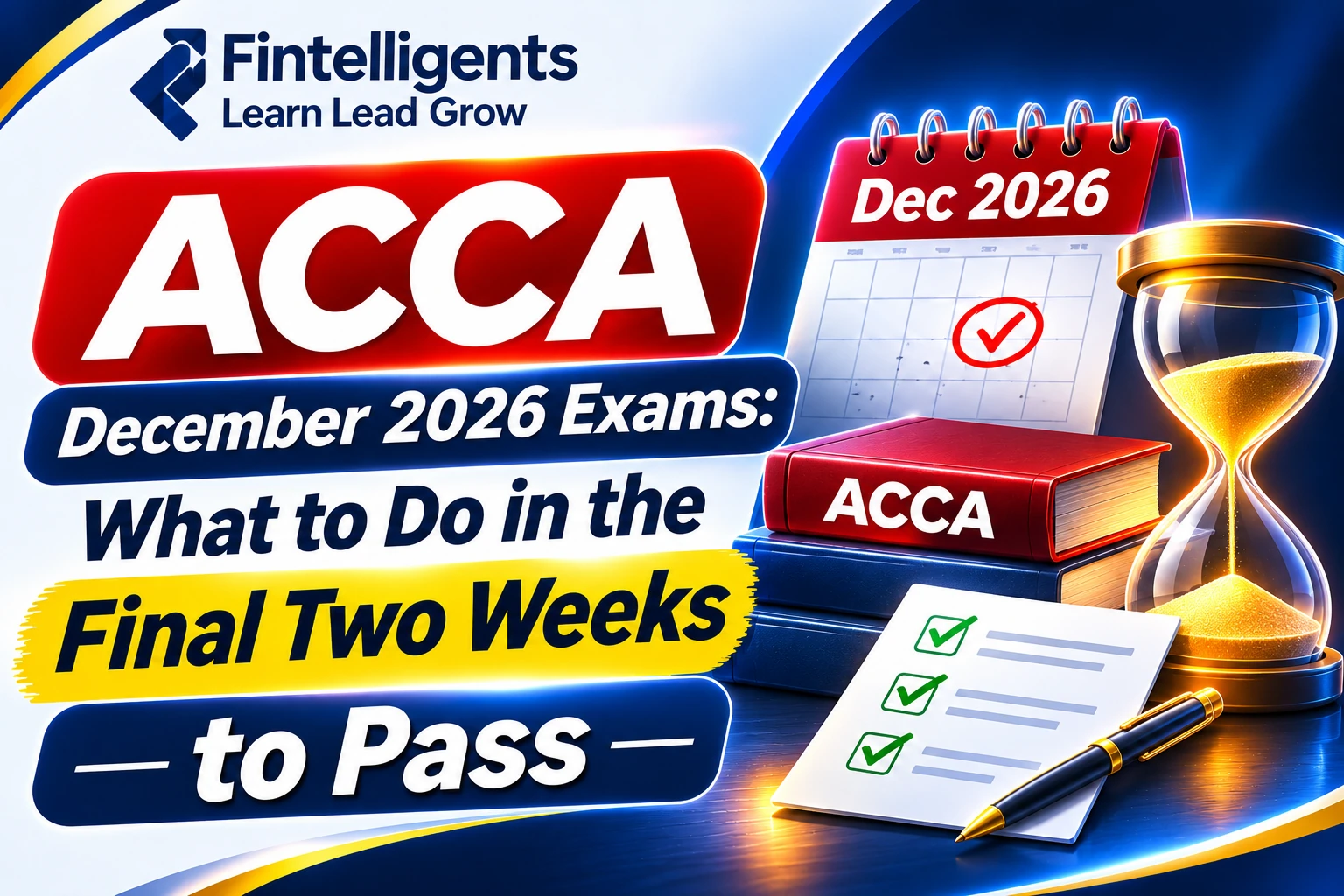
The ACCA December 2026 exam window is weeks away. If you have been preparing across the year, this is the period where the quality of your final two weeks determines whether that preparation converts into a pass. For candidates sitting Applied Skills or Strategic Professional papers, the approach to the last fortnight is different from every other phase of your preparation and deserves a specific plan.
This guide covers exactly what to do in the two weeks before ACCA December 2026, paper by paper considerations, and how to handle the exam itself.
Why the Final Two Weeks Are Different
Most ACCA preparation through the year is about building knowledge: reading Study Texts, understanding concepts, working through examples. The final two weeks are not a continuation of that phase. They are a consolidation phase, and the two are fundamentally different activities.
In consolidation, the goal is not to encounter new material. It is to ensure that the knowledge you have already built is accessible under exam conditions – that you can recall it quickly, apply it correctly, and present it in a form that earns marks. Candidates who treat the final two weeks as a continuation of their learning phase consistently underperform relative to their actual knowledge base.
Week One: Targeted Practice and Error Reduction
Complete at Least Two Full Past Papers
The single most valuable activity in the first week is completing full past papers under timed exam conditions. Not sections of papers, not untimed attempts: full papers, timed, with no reference to notes until you have submitted your answers.
ACCA makes past papers and mock exams available through the ACCA Practice Platform. These are the closest available approximations to your actual December 2026 exam. After each paper, go through every question you got wrong or partially answered and identify the root cause: was it a knowledge gap, a misreading of the question requirement, or a time management failure? Each root cause requires a different fix.
For Applied Skills papers like Financial Reporting (FR) or Performance Management (PM), two full past papers in the first week is a realistic and productive target. For Strategic Professional papers like Strategic Business Leader (SBL), which is a four-hour integrated case study, one full attempt is sufficient for the week.
Build Your Personal Mark Plan
ACCA exams reward structured, requirement-focused answers. Every question tells you exactly what it wants: calculate, discuss, evaluate, recommend, advise. Candidates who answer the question that is asked rather than writing everything they know about the topic consistently score better than candidates with the same underlying knowledge who do not follow the requirement.
In this first week, build a habit of reading every question requirement twice before writing a single word of your answer. Underline the verb (calculate, explain, discuss) and answer exactly that. Marks in ACCA exams are awarded for specific points against a marking scheme; padding around the right points does not earn extra marks and costs time.
Week Two: Consolidate, Not Cram
The 48-Hour Rule
By the start of week two, any topic that you do not have at least a working understanding of at this stage is unlikely to be fully remedied by intensive last-minute study. Spend no more than 48 total hours in the final two weeks on topics you are encountering for the first time. The rest of your time belongs to strengthening what you already know.
This is a difficult discipline but an important one. Candidates who abandon their strong areas to fix weak ones in the final week frequently end up in the exam unable to score well on either.
Ethics and Professional Marks
For Applied Skills and Strategic Professional papers, ACCA includes professional marks and ethics components that many candidates underweight in their preparation. In SBL, up to 20 of the total 100 marks are professional marks rewarding structure, format, and professional tone. In many Applied Skills papers, ethics scenarios carry standalone marks that require a specific approach – identifying the ethical issue, naming the relevant principle from the ACCA Code of Ethics, and recommending a course of action.
If you have been skipping ethics practice during your preparation, dedicate specific time in week two to working through ethics scenarios from past papers. These marks are among the most reliably acquirable on the paper for a prepared candidate.
Technical Revision by Topic Weightage
Use the ACCA examiner’s approach documents and the exam blueprints for your specific papers to identify which topics carry the most marks. Spend your revision time proportionate to that weightage, not based on what you personally find most interesting or most familiar.
For Financial Reporting (FR), group accounts and IFRS application questions consistently carry significant weight. For Performance Management (PM), budgeting, variance analysis, and performance measurement dominate the marks available. For Audit and Assurance (AA), risk assessment and audit procedures are the highest-value areas. Prioritise accordingly.
The Night Before: What to Do and What Not to Do
Stop at a Fixed Time
Set a hard stop time for exam preparation on the evening before each paper. 8 PM is a reasonable cut-off. Beyond this point, reviewing material adds anxiety without adding knowledge. What you do not know the night before the exam, an extra hour of revision will not fix.
Prepare everything physical: your exam confirmation, your valid photo ID, your pens and pencils. For computer-based exams at a CBE centre, confirm your centre address and arrival time. ACCA recommends arriving 30 minutes before your scheduled start to allow for check-in.
The Morning of the Exam
Eat breakfast. Do not attempt to review notes on the morning of the exam. If you feel the urge to read something, re-read your summary sheet of the top 10 formulas or concepts for your paper – nothing new, just familiar ground.
For common mistakes ACCA students make that undermine even well-prepared candidates, Top Mistakes ACCA Students Make in Exams is worth reading the evening before your paper.
In the Exam: Time and Mark Allocation
Allocating Time by Marks
In every ACCA exam, allocate your time strictly in proportion to marks. The standard calculation is 1.8 minutes per mark for a three-hour paper. A 25-mark question gets 45 minutes. A 10-mark question gets 18 minutes. Write this allocation on your question paper or on your rough work at the start and enforce it rigidly.
The single most common reason ACCA candidates fail by a small margin is not insufficient knowledge – it is running out of time on later questions because they spent too long on earlier ones. A partial answer to every question scores more marks than a perfect answer to half of them.
Reading Time
ACCA papers include reading time before the exam begins. Use it actively. Read every question, identify the requirements, make mental notes on what each question is testing, and decide the order in which you will attempt them. Starting with the questions you are most confident about builds momentum and ensures your strongest answers are written when your concentration is at its peak.
After Your Last Paper: What Comes Next
Results for ACCA December 2026 Applied Skills papers will be released on 10 February 2027. Strategic Professional results follow approximately two weeks later. If you are progressing through the qualification, begin planning your March 2027 or June 2027 sitting immediately after December exams end – the ACCA June 2027 exam session registration closes earlier than many candidates expect.
For a structured approach to managing papers, exemptions, and exam dates across your full ACCA journey, ACCA Study Plan 2026: How to Balance Papers, Exemptions and Exam Dates gives you the planning framework.
For candidates who want structured coaching and expert faculty support for ACCA papers, the ACCA online course at Fintelligents covers all Applied Skills and Strategic Professional papers with live sessions, recorded content, and regular mock exams. The ACCA Online Course: Study Smart for a Global Career blog gives you a full picture of how to combine self-study with structured coaching effectively.
Frequently Asked Questions
When do ACCA December 2026 exam results come out?
ACCA December 2026 Applied Skills results were released on 10 February 2027. Strategic Professional results are released approximately two weeks after Applied Skills results. Candidates can opt in for text message notifications through the myACCA portal.
How many past papers should I do in the final two weeks before ACCA?
For Applied Skills papers, aim for at least two to three full timed past papers in the two weeks before your exam. For Strategic Professional papers like SBL, one or two full attempts under timed conditions is sufficient. Quality of review after each attempt matters more than volume of papers done.
Should I study new topics in the final week before ACCA exams?
No. The final week should be entirely focused on consolidating what you already know through question practice and error review. Attempting to learn new topics in the final week adds anxiety without meaningfully improving your exam performance.
How is time best managed in the ACCA exam hall?
Allocate 1.8 minutes per mark for a three-hour paper and enforce it strictly. Begin with the questions you are most confident about. Use reading time to map out every question before you start writing. Never spend more than your allocated time on any single question – a partial answer on every question scores more than a perfect answer in half.
What should I do if I feel underprepared going into ACCA December 2026?
Focus on the highest-weighted topics for your specific paper and work through past paper questions on those topics under timed conditions. Prioritise question practice over re-reading notes. Even partial marks on every question add up – a candidate who attempts everything and scores partially consistently outperforms one who runs out of time leaving questions blank.