

Blog
Best Countries to Pursue a Finance Certification: 2026 Career Guide


Quick answer: The best countries to pursue a finance certification are the United States, the United Kingdom, Singapore, the UAE, Canada and Hong Kong. Each one pairs strong finance jobs with accessible exams and clear work routes. The right pick depends on your certification, budget and career goal.
You want a finance career that travels. A strong certification can open doors in many markets. However, the country you choose shapes your salary, network and visa path. This guide helps you choose with confidence.
Why Your Country Choice Matters
A finance certification is a global credential. Still, the market around it is local. Hiring demand, pay levels and employer brands change from one country to the next.
Think of it this way. The certificate proves your skill. The country decides where that skill earns the most.
What a Good Country Gives You
- Large banks, funds and consultancies hiring regularly
- Exam centres and study support close by
- Clear rules for international students and workers
- A professional network that helps you grow
- A cost of living you can manage
Why This Matters for Your Long-Term Career
Your first market becomes your base. Early roles shape your reputation. Therefore, choose a country that fits your five-year plan, not just your exam date.
How to Choose the Right Country

Many candidates pick a country because friends did. That is risky. Use a simple filter instead.
Step 1: Match the Country to Your Career Goal
Investment roles cluster in financial hubs. Audit and accounting roles are common in Commonwealth markets. Risk roles thrive where banks are large.
Step 2: Compare Total Cost
Count exam fees, study materials, travel and living costs. Also count lost income if you study full time.
Step 3: Check Work Rights Early
A certificate without a work route can disappoint. Read the visa rules before you pay any fees.
Step 4: Test the Job Market
Search job boards for roles that name your certification. If listings are rare, think twice.
Top 10 Countries for a Finance Certification
Here is a clear look at ten strong options. Each section explains who it suits best.
1. United States
The US hosts the world’s largest capital markets. Wall Street, asset managers and Big Four firms hire here at scale.
- Best for: CPA, CFA, FRM, CMA
- Why it stands out: Deep job demand and global employer brands
- Watch out for: The CPA has state-level rules. Education requirements vary, so check your state board first.
2. United Kingdom
London is a top global finance centre. Employers there value professional bodies highly.
- Best for: ACCA, CFA, ICAEW, CIMA
- Why it stands out: Strong recognition across Europe, Africa, Asia and the Middle East
- Watch out for: Living costs in London are high.
3. Singapore
Singapore is Asia’s wealth and fund management hub. It offers a stable system and clear regulation.
- Best for: CFA, FRM, CAIA
- Why it stands out: A direct bridge into Asian markets
- Watch out for: Work passes need an employer sponsor, so plan your job search early.
4. United Arab Emirates
Dubai and Abu Dhabi are growing finance centres. Many firms there hire globally and offer tax-friendly pay.
- Best for: ACCA, CFA, CMA, FRM
- Why it stands out: Fast career growth and a diverse workforce
- Watch out for: Competition for top roles is strong.
5. Canada
Canada pairs quality education with welcoming immigration pathways. Toronto is its main finance hub.
- Best for: CFA, CPA Canada, FRM
- Why it stands out: Skilled-worker routes for graduates
- Watch out for: Local experience often matters to employers.
6. Hong Kong
Hong Kong links global investors with mainland China. Asset management and trading roles are common.
- Best for: CFA, FRM, CAIA
- Why it stands out: Access to Greater China markets
- Watch out for: Fluency in Mandarin helps in many roles.
7. Switzerland
Switzerland leads in private banking and wealth management. Pay levels are among the highest worldwide.
- Best for: CFA, CAIA
- Why it stands out: Prestige and strong wealth management demand
- Watch out for: Work permits are tightly managed. Language skills help.
8. Germany
Germany offers a stable economy and a large corporate sector. Frankfurt hosts many banks and regulators.
- Best for: CFA, FRM, ACCA
- Why it stands out: Lower education costs and strong industry demand
- Watch out for: German language skills open far more roles.
9. India
India is a smart choice for cost-conscious candidates. Exam access is wide, and global firms run large finance centres there.
- Best for: CFA, FRM, ACCA, CMA
- Why it stands out: Low study cost and a large talent market
- Watch out for: You may need to relocate later for top-tier global roles.
10. Australia
Australia has a mature financial sector and strong accounting bodies. Sydney and Melbourne lead hiring.
- Best for: CPA Australia, CFA, ACCA
- Why it stands out: Skilled migration options and high quality of life
- Watch out for: Rules for migration change often, so verify the latest criteria.
Which Certification Fits Which Country?
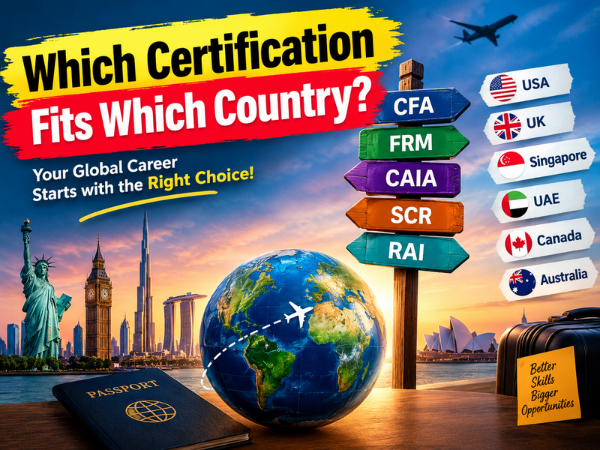
Not every credential carries equal weight everywhere. Use this guide as a starting point.
| Certification | Strongest Markets | Best For |
| CFA | US, UK, Singapore, Hong Kong, Canada | Investment management, research |
| FRM | US, UK, Singapore, UAE, Germany | Risk management, banking |
| ACCA | UK, UAE, Australia, India | Accounting, audit, finance |
| CPA | US, Canada, Australia | Accounting, tax, audit |
| CMA | US, UAE, India | Corporate finance, management |
| CAIA | Switzerland, Hong Kong, Singapore | Alternative investments |
How to Read This Table
First, find the career you want. Next, find the credential that leads there. Finally, pick the country where that credential is strongest.
A Note on Exam Access
Many top exams are computer-based. They run at test centres in many countries. Therefore, you can often study in one country and sit the exam in another. Always confirm current exam locations on the official body’s site before you book.
Cost and Return on Investment
Cost matters, but return matters more. A cheap path with no job is a poor deal.
What to Budget For
- Registration and enrolment fees
- Exam fees for each level or part
- Prep courses and mock exams
- Study materials and tools
- Living and travel costs
How to Judge Your Return
Ask three simple questions:
- How many relevant jobs exist in this country?
- What is the typical starting pay for my target role?
- How soon can I recover my total cost?
Smart Ways to Lower Cost
- Study in a lower-cost country, then work abroad
- Look for employer sponsorship for exam fees
- Use scholarships offered by professional bodies
- Choose self-study plus a mock exam bank
Visa and Work Rights: What to Check
Visa rules decide whether your plan works. They also change often. So always verify details with official government sources.
Questions to Answer First
- Can I work part time while I study?
- Is there a post-study work route?
- Does my certification help my application?
- Do I need an employer sponsor?
General Patterns
Canada and Australia offer skilled-worker routes for many graduates. Singapore and the UAE usually rely on employer sponsorship. The UK and the US have structured but competitive systems.
Rules shift every year. Treat this section as a guide, not as legal advice.
Common Mistakes to Avoid
Many strong candidates lose time through avoidable errors.
Choosing by Prestige Alone
A famous city does not guarantee a job. Match the market to your skills.
Ignoring Language and Culture
Local language skills can open more roles. Plan for this early.
Starting Without a Job Plan
A certificate helps, yet networking wins interviews. Build contacts while you study.
Skipping the Official Syllabus
Read the curriculum before you commit. Some programmes suit certain careers far better.
A Simple 5-Step Action Plan

Follow this plan to move from idea to action.
- Define your goal. Write down the role you want in five years.
- Pick your certification. Match it to that role.
- Shortlist three countries. Use the filters in this guide.
- Check costs and visas. Build a simple budget sheet.
- Start with a study plan. Set weekly targets and book your exam date.
Ready to start? Book a free 15-minute career strategy call with the Fintelligents team. We help you pick the right certification and country. Fill in the form today and take the first step.
Frequently Asked Questions
There is no single best country. The United States and United Kingdom lead on job volume and recognition. Singapore and the UAE are strong for fast growth. Choose the country that matches your target role and budget.
The CFA charter is widely recognised in investment roles. The FRM is highly valued in risk management. ACCA and CPA lead in accounting. Value depends on your career path.
Often, yes. Many exams run at test centres in many countries. Check the official body for current locations and dates before you register.
For many candidates, yes. Prep costs and living costs are often lower. Exam fees are usually set globally, so they stay similar. You may still choose to work abroad later.
It depends on the certification. Some, such as the CFA, allow candidates in the final year of a bachelor’s degree. Others, such as the CPA, set education rules by region. Always read the current eligibility rules.
Timelines vary. The CFA often takes two to four years across three levels. The FRM can be done in about a year across two parts. ACCA and CPA depend on your pace and experience.
The US, UK, Singapore, Hong Kong and Canada all have strong CFA markets. Pick based on whether you want asset management, research or private wealth.
It can strengthen your profile. However, a certificate alone rarely guarantees a visa. Employer sponsorship and skills-based points systems matter more.
The CFA suits investment careers. The FRM suits risk careers in banks and funds. Choose by role, not by popularity.
Start with your exam date and work backward. Split topics into weekly goals. Add mock exams every month. A free planning call can speed this up.
Final Thoughts
The best countries to pursue a finance certification offer more than famous skylines. They give you real jobs, fair costs and clear work routes. Therefore, compare markets with care.
Start with your goal. Next, match it to a certification. Then pick the country that supports both. Small decisions now can shape your whole career.
Take the next step today. Join the Fintelligents newsletter for weekly guides on CFA, FRM, ACCA and CPA careers. Subscribe now and receive our free Finance Career Country Checklist straight to your inbox.