
Blog
ACCA vs CA in India 2026: Fees, Duration, Difficulty, Salary and Career Scope

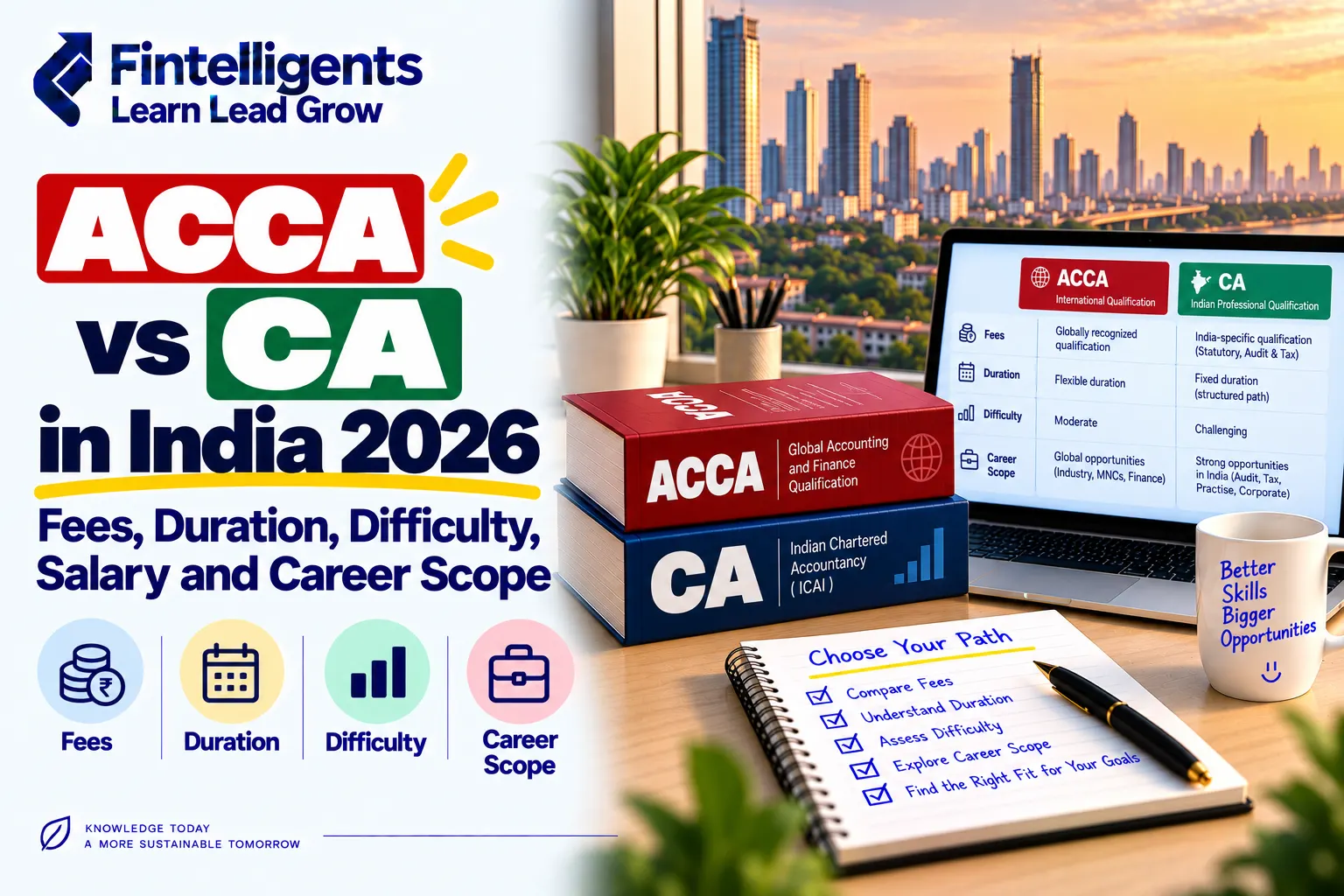
The ACCA vs CA debate divides Indian commerce students more sharply than almost any other career question. Both are rigorous accounting qualifications that lead to strong careers. But they are built differently, serve different career profiles, and take very different amounts of time and money to complete. If you are trying to decide between the two in 2026, this blog gives you a detailed, data-based comparison across fees, duration, difficulty, salary, and career scope so you can make the right call for your situation.
What Each Qualification Is
CA refers to the Chartered Accountant qualification awarded by the Institute of Chartered Accountants of India (ICAI). It is India’s most recognised accounting credential for domestic practice, audit, taxation, and corporate finance. It has three levels: Foundation, Intermediate, and Final, plus a mandatory three-year articleship.
ACCA stands for Association of Chartered Certified Accountants, a UK-based body that awards a globally recognised accounting and finance qualification. It has 13 papers across three levels – Applied Knowledge, Applied Skills, and Strategic Professional – with no mandatory articleship. ACCA is recognised in over 180 countries.
The fundamental difference is scope. CA is optimised for India-specific practice, regulation, and statutory audit. ACCA is optimised for international mobility and finance roles at MNCs, the Big Four, and global financial services companies.
Fees Comparison: ACCA vs CA in India 2026
One of the most common points of confusion in the ACCA vs CA comparison is the actual total cost, because both have fees spread across multiple stages.
CA fees in India are officially much lower than ACCA. ICAI charges approximately Rs 11,600 for Foundation, Intermediate, and Final registration combined. However, most CA aspirants spend significantly more in practice. Coaching for CA, which most candidates need given the difficulty, costs Rs 1 to Rs 2 lakh or more. Total all-in cost including registration, coaching, study material, and exam fees over the full duration typically runs Rs 2 to Rs 4 lakh.
ACCA fees are higher in direct terms because the exam fees are charged in GBP by the ACCA body. Registration costs approximately Rs 8,500. Annual subscription is GBP 140, approximately Rs 15,000 per year. Exam fees across all 13 papers work out to approximately Rs 2,30,000 in total. With coaching and study material added, the realistic total cost across the full ACCA qualification runs Rs 4 to Rs 6 lakh.
The important nuance the raw fee comparison misses is opportunity cost. CA’s mandatory three-year articleship and longer duration often mean candidates cannot work a full-time salaried job during their preparation, which adds a significant income foregone cost that does not appear in the fee comparison. ACCA candidates typically study while working full time, which changes the financial picture considerably.
For a full breakdown of what ACCA coaching and exam fees look like in 2026, ACCA Course Fees in India 2026: Full Fee Breakdown covers every cost component in detail.
Duration: How Long Each Takes
This is where the two qualifications diverge most starkly.
CA officially requires a minimum of 4 to 5 years to complete, including the three-year articleship. In practice, accounting for failed attempts at the Intermediate and Final levels, most candidates take 5 to 8 years to complete the full qualification. Many candidates attempt Final level multiple times before clearing.
ACCA has a realistic minimum of 2 to 3 years for a candidate starting from Class 12 with no exemptions, or 1.5 to 2.5 years for BCom graduates who receive exemptions from Applied Knowledge papers. Because ACCA is a paper-by-paper qualification with four exam sittings per year at the Applied Skills level and two at the Strategic Professional level, candidates who study consistently can move through papers efficiently without the long waits that characterise the CA exam cycle.
The minimum duration comparison of 4 to 5 years (CA) versus 2 to 3 years (ACCA) is significant. For candidates who want to begin their professional career sooner, ACCA offers a shorter path to full qualification.
Difficulty and Pass Rates: The Starkest Difference
This is where the ACCA vs CA comparison becomes most striking. CA is one of the hardest professional exams in the world by pass rate. The CA Final pass rate in the January 2026 sitting was approximately 11% overall, and historically the CA Final has seen pass rates between 5 and 16 percent across attempts. The CA Intermediate pass rate is better but still in the 20 to 35 percent range. These numbers reflect genuine difficulty and an exam design that intentionally selects a small percentage of candidates.
ACCA is genuinely challenging but structured with a far more achievable pass rate. Applied Knowledge papers typically see 65 to 70 percent of candidates pass. Applied Skills papers see approximately 40 to 55 percent passing each sitting. Strategic Professional papers, which are the hardest, see 38 to 50 percent passing. The contrast with CA is significant at every level.
The practical implication of this pass rate difference is that CA aspirants spend far more years in the exam cycle before qualifying, with multiple failed attempts common and expected. ACCA candidates who prepare properly typically clear papers in fewer attempts and complete the qualification in a more predictable timeline.
For a look at which ACCA papers are hardest and how to approach them, Most Difficult ACCA Papers and How to Tackle Them covers the strategic approach for the challenging papers.
Salary Comparison: ACCA vs CA in India
Salary outcomes for both qualifications are strong but with important differences in where they are strongest.
CA salary in India is highest in domestic practice, audit, and corporate finance roles. Freshers after CA qualification earn approximately Rs 6 to Rs 12 lakh per annum in their first roles. Mid-career professionals with 5 to 10 years of experience earn Rs 15 to Rs 25 lakh. CA partners at Big Four firms and senior CFOs at listed companies earn Rs 30 lakh and above with significant upside at the most senior levels.
ACCA salary in India at entry level typically runs Rs 4 to Rs 7 lakh for freshers in their first finance or accounting roles. Mid-career ACCA professionals with 3 to 5 years of experience at MNCs, Big Four, and financial services firms earn Rs 8 to Rs 15 lakh. Senior ACCA professionals at director and head of finance levels earn Rs 20 to Rs 35 lakh.
The key salary difference between the two is employer type. CA qualification commands higher salaries in domestic audit firms, Indian corporates, and roles requiring statutory audit rights. ACCA qualification commands comparable or higher salaries in MNCs, global firms, and international financial services companies, particularly in finance and accounting functions that do not require Indian statutory audit work.
At the global level, ACCA’s salary advantage grows considerably. ACCA professionals in the UAE, Singapore, and UK earn significantly more than their Indian counterparts in absolute terms, while CA’s international portability is limited outside India.
Career Scope: Where Each Takes You
CA is the strongest credential for candidates who want to practice chartered accountancy in India, work in statutory audit, or build a career in Indian tax and compliance. The ICAI charter gives CA holders statutory audit rights under the Companies Act, which ACCA does not. For roles at the partnership level in Indian audit firms, CA is effectively mandatory. For CFO roles at listed Indian companies, CA is the most common and preferred background.
ACCA is the strongest credential for candidates who want to work with MNCs in India, build a career in global financial services, or eventually work internationally. ACCA professionals work across audit, financial reporting, management accounting, tax, and finance advisory functions at the India offices of global firms and at international institutions across the Middle East, Southeast Asia, and the UK.
For candidates whose ambitions are specifically international, or who are targeting the Big Four in their MNC audit practice rather than their India domestic practice, ACCA is the more directly useful credential.
Enrolling in the best online ACCA course in India at Fintelligents gives you structured preparation across all ACCA papers with live and recorded sessions, specialist faculty, and regular mock exams.
For candidates who are also evaluating CFA alongside ACCA for finance roles, ACCA vs CFA: Which Qualification Is Right for You in 2026? gives you a direct comparison of both credentials.
Which Should You Choose?
The right answer depends on your career goals and circumstances rather than which qualification is objectively better.
Choose CA if you want to practice statutory audit in India, work in Indian tax and compliance, or build a career in domestic Indian practice and corporate finance where the ICAI qualification is the standard expectation. Choose CA if you perform well under high-pressure, low-pass-rate examination conditions and are prepared for a 5 to 8 year qualification journey.
Choose ACCA if you want to work with MNCs in India or internationally, value a more flexible and internationally portable qualification, or want to qualify in a shorter and more predictable timeline. Choose ACCA if you plan to work in the UAE, Singapore, UK, or any other international market where the Indian CA is not widely recognised.
Conclusion
ACCA and CA are both strong qualifications that lead to excellent careers. CA is the dominant credential for domestic Indian practice, statutory audit, and regulatory roles. ACCA is the strongest credential for international careers, MNC finance roles, and candidates who want global portability. The fee difference is lower than it appears when opportunity cost is factored in. The difficulty difference is significant, with CA being one of the hardest professional exams in the world by pass rate while ACCA is challenging but achievable. The duration difference is the clearest distinguishing factor, with ACCA offering a faster path to the full qualification for most candidates.
Frequently Asked Questions (FAQs)
Q. Which is better, ACCA or CA in India in 2026?
Neither is universally better. CA is the stronger credential for domestic Indian practice, statutory audit, and regulatory roles. ACCA is the strongest credential for international careers, MNC finance functions, and candidates wanting a qualification recognised across 180 countries. The right choice depends on whether your career goals are primarily in India or internationally oriented.
Q. What is the pass rate for CA vs ACCA in India?
The CA Final pass rate in the January 2026 sitting was approximately 11% overall. ACCA Applied Skills papers typically see 40 to 55 percent of candidates pass per sitting and Strategic Professional papers see 38 to 50 percent passing. CA is significantly harder to pass at every level.
Q. How long does CA take vs ACCA in India?
CA officially takes a minimum of 4 to 5 years including the mandatory three-year articleship. In practice most candidates take 5 to 8 years accounting for failed attempts. ACCA takes 2 to 3 years for candidates starting after Class 12 and 1.5 to 2.5 years for BCom graduates with exemptions who prepare consistently.
Q. Which pays more, CA or ACCA in India?
At the most senior levels in domestic Indian practice, CA partners at Big Four firms and CFOs at listed companies typically earn more than equivalent ACCA professionals. At mid-level in MNCs, global firms, and international financial services companies, ACCA professionals earn comparable or higher salaries than CA professionals. Globally, ACCA’s salary advantage is more pronounced given its international portability.
Q. Can I do both ACCA and CA?
Yes. Many professionals pursue ACCA after qualifying as CA, and ACCA grants exemptions for qualified CAs from up to nine papers. Holding both qualifications is a strong combination for senior roles in international audit and global financial services.