

Blog
ACCA Course in India 2026: Fees, Eligibility, Levels, Exams and Career Scope

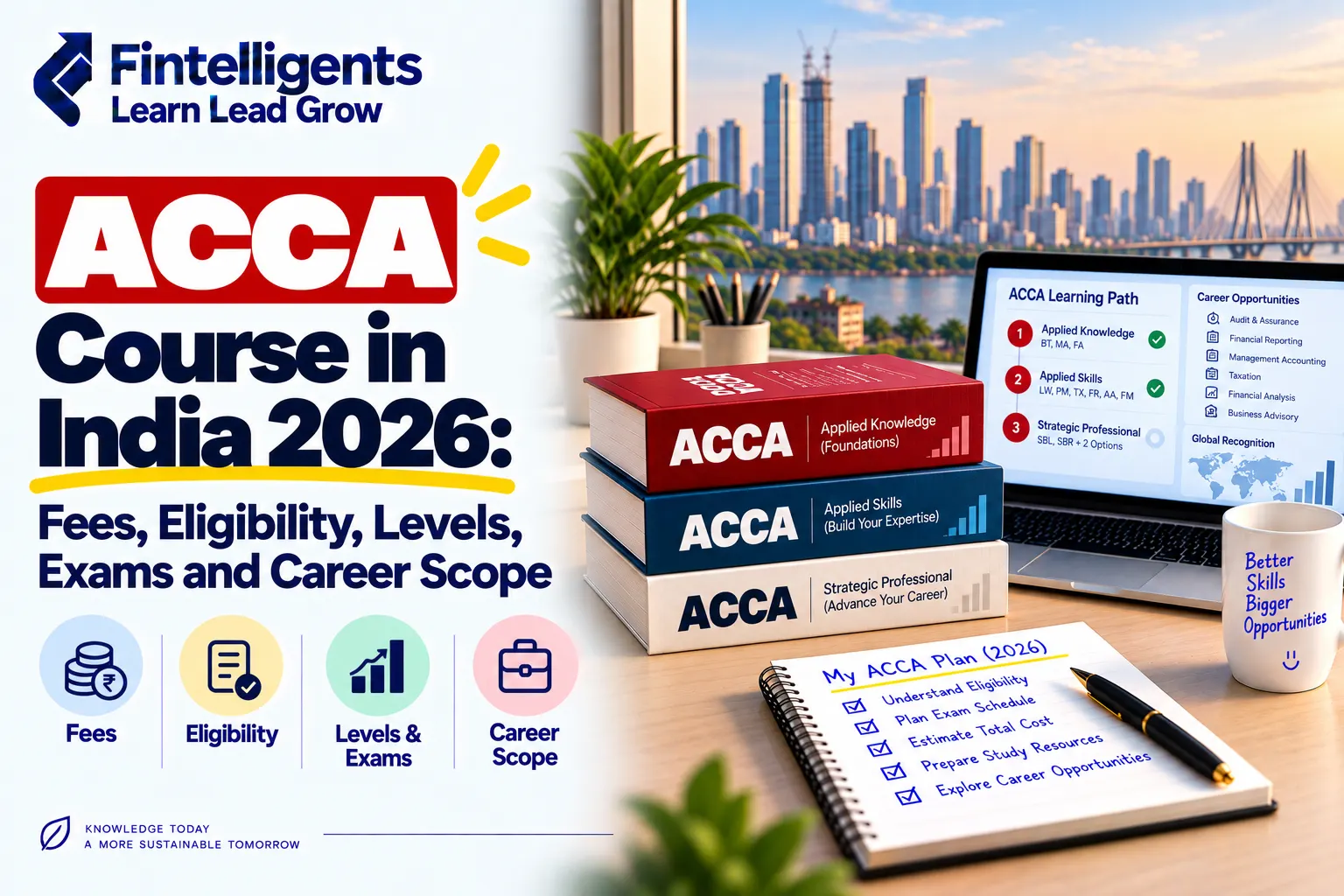
The ACCA, or Association of Chartered Certified Accountants, is one of the most widely recognised accounting and finance qualifications in the world. In India it has grown significantly in popularity over the last decade as more employers, especially multinational firms, Big Four accounting firms, and global financial services companies, have started actively seeking ACCA qualified professionals. If you are considering the ACCA course in India and want a complete picture before committing, this guide covers eligibility, fees, levels, exam structure, and what the qualification does for your career.
What Is the ACCA?
The ACCA is a globally recognised professional accountancy qualification awarded by the Association of Chartered Certified Accountants, headquartered in the United Kingdom. It is recognised in over 180 countries and is particularly valued in the UK, UAE, Singapore, Canada, and across Europe and Asia Pacific. In India, the ACCA is increasingly recognised by the Big Four accounting firms, MNCs, financial services companies, and fintech organisations.
The ACCA qualifies professionals in financial reporting, audit and assurance, taxation, management accounting, financial management, and strategic business leadership. Unlike a university degree, the ACCA is a professional certification that candidates pursue alongside or after undergraduate education. The full qualification is equivalent in standing to other top-tier accountancy credentials like the CA in India and the CPA in the United States.
Book a Free ACCA Counselling Session at Fintelligents
ACCA Eligibility in India 2026
The ACCA has two main entry routes depending on your educational background.
Standard Entry Route
The standard entry route is for candidates who have completed Class 12 or equivalent. You need a minimum of two A Level passes and three GCSE passes, or the equivalent under ACCA’s international entry requirements. For Indian candidates, this translates to completing Class 12 with a minimum of 65% in English and Maths or Accounts, and at least 50% in all other subjects. This route places you at the start of the Applied Knowledge level where you begin from the first paper.
Graduate Entry Route and Exemptions
If you hold a bachelor’s degree, you may be eligible for exemptions from some or all of the Applied Knowledge papers and selected Applied Skills papers. BCom graduates from recognised Indian universities typically receive exemptions from all three Applied Knowledge papers, which means you enter directly at the Applied Skills level and your total paper count reduces from 13 to around 9 or 10 depending on your specific degree.
CA qualified professionals in India receive the most significant exemptions. A fully qualified CA can receive up to nine exemptions from the ACCA qualification, which dramatically reduces the time needed to complete the full ACCA. MBA graduates with a finance specialisation may receive partial exemptions depending on their specific program content.
There is no age limit for ACCA eligibility. The qualification is open to candidates of any age who meet the educational requirements.
ACCA Course Structure and Levels
The full ACCA qualification consists of 13 papers organised across three levels. Candidates must progress through the levels in sequence, but within each level there is some flexibility in which papers you attempt first.
Applied Knowledge Level
This is the entry level and contains three papers. Business and Technology (BT) covers how organisations operate and the role of accountants within them. Management Accounting (MA) covers cost accounting, budgeting, and performance measurement. Financial Accounting (FA) covers the principles of financial reporting including preparation of basic financial statements.
All three Applied Knowledge papers are computer-based objective tests available on demand throughout the year at Pearson VUE centres. This means you can sit them at any time rather than waiting for a fixed exam window. Many BCom graduates receive exemptions from all three papers at this level.
Applied Skills Level
This is the main body of the qualification and contains six papers. Corporate and Business Law (LW) covers legal frameworks relevant to business. Performance Management (PM) covers advanced management accounting and decision-making. Taxation (TX) covers the tax framework for individuals and businesses. Financial Reporting (FR) covers financial reporting under IFRS and UK GAAP including group accounts. Audit and Assurance (AA) covers the principles of external audit and professional ethics. Financial Management (FM) covers financial decision-making including investment appraisal, working capital, and risk management.
Applied Skills papers follow fixed exam windows with four sittings per year in March, June, September, and December.
Strategic Professional Level
This is the final and most advanced level. It contains two compulsory papers and two optional papers selected from a set of four. The compulsory papers are Strategic Business Leader (SBL), a four-hour integrated case study exam, and Strategic Business Reporting (SBR), which covers advanced financial reporting. The optional papers are Advanced Financial Management (AFM), Advanced Performance Management (APM), Advanced Taxation (ATX), and Advanced Audit and Assurance (AAA). Candidates choose two from these four.
Strategic Professional papers are available twice a year in June and December.
For a detailed walkthrough of all 13 papers including what each one tests and how to approach it, Guide to All 13 ACCA Papers: Levels and Tips gives you the full curriculum breakdown.
ACCA Exam Schedule 2026
The upcoming ACCA exam windows for 2026 are December 2026 for Applied Skills and Strategic Professional papers. The registration deadline for December 2026 exams is October 22, 2026. Applied Knowledge papers are available on demand throughout the year.
Results for December 2026 exams will be released on February 9, 2027. ACCA results are available through the myACCA portal and candidates can opt in for text notifications.
ACCA Fees in India 2026
ACCA fees consist of several components that apply at different stages of your qualification journey.
The initial registration fee is GBP 98 which is a one-time fee paid when you first register with ACCA. Annual subscription fees are GBP 128 per year to maintain your student status while working through the papers.
Exam fees are charged per paper at the time of registration. For Applied Knowledge papers, the on-demand exam fee is GBP 82 per paper in India. For Applied Skills papers, the exam fee is GBP 136 per paper in India. For Strategic Professional papers, the fee is GBP 155 per paper for SBL and SBR and GBP 150 per paper for the optional papers.
Exemption fees apply when you are granted exemptions from papers based on your prior qualifications. Each exemption costs GBP 82 for Applied Knowledge papers and GBP 114 for Applied Skills papers.
In approximate INR terms at current exchange rates, Applied Knowledge paper fees are around Rs 8,700 per paper, Applied Skills paper fees are around Rs 14,400 per paper, and Strategic Professional paper fees are around Rs 16,400 per paper.
For a BCom graduate claiming three Applied Knowledge exemptions and sitting 10 remaining papers, the total exam and exemption fees across the full qualification amount to approximately Rs 2.8 to Rs 3.2 lakh depending on the papers attempted. Adding the registration fee, annual subscriptions across 3 to 4 years of study, and coaching costs typically brings the total investment to Rs 4.5 to Rs 6 lakh for most candidates in India.
ACCA Course Duration in India
With standard exemptions for a BCom graduate, completing the ACCA qualification typically takes 3 to 4 years if you attempt papers consistently across sittings. Candidates who attempt two papers per sitting and maintain a strong pass rate can complete it closer to 3 years. Those who attempt one paper at a time or take breaks between sittings often take 4 to 5 years.
The maximum time allowed to complete the ACCA qualification is 10 years from the date of registration, which gives candidates significant flexibility around work, family, and other commitments.
ACCA Career Scope in India 2026
The ACCA opens doors across a broad range of accounting and finance functions. In India, ACCA qualified professionals work across audit and assurance, financial reporting, taxation, management accounting, financial planning and analysis, and finance advisory roles.
The primary employers of ACCA professionals in India are the Big Four accounting firms which include Deloitte, PwC, KPMG, and Ernst and Young, along with mid-tier audit firms, MNC finance and accounting departments, Indian branches of global financial services companies, and shared service centres and global capability centres established by international corporations.
ACCA qualified professionals in India earn between Rs 5 and Rs 10 lakh per year at entry level, Rs 12 to Rs 25 lakh at mid-career, and Rs 28 lakh and above at senior levels. The qualification is particularly valued for candidates who want to work internationally or with globally operating organisations, given its recognition across 180 countries.
For a detailed look at the career paths available after completing the ACCA, Top 5 Career Paths for ACCA Graduates in 2026 covers the full range of options.
ACCA vs CA in India
For candidates choosing between ACCA and CA in India, the key distinction is scope and intent. The CA is the stronger credential for domestic practice in India, especially in audit, taxation, and compliance roles within the Indian regulatory framework. The ACCA is the stronger credential for candidates who want to work internationally or with MNCs operating in India, given its global recognition and alignment with IFRS-based reporting standards.
Many professionals eventually pursue both qualifications. Indian CAs who add the ACCA qualification gain significant exemptions from ACCA papers and end up with a credential combination that is extremely competitive for senior roles at global firms.
Enrolling in the best online ACCA course in India at Fintelligents gives you structured preparation across all ACCA papers with live and recorded sessions, specialist faculty for each paper, regular mock exams, and support throughout your preparation.
For a realistic look at the investment the ACCA requires and what it delivers in return, Is ACCA Worth It in India? Unfiltered ROI and Career Perspective gives you an honest assessment.
Conclusion
The ACCA course in India in 2026 is one of the strongest investments a finance or accounting professional can make if global career ambitions are part of the picture. Eligibility is broad, exemptions significantly reduce the workload for graduates, and the qualification’s recognition across 180 countries gives it portability that most India-specific credentials cannot match. Total costs across the full qualification typically range from Rs 4.5 to Rs 6 lakh depending on exemptions, papers attempted, and coaching choices. The career scope spans audit, reporting, advisory, and finance management functions at some of the most prestigious employers in India and internationally.
Frequently Asked Questions (FAQs)
Q. What is the eligibility for the ACCA course in India?
For the standard entry route, you need to have completed Class 12 with a minimum of 65% in English and Maths or Accounts and 50% in other subjects. For the graduate entry route, a bachelor’s degree in any discipline qualifies you, and you may also receive exemptions from certain papers depending on your degree content.
Q. How many papers are there in the ACCA qualification?
The full ACCA qualification has 13 papers across three levels: Applied Knowledge with 3 papers, Applied Skills with 6 papers, and Strategic Professional with 4 papers of which you choose 2 optional ones alongside 2 compulsory papers. Eligible graduates may receive exemptions that reduce the total papers you need to sit.
Q. How long does it take to complete the ACCA in India?
Most candidates in India complete the ACCA in 3 to 4 years when attempting papers consistently. BCom graduates with standard exemptions start at the Applied Skills level which can reduce the timeline compared to candidates who start from the Applied Knowledge level.
Q. What is the ACCA exam fee in India in 2026?
Applied Knowledge paper fees are approximately Rs 8,700 per paper. Applied Skills paper fees are approximately Rs 14,400 per paper. Strategic Professional paper fees are approximately Rs 16,400 per paper. There is also an initial registration fee and annual subscription fee payable to ACCA.
Q. Is ACCA recognised by employers in India?
Yes. The Big Four accounting firms, MNCs, financial services companies, and global shared service centres in India actively recruit ACCA qualified professionals. Recognition has grown significantly over the last decade alongside the expansion of global firms’ India operations.