Blog
What Is FRM? Meaning, Full Form, Eligibility, Exam

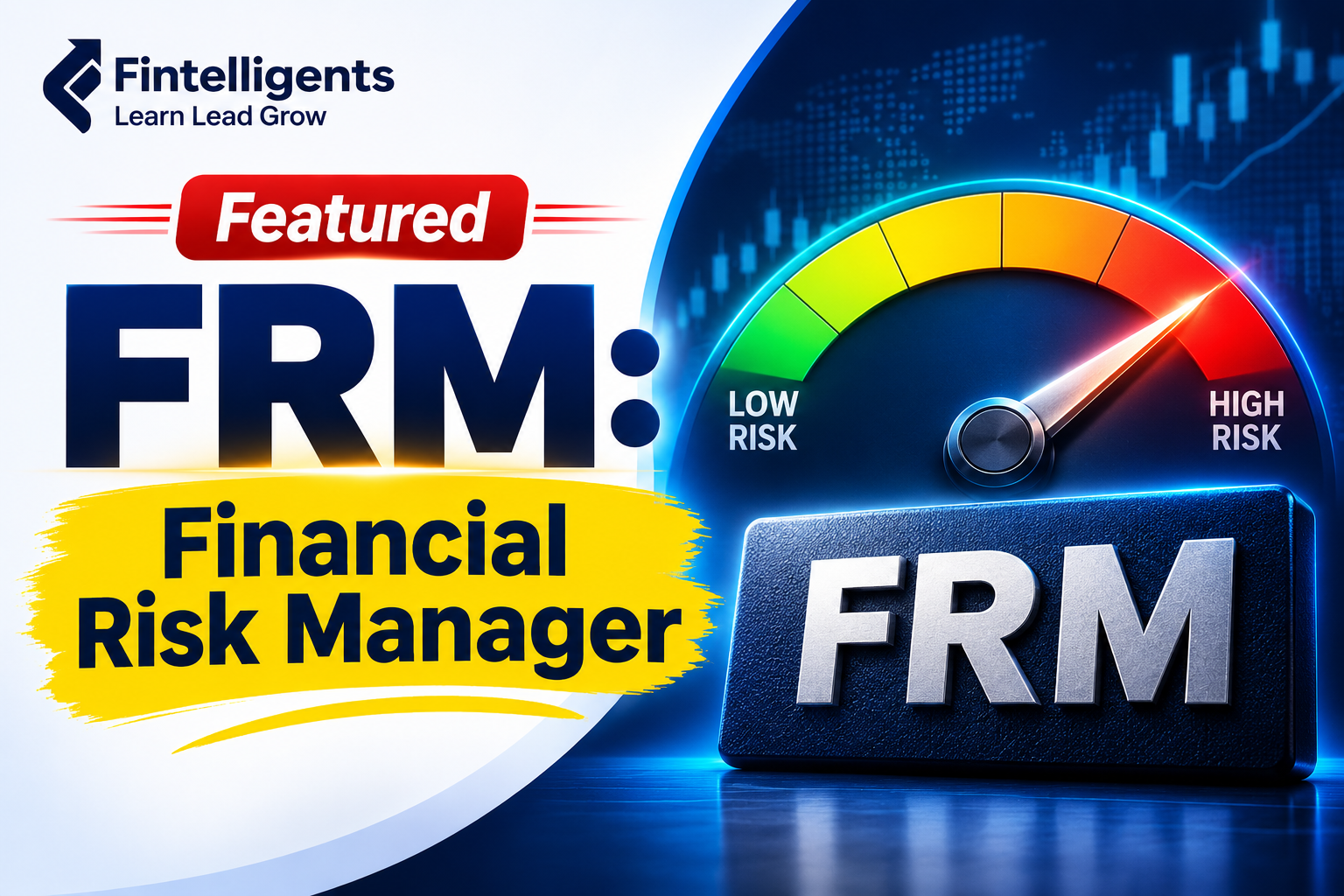
FRM stands for Financial Risk Manager. It is a globally recognised professional certification in financial risk management, offered by the Global Association of Risk Professionals (GARP). You earn it by passing two computer-based exams, FRM Part I and Part II, and then showing two years of relevant full-time work experience in risk or a closely related field.
If you searched “what is FRM” after seeing it on a job description, a banking forum or a friend’s LinkedIn profile, this guide covers what you actually need: what the credential means, who it suits, what the exams look like, what it costs in 2026, and whether it is worth your time.
What does FRM stand for in finance?

In finance, FRM means Financial Risk Manager. People use the term in two ways, and the difference matters:
- The certification: the FRM designation awarded by GARP.
- The job role: a “financial risk manager” working at a bank, asset manager, insurer or corporate treasury. You can hold this job title without the FRM certificate, and you can hold the certificate before you ever get the title.
In banking, “FRM” almost always points to the GARP certification. It signals that someone has been tested on how financial institutions identify, measure and control risk.
Quick answer : FRM is the Financial Risk Manager certification from GARP. Candidates pass two multiple-choice exams (Part I and Part II) and document two years of relevant work experience. It covers market, credit, operational and liquidity risk and is widely used in banks, asset managers and consulting firms.
Who offers the FRM?
The FRM is offered by GARP, the Global Association of Risk Professionals, a non-profit professional body for risk practitioners. GARP sets the curriculum, runs the exams through computer-based test centres, reviews work-experience submissions and awards the designation.
This is worth stating clearly because many students confuse the exam body with the coaching institute. GARP conducts the exam. Institutes such as Fintelligents help you prepare for it, but they do not conduct the exam or decide results.
Why does the FRM exist? A plain-language view
Every financial institution takes risk. A bank lends money that may not be repaid (credit risk). A trading desk holds positions whose prices can fall overnight (market risk). A payments system can fail, or an employee can make a costly mistake (operational risk). A fund can find it cannot sell assets quickly enough to meet withdrawals (liquidity risk).
The FRM trains you to name these risks, measure them with sound quantitative tools and decide how much of each is acceptable. That is why you will find FRM holders in risk, treasury, compliance, model validation, credit analysis and regulatory reporting teams.
FRM at a glance
| Detail | FRM |
| Full form | Financial Risk Manager |
| Awarding body | GARP (Global Association of Risk Professionals) |
| Number of exams | 2 (Part I and Part II) |
| Format | Computer-based, multiple-choice |
| Part I | 100 questions, 4 hours |
| Part II | 80 questions, 4 hours |
| Exam windows | May, August and November |
| Educational prerequisite to sit the exam | None |
| Work experience | 2 years of relevant full-time experience, needed for the designation (not for the exam) |
| Enrolment fee | USD 400 (one-time, for new candidates) |
| Exam fee per part (2026) | USD 600 early / USD 800 standard |
Who should consider the FRM?
The FRM fits you best if you are:
- A finance or commerce graduate who wants a risk-focused career and is comfortable with numbers
- A banking or NBFC professional in credit, treasury, audit or compliance moving towards risk
- A CA, CFA or MBA (Finance) candidate adding a specialist credential
- An engineer or maths graduate with quantitative strength who wants a finance career
- A professional aiming for roles abroad, since the FRM is recognised across major financial centres
It is a weaker fit if you want a broad finance credential covering portfolio management and equity research. That is closer to what the CFA covers. Our guide to the top finance certifications for 2026 compares them side by side.
FRM eligibility: who can take the exam?
GARP sets no minimum degree, age or work-experience requirement to register for FRM Part I. A final-year student or a fresh graduate can sit it.
Work experience only matters for the designation. To be called a certified FRM, you must:
- Pass Part I
- Pass Part II within four years of passing Part I
- Show two years of relevant, full-time professional experience in financial risk management or a closely related field
Internships and part-time work generally do not count towards the two years. The experience can be gained before or after the exams. Passing both parts without the experience makes you an exam passer, not a certified FRM.
Disagree on the window for submitting experience (some say within five years of passing Part II, others say experience up to ten years old can count). Check GARP’s current certification rules and state them exactly before publishing.
For a country-specific view, read our guides to FRM certification in India and FRM certification in the UAE.
FRM exam pattern and syllabus
FRM Part I: the tools
Part I has 100 multiple-choice questions in 4 hours, which is roughly 2.4 minutes per question. It builds the quantitative and conceptual base.
| Part I topic | Approx. weight |
| Foundations of Risk Management | 20% |
| Quantitative Analysis | 20% |
| Financial Markets and Products | 30% |
| Valuation and Risk Models | 30% |
Foundations weight (20%) and the other three against GARP’s 2026 learning objectives, as weights are adjusted over time.
FRM Part II: the application
Part II has 80 multiple-choice questions in 4 hours, so you get more time per question. It is more applied: you work through scenarios in market, credit, operational and liquidity risk, plus risk management and investment management, and current issues in the field.
Part II topic weights from GARP’s 2026 curriculum. I did not find a reliable current source for these in my research, so I have left them out rather than guess.
Prep providers also report that GARP has added more content on climate risk, AI applications in risk and digital assets in recent curricula. Treat that as a pointer to check, not a confirmed list.
Part I vs Part II in short
| Feature | Part I | Part II |
| Questions | 100 | 80 |
| Duration | 4 hours | 4 hours |
| Style | More formula and tool based | More scenario and application based |
| Purpose | Build the foundation | Apply it to real risk decisions |
| Deadline | None | Within four years of passing Part I |
Details are in our FRM Part 1 vs Part 2 comparison.
FRM fees in 2026
GARP’s fee page lists USD 400 as a one-time enrolment fee for new candidates, paid with the first Part I registration, and USD 800 per part at standard registration for the November 2026 window. Prep providers report the early-registration fee as USD 600 per part.
| Cost item | Amount (USD) |
| One-time enrolment fee | 400 |
| Exam fee per part, early registration | 600 |
| Exam fee per part, standard registration | 800 |
| First-time Part I candidate, early | 1,000 |
| First-time Part I candidate, standard | 1,200 |
| Both parts, all early | 1,600 |
| Both parts, all standard | 2,000 |
Other costs to know about: a deferral fee, a wire or bank-transfer charge, and applicable tax at checkout. A retake means paying the exam fee again, but not the enrolment fee.
In rupees: at roughly ₹96 per USD (an October 2026 reference rate), a first-time Part I candidate on early registration pays about ₹96,000, and both parts on early registration come to about ₹1.5 lakh, before tax and bank charges. The rate moves, so use a live rate before quoting this to students.
These are GARP’s fees only. Coaching, study materials and mock exams are separate.
When is the next FRM exam?
GARP’s November 2026 window runs 14 to 20 November for Part I and 21 to 25 November for Part II. Standard registration for it closed on 30 September 2026, so if you are reading this in November, your next realistic window is May 2027.
Prep providers report that early registration for May 2027 opens around 1 December 2026, but GARP had not published full 2027 details in the sources I checked.
How hard is the FRM?
It is demanding but manageable with a plan. GARP’s reference point for study time is around 240 hours per part range, and prep providers commonly recommend 150 to 200 hours for Part I and 200 to 300 for Part II. These are estimates, not guarantees, and your background changes the number a lot.
FRM career opportunities
Common roles where FRM knowledge is used:
- Market risk analyst
- Credit risk analyst
- Operational risk manager
- Model validation analyst
- Treasury and liquidity risk analyst
- Enterprise risk or regulatory risk roles
- Risk consulting
Employers include banks, NBFCs, asset managers, insurers, rating and consulting firms, and Big 4 advisory practices. The credential helps most when paired with relevant experience or a risk-focused role.
On salaries: I have not included salary figures because I could not verify a credible, current source that separates Indian and international pay. If you add them, name the source, year, currency and country, and label them as estimates. See our FRM jobs in India guide for the current role overview.
Is the FRM worth it? Advantages and limitations
Advantages
- Specialised and respected in risk roles
- Open to all, with no degree prerequisite for the exam
- Two exams, so you can pace yourself
- Recognised in many countries
Limitations
- Narrower than the CFA if you want portfolio management or research
- Designation needs two years of relevant experience
- Part II must be cleared within four years of Part I
- Fees are paid in dollars, so cost moves with the exchange rate
If risk is the career you want, FRM is a strong choice. If you are still undecided between paths, start with our FRM certification in India guide and compare it with the alternatives before paying the enrolment fee.
How to start your FRM journey: 5 steps
- Confirm the fit. Check that risk management matches the roles you want.
- Choose a window. Work backwards from the exam date and plan your study hours per week.
- Register with GARP and pay the enrolment and exam fees. Register early to save USD 200.
- Prepare with structure. Cover the curriculum, then spend your last weeks on practice questions and mocks.
- Schedule your test centre appointment before scheduling closes.
If you want structured guidance, see our overview of the best FRM coaching in India.
Conclusion
So, what is FRM? It is GARP’s Financial Risk Manager certification: two exams, two years of relevant experience, and a recognised credential for people building careers in financial risk. The exam is open to anyone, the fees are clear and the path is structured, which makes it a practical option for students and working professionals who want a career in risk.
Your next step is simple. Decide your target exam window, work out your study hours and speak to someone who can map the plan to your situation.
FAQs
FRM stands for Financial Risk Manager. It is a professional certification offered by GARP, the Global Association of Risk Professionals. The name refers both to the credential and, informally, to the type of job a risk professional does in banks and financial institutions.
In finance, FRM means Financial Risk Manager. It refers to the GARP certification that tests knowledge of market, credit, operational and liquidity risk, along with valuation and risk models, and is widely used for roles in banking and risk management.
In banking, FRM usually refers to the Financial Risk Manager certification. A banker with an FRM has been assessed on identifying, measuring and managing financial risks such as loan defaults, trading losses and liquidity shortages, which is why the credential appears in risk, credit and treasury job listings.
GARP, the Global Association of Risk Professionals, offers the FRM. It sets the syllabus, conducts the exams at computer-based test centres, checks work experience and awards the designation. Coaching institutes only prepare you for the exam and have no role in conducting it or deciding results.
Yes. GARP sets no work-experience, degree or age requirement to register for Part I or Part II. Work experience only applies to the designation: you need two years of relevant full-time risk experience, which can be earned before or after the exams, subject to GARP’s current rules.
There are two: Part I (100 multiple-choice questions) and Part II (80 multiple-choice questions). Each is four hours long and computer-based. You must pass Part II within four years of passing Part I, and GARP offers exam windows in May, August and November.
GARP charges a one-time USD 400 enrolment fee plus USD 600 per part for early registration or USD 800 for standard registration. A first-time candidate on early registration pays USD 1,000 for Part I. Deferral fees, bank charges and tax may apply. Always confirm on GARP’s website.
Neither is better in general. FRM focuses on risk management, so it suits risk, credit and treasury careers. CFA covers investment management and research more broadly. Choose based on the role you want. Our certification comparison guide explains the differences.