Blog
CAIA Level 2 Syllabus 2026: Topics, Weightage and How It Differs From Level 1

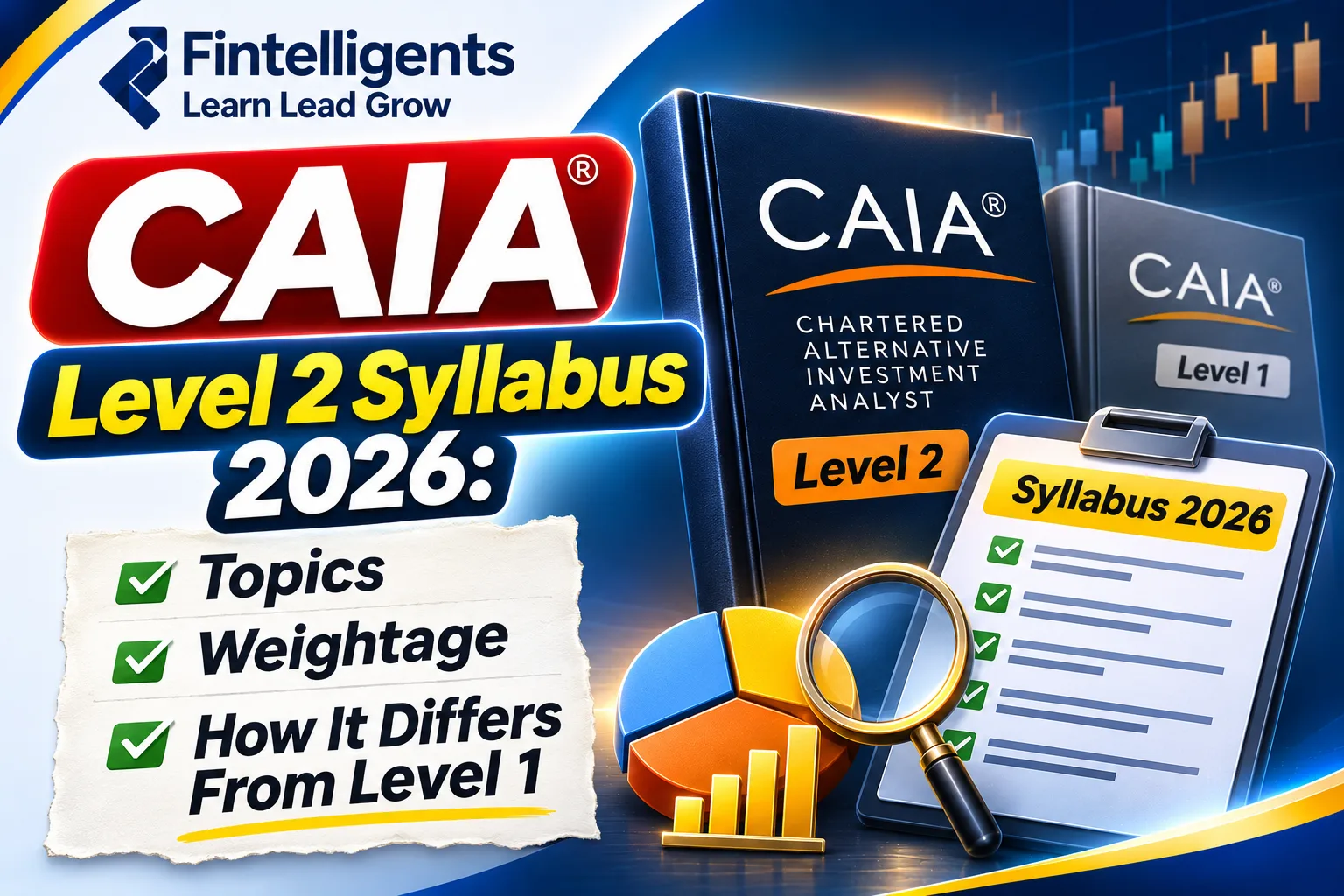
Passing CAIA Level 1 is a significant milestone, but it is only half of the journey to becoming a Chartered Alternative Investment Analyst. Level 2 is a different exam in both content and character. Where Level 1 builds foundational knowledge across alternative asset classes, Level 2 tests your ability to apply that knowledge in complex, integrated scenarios. Understanding what the CAIA Level 2 syllabus covers, how topics are weighted, and what distinguishes it from Level 1 is essential before you begin preparation.
Overview of the CAIA Level 2 Syllabus
The CAIA Level 2 curriculum is organised around the practical application of alternative investments within a portfolio management context. It moves beyond the asset class descriptions of Level 1 and places candidates in the role of an investment professional who must evaluate, allocate to, and manage alternative assets on behalf of institutional and high-net-worth clients.
The 2026 curriculum is built on the official CAIA Association readings, which are updated periodically to reflect developments in the alternative investment industry. Candidates should always verify they are studying the edition applicable to their exam sitting, as content can shift between years. The curriculum is provided digitally to registered candidates through the CAIA portal and does not require a separate textbook purchase.
Level 2 is examined over three hours and includes both multiple-choice questions and constructed-response questions, the latter requiring written answers that demonstrate analytical reasoning rather than simple recall. This format makes depth of understanding more important than breadth of memorisation.
CAIA Level 2 Topic Areas and Weightage
The CAIA Level 2 syllabus is divided into several broad topic areas, each carrying an approximate weighting in the exam. The following breakdown reflects the CAIA Association’s published curriculum structure.
Universal Investment Considerations
This topic area covers the principles that apply across all alternative investment strategies, including risk and return frameworks, factor investing, liquidity risk, and tail risk. It accounts for approximately 10 to 15 percent of the Level 2 exam. Candidates are expected to apply these concepts when evaluating specific alternative strategies rather than simply define them.
Institutional Asset Owners and Investment Policy
A significant portion of Level 2 is dedicated to understanding who the clients of alternative investment managers are and how they think. This includes endowments, pension funds, sovereign wealth funds, insurance companies, family offices, and high-net-worth individuals. Each type of institution has distinct return requirements, liability structures, liquidity needs, and regulatory constraints. This area carries approximately 10 percent of the exam weight and is often underestimated by candidates focused purely on asset class mechanics.
Private Equity and Real Assets
Building on Level 1 foundations, Level 2 examines private equity in greater depth, covering valuation methodologies, fund structures, deal mechanics, and performance attribution. Real assets, including infrastructure, timberland, farmland, and commodities, are assessed with an emphasis on portfolio integration and risk characteristics. Combined, these topics represent approximately 20 to 25 percent of the Level 2 exam.
Hedge Funds and Managed Futures
Hedge fund strategies, risk management practices, and the role of managed futures in portfolio construction are examined at a practitioner level. This includes due diligence frameworks, factor exposures, and fee structures including carried interest and high-water marks. Candidates should expect questions requiring evaluation of a strategy’s suitability for a given investor type. This topic area carries approximately 15 to 20 percent of the exam.
Portfolio Management with Alternative Investments
This is the most distinctive section of Level 2 and accounts for the largest share of exam content, approximately 25 to 30 percent. It covers how alternatives are incorporated into a broader portfolio, including mean-variance optimisation with non-normal return distributions, liquidity management, and the role of alternatives in liability-driven investing. Candidates planning to pursue a CAIA qualification in India should pay particular attention to this section, as it represents the applied, integrative thinking the exam rewards most.
Ethics and Professional Standards
As with CAIA Level 1, ethics carries a dedicated weighting at Level 2, typically around 10 percent. The focus shifts towards applying the CAIA Institute’s Standards of Practice to real-world dilemmas involving conflicts of interest, disclosure obligations, and fiduciary responsibilities specific to alternative investment managers.
How Level 2 Differs From Level 1
Candidates who passed Level 1 often underestimate the step up that Level 2 represents. The differences go beyond content volume and touch on the nature of the thinking required.
Depth Over Breadth
Level 1 covers a wide range of alternative asset classes and introduces the core concepts of each. A candidate who understands what private equity is, how hedge funds operate, and what commodities offer as an asset class can perform well at Level 1. Level 2 assumes all of that knowledge and builds on it. Rather than asking what a buyout fund is, Level 2 asks how you would evaluate one for inclusion in a pension fund’s portfolio, what risks it introduces, and how you would measure its performance against appropriate benchmarks.
Constructed-Response Questions
Level 1 is entirely multiple-choice. Level 2 introduces constructed-response questions, which require written answers. These questions cannot be answered by elimination or guesswork. They require a candidate to structure a coherent, technically grounded response within a time constraint. Many candidates who are strong on knowledge find the written format challenging if they have not practised it. Allocating time specifically to practising constructed-response questions is an essential part of Level 2 preparation.
Investor Perspective
A notable shift in Level 2 is the perspective from which content is examined. Level 1 largely asks candidates to understand alternative investments as asset classes. Level 2 asks candidates to understand them from the perspective of an institutional investor deciding whether and how to allocate. This requires familiarity with how different types of investors are structured, what constraints they operate under, and how alternative investments interact with their existing portfolios. For candidates also preparing for the FRM, there is some overlap in risk management concepts, and reviewing FRM Part 1 preparation strategies can reinforce the analytical habits that serve well at CAIA Level 2.
Exam Format Comparison
At Level 1, candidates sit a four-hour, 200-question multiple-choice exam. At Level 2, the exam is three hours and contains 100 multiple-choice questions alongside three constructed-response questions. The shorter time and mixed format make efficient time management more critical at Level 2. Candidates should practise completing each section within its allocated time rather than treating the exam as a single uninterrupted block.
What to Expect From Level 2 Exam Questions
Understanding the style of questions at Level 2 is as important as knowing the content. The exam tests application and judgement, not just recall.
Multiple-Choice Question Style
The multiple-choice questions at Level 2 are more complex than those at Level 1. Many are scenario-based, presenting a brief case involving a hypothetical investor, portfolio, or market situation, followed by a question requiring analysis rather than definition. Distractors are designed to catch candidates who have surface-level knowledge but have not fully internalised the reasoning behind a concept. Working through official practice questions and past exam materials is the most effective way to calibrate for this style.
Constructed-Response Question Style
Each constructed-response question at Level 2 is typically broken into sub-parts, with marks allocated to each. Answers are expected to be concise and directly responsive to what is asked. Examiners reward candidates who address the question directly with technical accuracy, not those who write at length without engaging with the specific scenario. Reading the question carefully, identifying the precise action word (evaluate, recommend, explain, justify), and structuring the response accordingly is a habit worth building in preparation. Candidates who have sat professional exams with written components, such as ACCA Strategic Professional, will find this format familiar. Those new to written professional exams may benefit from reviewing how written exam technique is approached in a comparable qualification, such as tips on ACCA exam preparation in the final weeks.
Final Thoughts
The CAIA Level 2 syllabus represents a genuine step up in both content and exam technique. Candidates who approach it with the same strategies that worked at Level 1 often find themselves underprepared, particularly for the constructed-response questions and the portfolio management focus. Begin preparation early, work through the official curriculum thoroughly, and dedicate specific practice sessions to written response technique. The qualification is well respected in the alternative investment industry, and passing Level 2 opens doors to roles in hedge funds, private equity, real assets, and institutional investment management that the credential is specifically designed to support.
Frequently Asked Questions
Is CAIA Level 2 harder than Level 1?
Most candidates find Level 2 more demanding than Level 1. The content is more applied and integrative, requiring candidates to combine knowledge across topic areas rather than understand each in isolation. The addition of constructed-response questions also makes the exam format more challenging for those accustomed to multiple-choice only. However, with focused preparation and adequate practice on written responses, the step up is manageable.
How much of CAIA Level 2 overlaps with Level 1?
Level 2 builds directly on Level 1 content rather than repeating it. Candidates who have passed Level 1 are assumed to have a working knowledge of the alternative asset classes covered there. Level 2 deepens and contextualises that knowledge within portfolio management and institutional investor frameworks. Reviewing Level 1 concepts before beginning Level 2 study can reinforce the foundation the second level builds on.
How long should I study for CAIA Level 2?
The CAIA Association recommends approximately 250 hours of study for Level 2. Most candidates spread this over three to four months. The constructed-response format means that passive reading of the curriculum is not sufficient. Candidates should allocate a significant portion of their study time to answering practice questions and reviewing model answers to understand what examiners are looking for.
What is the pass rate for CAIA Level 2?
The CAIA Association does not publish granular pass rate data for each exam window. Historical averages suggest a pass rate broadly in the range of 55 to 65 percent for Level 2, though this varies by window and cohort. The pass rate underscores the importance of thorough preparation, particularly on the constructed-response component, which can be the differentiating factor for borderline candidates.
Can I use a calculator in the CAIA Level 2 exam?
Yes. The CAIA Association permits approved financial calculators in the exam. The Texas Instruments BA II Plus and the Hewlett Packard HP12C are the most commonly approved models, though candidates should verify the current approved list on the official CAIA website before the exam date. Proficiency with an approved calculator is particularly relevant for quantitative questions in the portfolio management section.