Blog
CAIA Certification in USA: Eligibility & Enrollment Guide

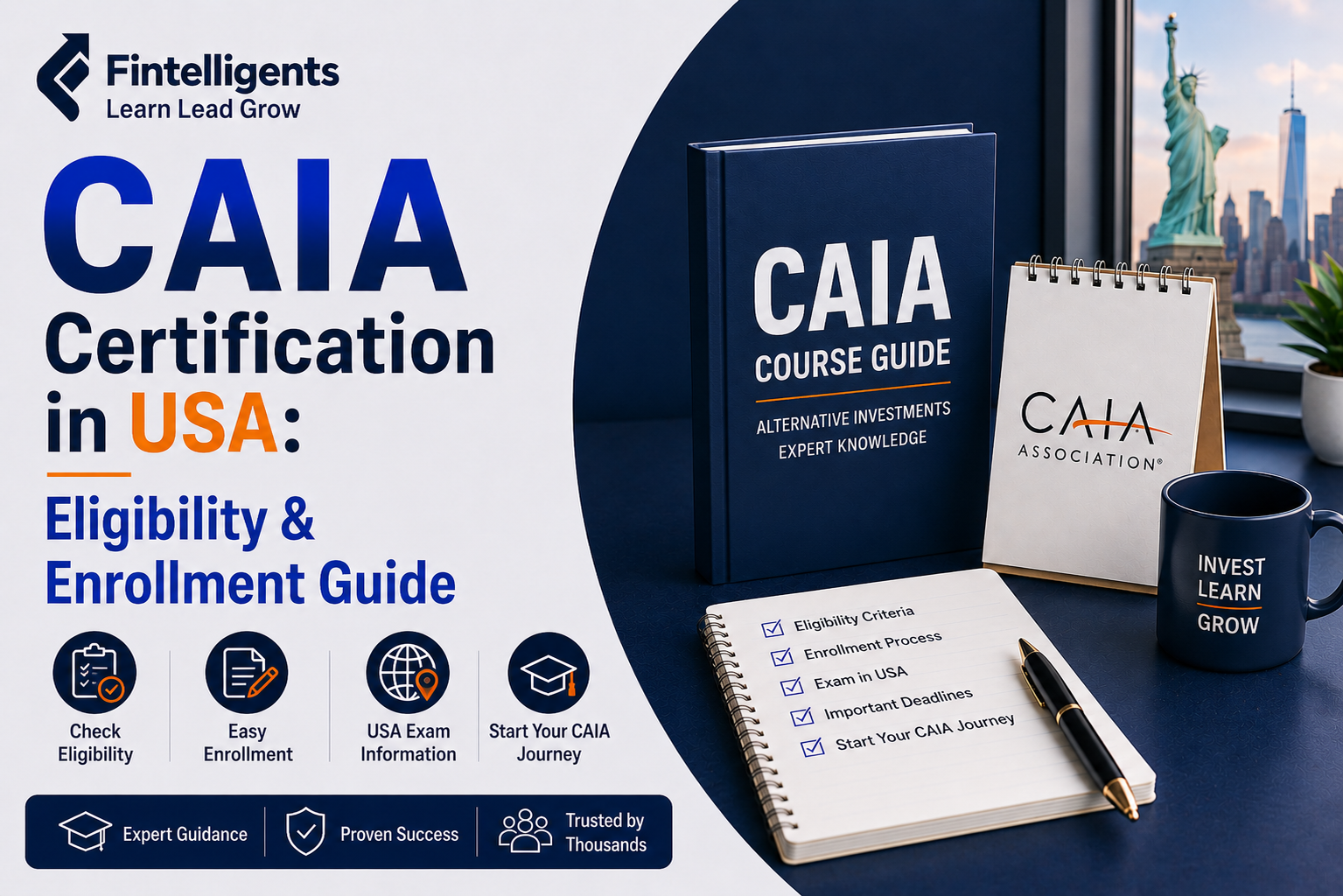
If you work in private equity, hedge funds, real assets, or private debt or want to the CAIA (Chartered Alternative Investment Analyst) charter is one of the fastest ways to prove you understand alternative investments at a professional level. This guide walks you through everything a US-based candidate needs before signing up: who qualifies, what it costs, how the exam is structured, and exactly how to enroll in 2026.
What Is the CAIA Certification?
- Far far away, behind the word mountains, far las.
- Vokalia and Consonantia, there live the blind tex.
- Separated they live in Bookmarksgrove right attr.
The Chartered Alternative Investment Analyst (CAIA) designation is a globally recognized professional credential administered by the CAIA Association, awarded to finance professionals who demonstrate expertise in alternative investments hedge funds, private equity, private debt, real assets, infrastructure, digital assets, and structured products.
Launched in 2002, the CAIA charter has grown into the leading specialized credential for alternative asset classes, with members working as portfolio managers, risk managers, consultants, analysts, and asset allocators across the world. As traditional and alternative investing continue to blend, more US employers from pension funds to family offices now list CAIA as a preferred or required qualification.
Who Administers the CAIA Program?
The CAIA Association sets the curriculum, eligibility rules, and exam standards, while exams are delivered through Pearson VUE test centers (in-person) or, in limited accommodation cases, online proctoring.
Why Pursue CAIA in the USA?
The United States remains the largest market for alternative investment strategies, home to the majority of the world’s hedge funds, private equity firms, and institutional allocators. Here’s why the CAIA charter carries particular weight for US-based professionals:
- Specialized recognition Unlike broader credentials, CAIA is built entirely around alternative investments, a segment growing faster than traditional asset management.
- No restrictive degree requirement You don’t need a finance or business degree to qualify.
- Career mobility CAIA charterholders work across private equity firms, hedge funds, endowments, insurance companies, wealth management firms, and consulting practices.
- Global portability A CAIA charter earned in the US is recognized internationally, useful if you plan to work abroad later.
- Stackable with CFA CFA charterholders can bypass Level I entirely, making CAIA an efficient add-on credential.
CAIA Eligibility Requirements
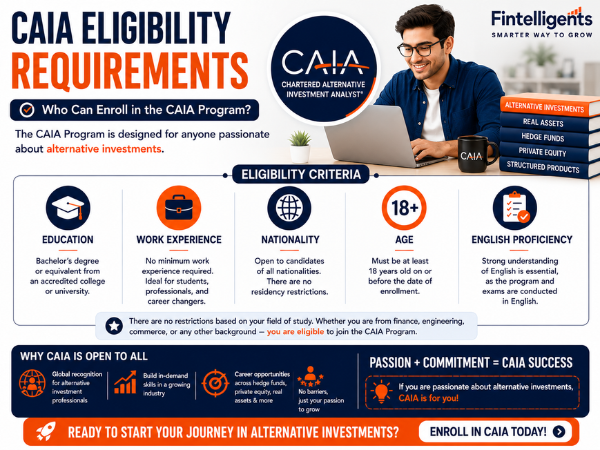
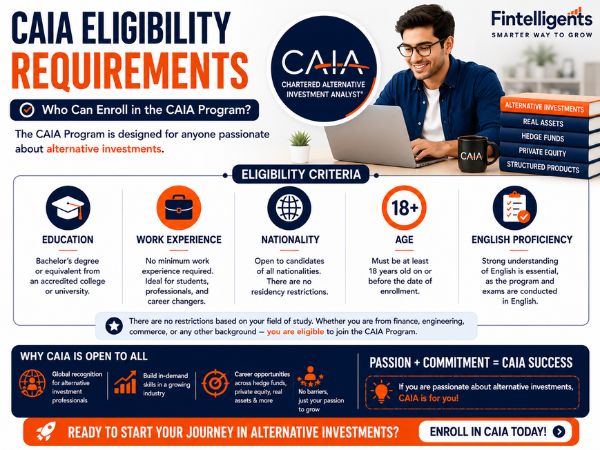
One of the most attractive aspects of the CAIA program is that it has no rigid academic prerequisite tied to a specific major. Instead, the CAIA Association allows candidates to qualify through any One of the following paths:
Path 1: Bachelor’s Degree + Professional Experience
Hold a bachelor’s degree (or recognized international equivalent) and have at least one year of professional experience in a related field (finance, banking, regulatory, or similar professional capacity).
Path 2: Professional Experience Only
No bachelor’s degree? You can still qualify with four years of professional experience in a relevant financial or business field.
Path 3: CFA Charterholder (Stackable Credential Pathway)
If you already hold the CFA charter, you can skip CAIA Level I entirely and register directly for Level II, cutting your total time and cost to earn the CAIA designation nearly in half.
Additional Requirements
- No enrollment during undergraduate study: You must have already been conferred your bachelor’s degree being an active student does not satisfy the requirement.
- No major restriction: The CAIA Association does not require a finance, economics, or business degree candidates from engineering, science, law, and other backgrounds are equally eligible.
- Member Agreement: All candidates must agree to abide by the CAIA Association’s Member Agreement and professional conduct standards.
- Both exam levels must be passed: Eligibility to register is separate from earning the charter you must clear both Level I and Level II, and later apply for membership, to use the CAIA designation.
Tip: If your qualifying experience is borderline (for example, 10–11 months), it’s worth waiting a few weeks before registering rather than risking a rejected application.
What Counts as “Professional Experience”?
The CAIA Association defines qualifying professional experience broadly as full-time employment in a professional capacity within regulatory, banking, financial, or closely related fields. This means roles in compliance, accounting, financial planning, insurance, and corporate finance can all count toward eligibility not just front-office investment jobs. Part-time work, internships, and unpaid experience generally do not satisfy the requirement, so it’s worth documenting your employment history carefully before you apply.
Documents You May Need to Verify Eligibility
While the CAIA Association does not require you to submit transcripts or employment letters at the point of registration, you should be prepared to provide supporting documentation if your eligibility is later reviewed:
- Proof of degree conferral (diploma or official transcript)
- Employment verification letters confirming job title, dates, and responsibilities
- CFA charter confirmation, if applying through the Stackable Credential pathway
Keeping these documents organized in advance prevents delays if verification is requested during the membership application stage.
CAIA Exam Structure: Level I and Level II
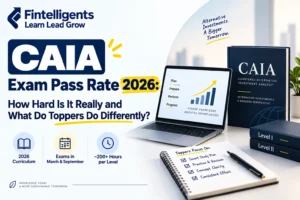
The CAIA program consists of two exam levels, each administered as a 4-hour, computer-based test at Pearson VUE centers.
CAIA Level I
- Format: 200 multiple-choice questions, split into two 100-question sections
- Duration: 4 hours, with an optional 30-minute break between sections
- Focus areas: Professional standards and ethics, introduction to alternative investments, real assets, private equity, private debt, hedge funds, structured products, and asset allocation
- Recommended study time: Roughly 200–250 hours
CAIA Level II
- Format: 100 multiple-choice questions (Section 1, worth 70% of the score) plus three constructed-response (essay-style) questions (Section 2, worth 30% of the score)
- Duration: 4 hours
- Focus areas: Emerging topics in alternative investments, portfolio construction, risk management, manager selection and due diligence, ethics, and current issues
- Recommended study time: Roughly 250–280 hours
How Results Are Released
Level I results are typically released within three weeks of the final exam day. Level II results take longer up to six weeks because the constructed-response section requires manual grading.
CAIA Enrollment Process: Step-by-Step
Here’s exactly how to enroll for the CAIA exam in the USA:
Step 1: Confirm Your Eligibility
Check that you meet one of the three eligibility paths above (degree + experience, experience only, or CFA charterholder).
Step 2: Create a CAIA Association Account
Register on the official CAIA Association website and set up your candidate profile.
Step 3: Choose Your Exam Level
First-time candidates start with Level I, unless you qualify for the Stackable Credential Program as a CFA charterholder, in which case you go straight to Level II.
Step 4: Pay the Enrollment and Registration Fees
New candidates pay a one-time program enrollment fee plus a per-level exam registration fee (early or standard pricing details in the cost section below).
Step 5: Select Your Exam Window
Choose between the March or September exam window, based on your preparation timeline.
Step 6: Schedule Your Test Appointment via Prometric
Once registered, you’ll receive a candidate ID to book your test date and Pearson VUE/Prometric test center location.
Step 7: Access the Digital Curriculum
Your registration fee includes digital access to the official CAIA curriculum — begin studying as soon as your window opens.
Step 8: Sit for the Exam
Arrive at your scheduled test center (or complete your approved online proctored session) with valid identification.
Step 9: Repeat for Level II
After passing Level I, follow the same registration steps for Level II.
Step 10: Apply for CAIA Membership
Once both levels are passed and your professional experience is verified, apply for CAIA membership to officially use the charter.
CAIA Exam Dates and Registration Windows 2026
The CAIA exam is offered twice a year — in March and September allowing motivated candidates to complete both levels within a single calendar year.
| Window | Registration Opens | Early Registration Deadline | Registration Closes |
| September Exam | Mid-April | Early June | Early August |
| March Exam | Mid-October | Early December | Early February |
Registering during the early registration period saves candidates several hundred dollars per level compared to standard registration, so it pays to plan your study timeline in advance. Most candidates need 8–18 months to complete both levels, depending on prior experience and available study time per week.
CAIA Certification Cost in the USA
Budgeting for CAIA involves three components: a one-time enrollment fee, per-level exam fees, and optional study materials.
| Fee Type | Amount |
| One-time Program Enrollment Fee (paid once, at first registration) | $400 |
| Level I Exam Fee Early Registration | $995 |
| Level I Exam Fee Standard Registration | $1,395 |
| Level II Exam Fee Early Registration | $995 |
| Level II Exam Fee Standard Registration | $1,395 |
| Retake Fee (per level, no second enrollment fee) | $795 |
| CAIA Membership Dues (after earning the charter) | $350/year (or $650 for two years) |
Total estimated cost for both levels, assuming early registration and no retakes, generally falls between $2,800 and $3,200. Every exam registration fee includes access to the official digital curriculum, so there’s no separate charge for core study material though many candidates also invest $500–$1,500 per level in third-party prep courses or question banks.
Cost-saving tip: CFA charterholders using the Stackable Credential Program only pay the enrollment fee once and register directly for Level II skipping an entire exam fee.
How to Prepare for the CAIA Exam
A structured study plan matters more than raw hours. Here’s a practical approach:
1. Start With the Official Curriculum
The digital curriculum included with your registration is the primary source build your study calendar around its topic weights rather than treating every section equally.
2. Prioritize High-Weight Topics
“Introduction to Alternative Investments” and “Ethics” typically carry significant weight on Level I mastering these early builds a strong foundation for the rest of the syllabus.
3. Use Practice Questions Consistently
Regular exposure to multiple-choice style questions builds speed and pattern recognition, which matters given the 4-hour, 200-question format at Level I.
4. Build an Essay Strategy for Level II
Since Level II includes constructed-response questions, practice structuring clear, complete written answers under time pressure not just recognizing correct MCQ options.
5. Simulate Exam Conditions
Take at least two or three full-length timed mock exams before your actual test date to build stamina for the 4-hour session.
6. Study in a Consistent Weekly Rhythm
Spreading 200-280 recommended study hours across 12-16 weeks (roughly 15-20 hours per week) tends to be more sustainable than cramming in the final month.
7. Join a Study Group or Online Forum
Candidate communities can help you stay accountable and clarify tricky concepts, particularly around structured products and derivatives-linked alternative strategies, which many candidates find the most technically demanding part of the curriculum.
8. Review Ethics Case Studies Closely
Ethics questions on both levels often test situational judgment rather than rote memorization. Working through real-world case studies helps you apply the CAIA Association’s Member Agreement principles correctly under exam conditions.
Sample 12-Week Study Timeline (Level I)
| Weeks | Focus |
| 1–3 | Introduction to Alternative Investments, Ethics |
| 4–6 | Real Assets, Private Equity |
| 7–9 | Private Debt, Hedge Funds |
| 10–11 | Structured Products, Asset Allocation |
| 12 | Full-length timed mock exams and weak-area review |
CAIA vs CFA vs FRM: Which One Should You Choose?
| Factor | CAIA | CFA | FRM |
| Focus Area | Alternative investments | General investment management | Risk management |
| Levels | 2 | 3 | 2 |
| Typical Timeline | 1–1.5 years | 2–4 years | 1–2 years |
| Approx. Total Cost | $2,800–$3,200 | $3,000–$5,000+ | $1,500–$2,500 |
| Degree Required | No | No (with experience) | No |
| Best For | Alternative asset professionals | Broad investment management careers | Risk and derivatives professionals |
If your career is centered on private equity, hedge funds, or real assets, CAIA is the more targeted choice. If you already hold the CFA charter, stacking CAIA on top is a highly efficient way to specialize without repeating a multi-year exam sequence.
Career Opportunities After CAIA Certification
CAIA charterholders in the US work across a wide range of roles, including:
- Portfolio Manager alternative asset or multi-strategy funds
- Investment Analyst private equity or hedge fund research teams
- Risk Manager evaluating exposure across alternative asset classes
- Consultant advising institutional investors on alternative allocations
- Asset Allocator pension funds, endowments, and family offices
- Fund Administrator / Due Diligence Analyst manager selection and operational review
Because alternative investments continue to take up a growing share of institutional portfolios, demand for professionals who can evaluate these strategies rigorously continues to rise year over year.
Common Mistakes to Avoid During Enrollment
- Registering before confirming eligibility a rejected application can cost you time and, in some cases, non-refundable fees.
- Missing the early registration deadline waiting until standard registration means paying several hundred dollars more per level.
- Underestimating Level II’s essay section many candidates prepare only for multiple-choice questions and are caught off guard by constructed-response grading standards.
- Assuming deferrals are allowed once you register for a specific exam window, you generally cannot move your registration to a different session.
- Ignoring the rescheduling fee structure changing your test date or center close to the exam date can incur additional charges.
Frequently Asked Questions
No. The CAIA Association does not restrict eligibility by undergraduate major. Candidates from any academic background can qualify, provided they meet the degree-plus-experience or experience-only pathway.
No. Student status alone does not satisfy eligibility. You must have already received your bachelor’s degree, or have completed the required years of qualifying professional experience, before registering.
Most candidates complete both levels in 12 to 18 months, since exams are offered twice a year, in March and September. Highly motivated candidates can finish within a single calendar year.
Budget roughly $2,800 to $3,200 for both levels combined, assuming early registration with no retakes. This includes the one-time enrollment fee, both exam registration fees, and the digital curriculum.
Yes. Through the Stackable Credential Program, CFA charterholders in good standing can skip Level I entirely and register directly for Level II.
CAIA exams are administered at Pearson VUE test centers. Online proctored exams are available only by exception, for candidates with an approved accommodation.
You can retake the exam in the next available window for a reduced retake fee of $795 the one-time enrollment fee is not charged again.
CAIA is generally considered more specialized but comparatively less time-intensive than the three-level CFA program. Pass rates for CAIA Level I typically range between 45–55%, while Level II ranges between 55–65%.
No. Your qualifying professional experience does not need to be in alternative investments directly broader roles in banking, financial planning, compliance, accounting, or regulatory fields typically satisfy the requirement, as long as they are full-time and professional in nature.
Yes. The CAIA program is open to candidates worldwide, and US-based international professionals can register using the same eligibility pathways bachelor’s degree plus experience, experience only, or the CFA Stackable Credential route. Exam fees are charged in USD regardless of location.
Final Thoughts
The CAIA certification offers US finance professionals a focused, efficient path into the fast-growing world of alternative investments without requiring a specific degree or years of graduate study. With a clear two-level structure, a flexible eligibility framework, and strong recognition among institutional allocators and asset managers, CAIA is well worth considering if your career is heading toward private equity, hedge funds, private debt, or real assets.
Plan your registration around the early-bird deadlines, build a realistic study schedule around the official curriculum, and you can realistically hold the CAIA charter within 12–18 months.