Blog
Why Choosing a CAIA Program Makes Sense: Benefits, Career Value & ROI

If you’ve spent any time browsing finance job boards lately, you’ve probably noticed something. Roles in private equity, hedge funds, real assets, and infrastructure investing keep asking for a very specific three-letter credential: CAIA. Not CFA. Not MBA. CAIA the Chartered Alternative Investment Analyst designation.
That’s not a coincidence. Alternative investments have quietly become one of the fastest-growing corners of global finance, and the CAIA Program is the one credential built specifically around this space. But “it’s growing” isn’t a good enough reason to spend a year and a good chunk of money on any certification. You need to know exactly what you’re getting and whether it actually moves the needle on your career.
This article is written for exactly that decision point. We’ll walk through what the CAIA Program actually is, why professionals across the world (and increasingly, in India) are choosing it, what it realistically does for your salary and job prospects, and where it falls short. We’ll also answer the sharp, practical questions candidates actually type into Google before enrolling about salary bumps, employer requirements, continuing education, and visa eligibility for international students.
By the end, you should have a clear, no-fluff answer to the question: is a CAIA Program the right move for you?
What Is the CAIA Program?
The CAIA Program is a graduate-level credential offered by the CAIA Association, focused entirely on alternative investments hedge funds, private equity, venture capital, real assets, commodities, structured products, and increasingly, digital assets and ESG-linked strategies. It’s a two-level exam program (Level I and Level II), each requiring roughly 200 – 250 hours of study, sat at Prometric test centers around the world.
Unlike broader credentials that try to cover the entire universe of finance, CAIA goes narrow and deep. It exists because traditional investment education even the CFA Program historically gave alternative assets a fairly small slice of the curriculum, even though institutional portfolios now allocate 20 – 40% (sometimes more) to alternatives.
That gap is exactly where CAIA holders operate.
Why the CAIA Program Exists and Why It Matters Now
Alternative assets under management globally have been on a steady climb, with projections putting the alternatives industry well past the $17–18 trillion mark by the mid-2020s. Pension funds, sovereign wealth funds, endowments, and family offices are no longer treating hedge funds and private equity as a side bet they’re core allocations.
In India specifically, the alternative investment fund (AIF) industry has expanded rapidly over the past few years, with category II and III AIFs (private equity, venture debt, hedge-fund-style strategies) pulling in serious institutional and HNI capital. Wealth management firms, family offices, and boutique advisory shops are actively hunting for professionals who actually understand how these products are structured, priced, and risk-managed not just generalists with a finance degree.
That’s the market CAIA was built for. And it’s why “why choose a CAIA program” isn’t just an academic question anymore it’s a genuinely practical career decision for people working in or targeting this space.

Top Benefits of Choosing a CAIA Program
Let’s get into the actual benefits the ones that matter when you’re deciding whether to commit a year of study to this.
1. Deep, Practitioner-Focused Specialization
The single biggest reason people choose CAIA over a more generalist path is depth. The curriculum is built entirely around alternative asset classes: hedge fund strategies, private equity structures, real estate and real assets, commodities, structured products, digital assets, and portfolio management with alternatives. You’re not skimming a chapter on hedge funds within a 3,000-page general finance syllabus you’re spending the entire program there.
For someone whose career is (or will be) built around alternatives, this specificity is the whole point.
2. Global Recognition Without a Local Bottleneck
The CAIA charter is recognized in over 100 countries, administered by a single global body (the CAIA Association), with a growing charterholder community spread across major financial hubs New York, London, Hong Kong, Singapore, and increasingly Mumbai and Bangalore. That matters if your career ambitions aren’t confined to one country. A charter earned in India carries the same weight in a hiring conversation in Dubai, Singapore, or London.
3. Strong Signal to Employers in a Crowded Resume Pile
Finance hiring is saturated with MBAs and generic finance degrees. A CAIA charter (or even progress through Level I/II) tells a hiring manager something specific: this candidate has voluntarily gone deep into alternatives, understands the mechanics of illiquid and complex strategies, and has passed a rigorous, internationally proctored exam to prove it. In niche hiring fund selection, due diligence, risk oversight on alternative books that signal carries real weight.
4. Career Mobility Across Asset Classes and Roles
Because the curriculum spans hedge funds, private equity, real assets, and structured products, a CAIA charter doesn’t lock you into one narrow lane. Charterholders move across portfolio management, manager research and due diligence, risk management, fund administration, consulting, and wealth advisory roles that distribute alternative products to high-net-worth clients. That flexibility is genuinely useful in a job market where roles evolve fast.
5. Complements (Not Competes With) the CFA Charter
A meaningful share of CAIA charterholders also hold the CFA charter and CAIA even offers a stackable pathway that waives Level I for CFA charterholders. If you already have a CFA and want to specialize further into alternatives without starting from scratch, CAIA is designed to sit on top of that foundation rather than duplicate it.
6. No Rigid Prerequisites to Start
There’s no mandatory undergraduate major, no minimum GPA, and no requirement to already be working in finance before you register for Level I. You do need relevant professional experience (or a qualifying degree) to ultimately earn the charter, but you can begin studying and sit the Level I exam while still building that experience including while completing a degree.
7. A Genuinely Global Professional Network
Charterholders join a community of tens of thousands of professionals across 80+ countries, with access to CAIA Association events, research, and local chapter networking. For candidates in India building connections into global asset management and family office circles, that network has real, practical value beyond the certificate itself.
8. Curriculum That Keeps Pace With the Market
The CAIA Association revises roughly 10–20% of exam content every year to reflect what’s actually happening in the market digital assets, private credit growth, ESG integration into alternatives, and evolving fund structures. You’re not studying a syllabus frozen in 2010; you’re studying something that gets refreshed against current industry practice.
9. A Faster Path Than an MBA, at a Fraction of the Cost
An MBA from a strong program can cost anywhere from ₹20–60+ lakhs in India (or far more abroad) and take one to two years full-time, often requiring you to step out of the workforce. CAIA, by contrast, is typically completed in 12–18 months alongside a full-time job, at a fraction of the cost making it one of the more capital-efficient ways to pivot into or deepen a career in alternatives.
10. Positions You Ahead of a Genuine Talent Gap
Alternative investments are growing faster than the pool of professionals who deeply understand them. That mismatch more AUM in alternatives than there are specialists to manage, evaluate, and distribute them is exactly the kind of gap a targeted credential is built to close. Choosing CAIA now means positioning yourself ahead of a demand curve rather than chasing an oversaturated one.
Who Should (and Shouldn’t) Pursue CAIA
CAIA tends to make the most sense for:
- Wealth managers and private bankers who need to credibly explain and sell alternative products to HNI and UHNI clients.
- Analysts and associates at pension funds, endowments, and family offices who select and monitor external hedge fund and private equity managers.
- Risk professionals at asset managers who need to assess exposure across illiquid or complex strategies.
- Finance graduates and career switchers targeting private equity, venture capital, or fund-of-funds roles, especially in India’s growing AIF ecosystem.
- CFA charterholders who want to specialize further without duplicating the broader CFA curriculum.
It’s a weaker fit if you’re aiming purely at traditional equity research, investment banking M&A execution, or public-markets portfolio management with no alternatives exposure those paths are usually better served by the CFA charter or a targeted MBA.
CAIA Program Structure: Levels, Curriculum & Timeline
- Level I covers the foundations: hedge funds, private equity, real assets, structured products, risk management, ethics, and professional standards. Recommended study time is around 200 –250 hours.
- Level II builds on that foundation with portfolio construction, manager due diligence, emerging topics (digital assets, ESG in alternatives), and applied case-based questions again around 200 –250 hours of preparation.
- Exams run in two cycles a year (typically March and September), and Level I and Level II must be taken in separate cycles.
- To earn the full charter, you also need to satisfy the CAIA Association’s professional experience requirement and agree to its Member Agreement covering ethics and professional conduct.
Most working professionals complete both levels in 12–18 months, studying alongside a full-time job.
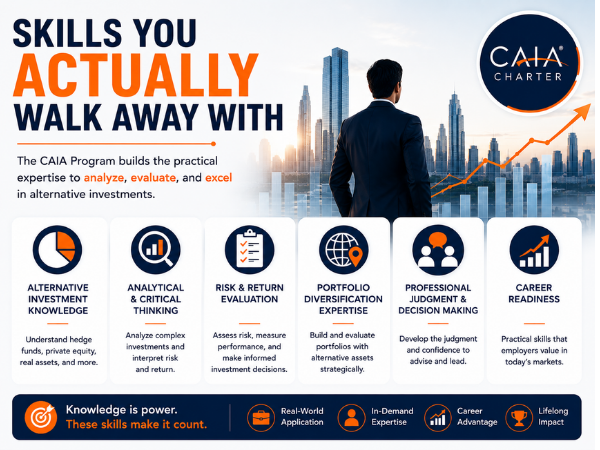
Skills You Actually Walk Away With
Beyond the credential itself, the process builds specific, usable :
- Structuring and evaluating hedge fund strategies (long/short, macro, event-driven, relative value)
- Understanding private equity and venture capital deal structures, fund lifecycles, and valuation approaches
- Assessing real assets real estate, infrastructure, natural resources and their role in a diversified portfolio
- Evaluating risk and return characteristics unique to illiquid and complex strategies
- Manager due diligence frameworks used by allocators and consultants
- A working vocabulary in structured products, digital assets, and ESG integration within alternatives
These are the exact skills that show up in job descriptions for alternative investment analyst, fund selection, and due diligence roles.
Career Paths and Roles After CAIA
CAIA charterholders and candidates typically land in roles such as:
- Alternative Investment Analyst
- Private Equity / Venture Capital Analyst or Associate
- Hedge Fund Analyst or Risk Analyst
- Portfolio Manager (alternatives sleeve)
- Fund of Funds / Manager Research Analyst
- Due Diligence Analyst at consultants, pension funds, or family offices
- Wealth Manager / Private Banker specializing in alternative product distribution
- Risk Management professional at asset managers handling complex, illiquid books
In India, this maps closely onto the fast-growing AIF industry, family office advisory desks, and the alternatives arms of large wealth management platforms sectors that are actively hiring but have a thin bench of specialized talent.
CAIA vs CFA vs FRM: Where It Fits
A quick way to think about it:
- CFA – broad investment management: equities, fixed income, portfolio management, ethics, across all asset classes.
- FRM – risk management, focused on market, credit, and operational risk, generalist across sectors.
- CAIA – narrow and deep on alternative investments specifically: hedge funds, private equity, real assets, structured products.
They aren’t rivals so much as different specializations. Many professionals hold CFA plus CAIA to combine broad investment knowledge with alternatives depth and CAIA’s stackable pathway is built to make that combination efficient rather than repetitive.
Cost, Time Investment, and Real ROI
Total cost for the CAIA Program (enrollment, both exam levels, and study materials) generally runs in the range of $3,000–$4,500 depending on registration timing and materials chosen noticeably lower than a full MBA, and roughly comparable to or slightly above the CFA Program’s total cost.
On the return side, salary data from recent job postings and industry surveys shows a wide range depending on role, sector, and experience from roughly $75,000 for early-career alternatives roles in the US up to $150,000–$300,000+ for senior private markets and portfolio roles, with specialized research positions going higher still. In India, professionals in alternative investment roles with CAIA credentials have reported packages roughly in the ₹15–40 LPA range depending on the employer, city, and seniority figures our own team at Fintelligents has tracked closely through candidate outcomes.
The honest takeaway: CAIA alone doesn’t guarantee a number. It works best combined with relevant experience, and it tends to compound the value of roles you’re already targeting in alternatives, rather than acting as a standalone salary lever for someone with no related experience.
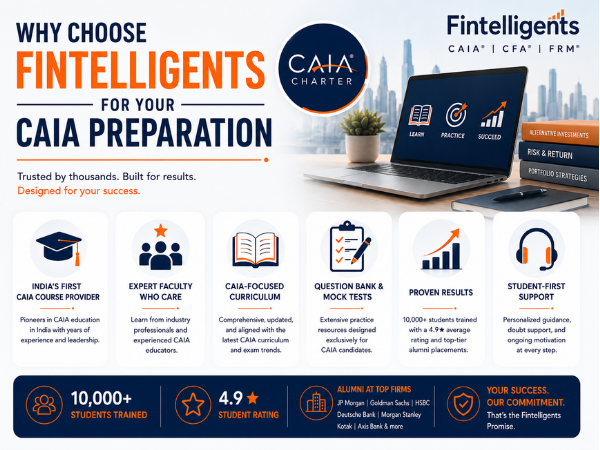
Why Choose Fintelligents for Your CAIA Preparation
At Fintelligents, CAIA isn’t a side offering bolted onto a broader course catalog it’s part of a focused finance-education ecosystem that also covers CFA, FRM, and ACCA, taught by faculty who work with these curricula year-round. A few things that set our approach apart for CAIA candidates in India:
- Structured live batches timed around the March and September exam cycles, so you’re never studying against a vague, self-paced timeline.
- India-specific career guidance – since alternative investment hiring patterns, expected salary bands, and target employers differ meaningfully between India and global markets, our mentorship accounts for that context rather than applying a one-size-fits-all US framework.
- Faculty with real markets experience, not just exam-coaching backgrounds, so concepts like manager due diligence or private equity structuring are taught with practical grounding.
- A genuine track record with Indian CAIA, CFA, and FRM candidates, reflected in the outcomes and placement conversations our students report back to us.
If you’re weighing whether to self-study or enroll in a structured program, the honest answer is: CAIA’s curriculum is dense enough that structured guidance materially shortens the learning curve, especially for candidates balancing this with a full-time job which is why Fintelligents has become a trusted name for CAIA preparation in India.
Frequently Asked Questions
It can, but not as a flat, guaranteed bump it depends heavily on your starting role, sector, and experience level. Job-posting data from 2026 shows CAIA-linked roles in the US ranging from around $75,000 for early-career analysts to $150,000–$300,000+ for senior private markets and portfolio positions, with some specialized research roles going even higher. In India, professionals in alternative investment roles with a CAIA background have reported compensation broadly in the ₹15 – 40 LPA range, depending on the employer and city. The charter tends to work best as an accelerant on top of relevant experience and the right role, rather than as a standalone salary trigger for someone with no exposure to alternatives.
Honestly it’s rarely a strict requirement. Most job postings that mention CAIA list it as “preferred” or “a plus,” especially for roles in fund selection, manager due diligence, and alternatives-focused wealth advisory. Hedge fund analyst and portfolio roles, in particular, often prioritize track record and modeling skills over the credential itself. Where CAIA shows up more consistently is at pension funds, family offices, consultants, and wealth platforms that need staff who can credibly evaluate and explain alternative products there, it’s a strong differentiator even when it’s not a hard requirement on paper.
The CAIA Association does not mandate continuing education (CE) to keep the designation active there’s no formal expiry tied to CE credits. That said, the Association strongly recommends around 40 hours of professional development every two years and offers members complimentary access to its learning platform to support that. What you do need to maintain is active CAIA Association membership (paid annually or biennially) and adherence to the Member Agreement’s professional and ethical standards lapse on membership and you lose the right to use the CAIA designation, even though there’s no exam-based renewal.
Yes. The CAIA exam has no citizenship or visa-status requirement it’s administered globally through Prometric test centers, and eligibility is based on meeting CAIA’s education/experience criteria, not immigration status. International students on an F-1 visa (including those on OPT) can register and sit for Level I and Level II at any Prometric center, in the US or elsewhere, the same way a domestic candidate would. Just keep in mind that CAIA registration and exam-day identification requirements ask for valid passport/ID documentation, so make sure your documents are current when you book your slot.
CAIA itself has no direct legal bearing on H-1B sponsorship the visa process depends on the employer’s willingness to sponsor, the role’s specialty-occupation classification, and the annual H-1B lottery, not on which professional certifications a candidate holds. Where CAIA can help indirectly is by strengthening your candidacy for niche alternative-investment roles at firms that already sponsor visas for specialized finance talent a strong CAIA-backed profile can make you a more compelling case for a firm to go through the sponsorship process in the first place, but it doesn’t change the underlying visa mechanics or guarantee an outcome.