Blog
CAIA Exams : All Our Best Guides in One Place

The Chartered Alternative Investment Analyst (CAIA) designation has become the go-to credential for finance professionals who want to specialise in hedge funds, private equity, real assets, and other alternative investments. This guide brings together everything a prospective candidate needs in one place: what the CAIA program actually involves, current exam windows and fees, a level-by-level breakdown of the syllabus, a realistic study plan, and how CAIA compares with the CFA and FRM charters. It closes with straight answers to three questions Indian candidates ask constantly whether CAIA has a track record in India, whether to pick CAIA over FRM, and how the CAIA exams stack up against the CFA in terms of difficulty.
What Is the CAIA Charter? what-is-the-caia-charter
The CAIA (Chartered Alternative Investment Analyst) charter is a globally recognised professional credential focused entirely on alternative investments the corner of finance that sits outside traditional stocks and bonds. Think hedge funds, private equity, venture capital, real assets, infrastructure, commodities, digital assets, and structured product.
The credential is awarded by the CAIA Association, a non-profit body originally founded through a partnership between the Alternative Investment Management Association (AIMA) and the Center for International Securities and Derivatives Markets (CISDM). The Association administered its first exam back in 2003, and the charterholder community has grown steadily every year since today it numbers well over 14,000 professionals across more than 100 countries.
Unlike broader credentials such as the CFA, which spans equities, fixed income, derivatives, economics, and portfolio management across three levels, CAIA is deliberately narrow. It exists to answer one question extremely well: how do you evaluate, allocate to, and manage alternative asset classes? That focus is exactly why it has become the preferred qualification for professionals working in private equity shops, hedge funds, family offices, endowments, sovereign wealth funds, and the alternatives desks of larger asset managers.
Earning the charter requires clearing two sequential exams Level I and Level II plus meeting a professional experience requirement and agreeing to the CAIA Association’s Member Agreement, which includes a code of ethics similar in spirit to the CFA Institute’s.
Who Should Consider CAIA? who-should-consider-caia
CAIA tends to make the most sense for:
- Investment analysts and portfolio managers who already work with, or want to move into, alternative asset allocation.
- Private equity and venture capital professionals who want a formal credential that signals expertise in illiquid, long-horizon investing.
- Hedge fund analysts who need a structured grounding in strategies like long/short equity, global macro, event-driven, and relative value investing.
- Risk and due-diligence professionals at fund-of-funds, consultants, and institutional allocators (pension funds, endowments, insurance companies) who evaluate alternative managers.
- CFA charterholders or candidates who want to add a specialised layer on top of a broad, generalist credential CAIA’s “stackable” pathway (explained below) makes this efficient.
- Career switchers moving into alternatives from adjacent fields like investment banking, corporate finance, or wealth management, who need a recognised way to prove specialised knowledge quickly.
If your ambitions lie in public-market equity research, corporate finance, or a broad generalist investment career, the CFA remains the more versatile choice. If your interest is in quantifying and managing financial risk market, credit, operational, liquidity FRM is the more targeted option. CAIA sits in its own lane: alternatives, and alternatives specifically.
CAIA Exam Structure: Level I and Level II caia-exam-structure
The CAIA program is built around two levels, each tested through a separate, standalone exam.
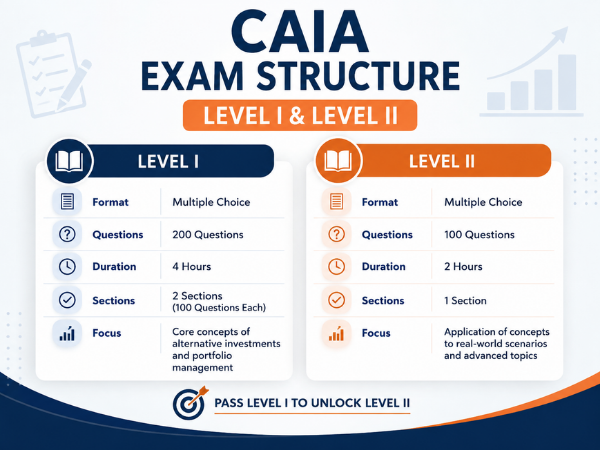
Level I focuses on foundational knowledge the tools, concepts, and vocabulary needed to analyse alternative investments. It is a 200-question, multiple-choice exam. Candidates need a working grasp of statistics, the structure of alternative investment vehicles, and the basic mechanics of hedge funds, private equity, real assets, and structured products.
Level II builds on that foundation and shifts toward application. It has a mixed question format multiple-choice combined with constructed-response (essay-style) questions and roughly 100 total items across the paper. Level II tests how well a candidate can apply Level I concepts to real allocation decisions, manager due diligence, portfolio construction, ethics, and risk management within an alternatives context.
Both exams are typically four hours long and are administered as in-person, computer-based tests at Pearson VUE / Prometric test centres worldwide. Online proctored exams exist only as an approved accommodation, not as a standard option most candidates will sit the exam at a physical centre.
CAIA exams run twice a year, in March 2027 which means a motivated candidate can realistically complete both levels within a single calendar year if they pass on the first attempt at each stage.
CAIA Eligibility Requirements caia-eligibility-requirements
To register for Level I, there’s no strict prerequisite anyone can sign up. However, to eventually receive the CAIA Charter after passing both levels, candidates must meet one of the following:
- A bachelor’s degree (or equivalent) plus at least one year of relevant professional experience, or
- At least four years of relevant professional experience if you don’t hold a bachelor’s degree.
“Relevant professional experience” is defined broadly as full-time employment in a professional capacity within regulatory, banking, financial, or related fields so it doesn’t have to be an investment-specific role.
There’s also a stackable credential pathway: candidates who already hold certain charters or designations (such as the CFA) can bypass Level I entirely and register directly for Level II as their first CAIA exam, since the foundational knowledge is assumed to already be in place. This is one of the most efficient routes into the CAIA charter for existing CFA charterholders.
Finally, candidates must formally agree to the CAIA Association’s Member Agreement, which includes adherence to a professional code of conduct.
CAIA Exam Dates 2027 caia-exam-dates
CAIA exam administration follows a predictable twice-yearly cycle. Based on the current CAIA Association schedule:
March 2027 Cycle
- Registration opens: October 12, 2026
- Early registration deadline: December 7, 2026
- Final registration closes: February 1, 2027
- Level I exam window: March 1 – March 12, 2027
- Level II exam window: March 15 – March 26, 2027
A few practical notes on scheduling:
- The “exam window” is not a single day it’s an 11–12 day period during which you personally book an appointment at a test centre via Prometric, using your CAIA candidate ID.
- Registering early is almost always worth it financially (more on this below) and also gives you first pick of test-centre dates, which matters if you have a preferred city or time slot.
- You generally cannot defer your registration from one exam window to another once it’s booked if you register for September, you’re committed to that cycle.
- Rescheduling your appointment within the same window is usually free if done 30+ days in advance, incurs a modest fee inside 30 days, and is not permitted inside 5 days of your slot.
Because CAIA dates shift slightly year to year, always cross-check the live schedule on the official CAIA Association website before finalising your study calendar.
CAIA Exam Fees: Full Cost Breakdown caia-exam-fees
Budgeting for CAIA involves three separate cost components: a one-time enrollment fee, per-level exam registration fees, and optional third-party study material.
One-time enrollment fee: $400, charged only once when you register for your very first CAIA exam (Level I for most candidates, or Level II if you’re on the stackable pathway).
Per-level exam registration fee:
- Early registration: $995 per level
- Standard registration: $1,395 per level
Registering early therefore saves $400 per level a meaningful discount that compounds if you’re paying for two levels.
Retake fee (if needed): $795 per level, with no additional enrollment fee charged on a retake.
Putting it together, a first-time candidate who registers early for both levels and passes on the first attempt should expect an all-in cost of roughly:
$400 (enrollment) + $995 (Level I, early) = $1395
$995 (Level II, early) = ≈ $ 995 total
Registering at the standard deadline for both levels instead pushes the total closer to ≈ $3,190, and combining a late registration with one retake can bring the total nearer $3,500–$4,000.
The good news is that the digital CAIA curriculum is included at no extra charge with every registration, so you aren’t required to buy separate textbooks to sit the exam. That said, many candidates supplement the official curriculum with third-party prep providers (question banks, video lectures, mock exams), which typically run an additional $500 – $1,500 per level depending on the package.
Once both levels are passed, maintaining the CAIA Charter through Association membership costs roughly $350 per year (or a discounted rate for a two-year membership), which grants access to research, local chapter events, and continuing education resources.
Scholarships worth knowing about: Students and faculty affiliated with CAIA Academic Partner programs can access scholarships that significantly reduce the registration fee sometimes down to a nominal amount so it’s worth checking whether your university or employer has an existing partnership before you pay full price.
CAIA Syllabus: Level I and Level II Topics caia-syllabus
Level I Curriculum
Level I is organised around building a toolkit for analysing alternative investments. Core topic areas typically include:
- Professional Standards and Ethics the CAIA Association’s code of conduct and standards of practice.
- Introduction to Alternative Investments what distinguishes alternatives from traditional assets, and the due diligence process.
- Real Assets real estate, infrastructure, natural resources, commodities, and land.
- Private Equity buyouts, venture capital, growth equity, fund structures, and valuation methods.
- Hedge Funds strategy classifications (long/short equity, global macro, event-driven, relative value), fee structures, and performance measurement.
- Structured Products asset-backed securities, collateralised debt obligations, and other engineered instruments.
- Quantitative foundations the statistical and financial-mathematics tools needed to analyse risk and return in non-traditional assets, including performance metrics unique to illiquid or skewed-return investments.
Level II Curriculum
Level II shifts from “what are these instruments” to “how do you actually use them in a portfolio.” Expect deeper coverage of:
- Emerging Topics digital assets, ESG in alternatives, and other areas the CAIA Association periodically refreshes to stay current with industry trends.
- Asset Allocation and Portfolio Management integrating alternatives into a broader institutional portfolio, liquidity budgeting, and rebalancing considerations.
- Manager Selection, Due Diligence, and Risk Management how institutional allocators evaluate and monitor alternative investment managers.
- Methods for Alternative Investing valuation and risk-modelling approaches specific to illiquid or non-normally-distributed return streams.
- Ethics, Regulation, and Professional Standards a deeper, case-based treatment building on the Level I foundation.
Level II’s constructed-response section is where many candidates feel the real jump in difficulty compared to Level I it isn’t enough to recognise the correct answer among four choices; you have to construct and justify an analysis yourself, in writing, under time pressure.
The CAIA Association updates topic weightings periodically, so always download the current curriculum outline for your specific exam window rather than relying on a prior year’s weightings.
CAIA Pass Rates: How Hard Is It Really? caia-pass-rates
Historically, CAIA pass rates have hovered in a moderate band:
- Level I: averaging around 45–50% over recent years, though it can be more volatile from one sitting to the next ecent Level I sittings have ranged from roughly 45% to just over 50%.
- Level II: somewhat higher on average, typically in the 55–65% range, since the pool of candidates sitting Level II has already cleared one exam and tends to be more prepared.
Compare that to the CFA program, where Level I pass rates have often sat in the 35–45% range historically, and you get a useful data point: CAIA is generally regarded as moderately difficult harder than a casual professional exam, but not quite in CFA territory in terms of sheer breadth and attrition.
The CAIA Association itself recommends a minimum of roughly 200 hours of study per level as a baseline, though candidates coming from a non-finance background, or those balancing a demanding full-time job, often need more.
How to Study for CAIA: A Realistic Plan how-to-study-for-caia
A structured approach beats cramming, especially given the exam’s four-hour length and, at Level II, the need to write constructed responses under pressure. Here’s a practical framework:
1. Map your timeline backward from exam day. With a March or September window and roughly 200+ recommended study hours per level, most working professionals need 4–6 months of consistent study around 10–12 hours per week rather than trying to compress everything into the final six weeks.
2. Read the official curriculum once, fully, before diving into practice questions. Alternative investments involve a lot of vocabulary and structural nuance (fund structures, waterfall mechanics, fee calculations) that’s hard to shortcut. A first complete pass builds the scaffolding everything else hangs on.
3. Layer in a question bank early, not at the end. Practising retrieval actually answering exam-style questions cements concepts far better than re-reading notes. Start light in month one and increase volume as the exam approaches.
4. Take at least two full-length, timed mock exams before test day, especially for Level II, where time management on the constructed-response section is a common failure point. Many candidates who know the material still lose points simply because they ran out of time structuring their written answers.
5. Weight your revision toward your weakest topic areas, not your favourites. It’s tempting to keep re-reading the sections you already understand because it feels productive track your mock-exam scores by topic and let the data tell you where to spend your final weeks.
6. Don’t neglect ethics. It’s a recurring, testable section at both levels and is often under-prepared because candidates assume it’s “common sense.” It isn’t always the CAIA Association’s specific standards can differ from general intuition.
7. If you’re on the stackable pathway (skipping Level I), don’t skip the Level I curriculum entirely. Level II assumes that foundational knowledge; if it’s been a few years since you studied related material (e.g., since your CFA exams), a light refresher pass on Level I concepts pays off.
8. Build in a formal review week before the exam, not just more new content. It’s tempting to keep pushing through fresh material right up to exam day, but a dedicated week of pure review revisiting your weak-topic notes, redoing flagged questions, and skimming formula sheets consolidates retention far better than a last-minute rush through material you haven’t touched yet.
9. Simulate real exam conditions at least once. Sit a full mock exam at the same time of day as your actual appointment, in a quiet room, with a hard stop at the four-hour mark. This does two things: it calibrates your pacing (especially important for Level II’s written section) and it reduces exam-day anxiety, since the format and time pressure won’t be a surprise.
10. Plan your exam-week logistics early. Confirm your test-centre location, travel time, and required ID documents well ahead of your appointment. Especially during peak weeks in major cities, Prometric centres can be busy, and last-minute surprises about parking, ID requirements, or centre policies are an entirely avoidable source of stress on exam day.
A rough week-by-week allocation for a 20-week (roughly 5-month) study plan per level might look like this: weeks 1–8 for a first full read-through of the curriculum alongside light question practice; weeks 9–14 for heavier question-bank practice and topic-by-topic review, prioritising your weakest areas; weeks 15–18 for full-length timed mock exams and error-log review; and the final 1–2 weeks for pure revision and light practice only, avoiding new material entirely.
CAIA Charter Benefits and Career Paths caia-charter-benefits
Once you’ve passed both levels and met the experience requirement, holding the CAIA Charter offers several tangible advantages:
- Specialised credibility. In a field crowded with generalist finance credentials, CAIA signals deep, specific expertise in alternatives exactly the niche many employers in private equity, hedge funds, and institutional allocation are hiring for.
- Global recognition. The charter is recognised across major financial hubs New York, London, Singapore, Hong Kong, and a growing base in India and the Middle East making it useful for professionals with international career ambitions.
- Access to a professional network. CAIA Association membership includes access to local chapters, research, webinars, and networking events, which can be valuable for career moves within the alternatives industry.
- Career progression. CAIA charterholders commonly move into roles such as investment analyst, portfolio manager, investment consultant, and eventually senior positions like managing director or chief investment officer at private equity firms, hedge funds, and institutional investment platforms.
Typical employers actively hiring CAIA charterholders include private equity firms, hedge funds, real estate investment platforms, infrastructure funds, fund-of-funds managers, pension funds, endowments, sovereign wealth funds, and specialist investment consultancies.

CAIA vs CFA vs FRM: Quick Comparison caia-vs-cfa-vs-frm
| Factor | CAIA | CFA | FRM |
| Focus | Alternative investments (hedge funds, PE, real assets) | Broad investment management — equities, fixed income, portfolio management | Financial risk management (market, credit, operational risk) |
| Levels | 2 | 3 | 2 |
| Typical total cost | ~$2,400–$3,200 | Higher, due to 3 levels | Comparable to CAIA, 2 levels |
| Approx. study hours | ~200+ per level | 300+ per level | 200–240 per level |
| Best suited for | Private equity, hedge funds, alternative asset allocation | Broad investment management, equity research, portfolio management | Risk management, quantitative and regulatory roles |
| Difficulty (relative) | Moderate | High — broadest curriculum | High — technical and quant-heavy |
None of these credentials is objectively “the best” the right one depends entirely on the corner of finance you want to work in. That said, they aren’t mutually exclusive: many professionals hold two, using the CAIA-CFA stackable pathway or pairing CAIA with FRM to cover both alternatives and risk expertise.
CAIA in India: Recognition and Scope caia-in-india
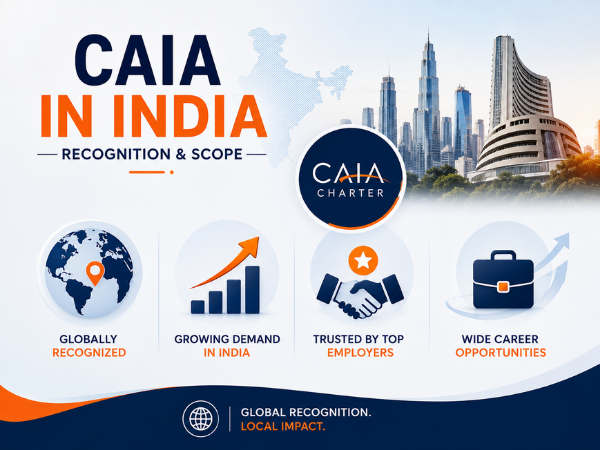
CAIA has a real, growing footprint in the Indian market. The CAIA Association operates an India Chapter, which supports continuing education, career opportunities, and scholarships for local candidates, and has also established a liaison presence in Mumbai to serve the Indian candidate base directly.
India’s alternative investment ecosystem Alternative Investment Funds (AIFs), private equity, venture capital, and increasingly infrastructure and private credit has expanded rapidly over the past decade, and that expansion has created real demand for professionals who can speak the specialised language of alternatives. Typical roles for CAIA-qualified professionals in India include portfolio analyst, risk analyst, and alternative investment manager, with employers ranging from large asset management houses and investment banks to boutique AIFs and financial consultancies.
Scholarships are also available specifically for Indian candidates through the CAIA Association’s academic partnerships, which can materially reduce the cost of entry for students and early-career professionals.
A few factors are driving CAIA’s growing relevance in India specifically. First, the regulatory framework around Alternative Investment Funds (Category I, II, and III AIFs) has matured significantly over the past decade, and fund managers under this framework increasingly look for staff who understand the mechanics of private equity, venture capital, and hedge fund-style strategies at a technical level exactly what CAIA teaches. Second, global asset managers and private equity firms with India offices (including well-known names in private equity and credit investing) recruit locally for roles that require the same alternative-investment vocabulary used internationally, making a globally recognised credential like CAIA useful for candidates targeting these employers specifically. Third, family offices and ultra-high-net-worth wealth management in India have grown quickly, and many of these mandates now include meaningful allocations to alternatives private credit, real estate funds, and pre-IPO opportunities creating additional demand for professionals who can speak knowledgeably about these asset classes.
For Indian candidates weighing the decision, it’s worth being realistic about positioning: CAIA is not yet as broadly known among generalist HR recruiters in India as the CFA is, simply because the CFA candidate pool in India is much larger and has existed for longer. Within specialist alternative-investment teams, however the exact audience a CAIA charterholder is trying to reach recognition and respect for the credential are strong. If your target employers and roles sit specifically in private equity, hedge funds, AIFs, or institutional alternative allocation, that specialist recognition matters far more than broader name recognition would.
Frequently Asked Questions
Yes CAIA has an established and growing candidate and charterholder base in India. The CAIA Association’s dedicated India Chapter and its liaison office in Mumbai exist specifically because enough Indian professionals have gone through the program to justify local support infrastructure, including continuing education, scholarships, and networking events. Indian candidates have been sitting for and passing both Level I and Level II for several years now, and charterholders work across major asset management firms, investment banks, and the country’s expanding Alternative Investment Fund (AIF) industry. If you’re wondering whether it’s a “known” or “recognised” credential locally it is, particularly among employers in private equity, hedge funds, and institutional investing. It’s less universally recognised on the street than the CFA (which has a much larger and older candidate base in India), but within alternative investment circles specifically, CAIA carries real weight and a track record of successful Indian candidates.
It depends entirely on which part of finance you want to build a career in, not on which exam is “better.” CAIA and FRM aren’t really competing for the same job they’re built for two different specialisations. CAIA is the right choice if your interest lies in alternative investments: private equity, hedge funds, real assets, infrastructure, or working as an allocator who selects and monitors alternative managers. FRM is the right choice if your interest lies in financial risk management: market risk, credit risk, operational risk, or regulatory and compliance-facing roles at banks, insurers, or regulators. If you’re unsure, look at the job descriptions you’re actually attracted to if they mention private equity, hedge fund strategies, or alternative asset allocation, lean CAIA; if they mention Value-at-Risk, stress testing, Basel requirements, or credit risk modelling, lean FRM. Cost and time commitment are broadly comparable between the two, so the deciding factor should be the career path, not the exam logistics. It’s also worth noting these credentials pair well together for professionals who want both an alternatives and a risk-management skill set, and plenty of finance professionals eventually hold both.
CAIA is generally considered moderately difficult meaningfully more rigorous than an average professional certification, but not as gruelling as the CFA program overall. The core reason is scope: CFA spans three levels covering equities, fixed income, derivatives, economics, financial reporting, corporate finance, and portfolio management in exhaustive depth, with historical Level I pass rates often in the 35–45% range and a total recommended study commitment well above 300 hours per level. CAIA, by contrast, covers two levels focused specifically on alternative investments, with recommended study time closer to 200+ hours per level and pass rates that have generally run higher roughly 45–50% at Level I and 55–65% at Level II in recent cycles. That doesn’t make CAIA easy Level II in particular includes constructed-response questions that test your ability to apply concepts under real time pressure, which trips up plenty of well-prepared candidates. But if you’re comparing the two purely on breadth, total time commitment, and historical pass rates, CAIA is the shorter, more targeted, and somewhat less punishing path to a respected finance credential. Many candidates who’ve done both describe CFA as a broader marathon and CAIA as a more focused, faster sprint.