Blog
CAIA Exams Explained: Levels, Syllabus, Fees and Pass Rate

The CAIA exams are a two-level series, Level I and Level II, run by the CAIA Association for the Chartered Alternative Investment Analyst charter. They are held twice a year, in March and September. Level I has 200 multiple-choice questions. Level II has 100 multiple-choice questions plus three constructed-response (written) sets. In March 2026, 45% of Level I candidates and 64% of Level II candidates passed. A first-time Level I candidate pays US$1,395 if they register early, plus applicable taxes.
If you are a finance student or working professional in India wondering whether the CAIA exams are worth the effort, this guide covers what you actually need to decide: the structure, the real costs, what the syllabus contains, how hard the exams are, and how to plan for a first-attempt pass.
What are the CAIA exams?
The CAIA exams test your knowledge of alternative investments: hedge funds, private equity, private debt, real assets such as real estate and infrastructure, and digital assets. Passing both levels, plus meeting the experience and membership requirements, earns the Chartered Alternative Investment Analyst (CAIA) charter, issued by the CAIA Association.
Alternative investments are anything outside the traditional mix of listed shares and bonds. Pension funds, endowments and family offices use them heavily, which is why the charter appeals to people in asset management, wealth management, private banking and investment consulting.
Your Gateway to the CAIA Certificate
Take the next step towards a career in alternative investments. Start your CAIA preparation with Fintelligents.
Build expertise. Advance your career.
How many levels are there in the CAIA exam?
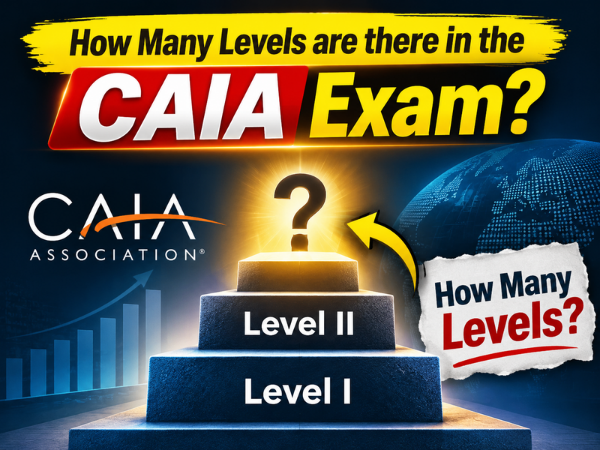
There are two levels, taken in order, and they cannot be sat in the same exam window. Level I builds the foundation. Level II applies it to portfolio decisions and adds written answers.
| Feature | CAIA Level I | CAIA Level II |
| Focus | Tools and asset-class knowledge | Applying tools to investment decisions |
| Question format | 200 multiple-choice questions in two sections of 100 | 100 multiple-choice questions (70% of marks) plus three constructed-response sets (30%) |
| Written answers | No | Yes |
| Fee for first attempt | US$995 early / US$1,395 standard, plus one-time US$400 enrolment | US$995 early / US$1,395 standard [VERIFY] |
| Scoring | Pass/fail; no numeric passing score published | Pass/fail; no numeric passing score published |
CAIA exam dates and registration deadlines
You have two sittings a year. Registration closes months before the exam, and the early deadline saves you US$400.
| March 2027 | September 2027 | |
| Registration opens | 12 Oct 2026 | 12 Apr 2027 |
| Early registration deadline | 7 Dec 2026 | 7 Jun 2027 |
| Registration closes | 1 Feb 2027 | 2 Aug 2027 |
| Level I window | 1-12 Mar 2027 | 30 Aug-10 Sep 2027 |
| Level II window | 15-26 Mar 2027 | 16-24 Sep 2027 |
Exams are taken at test centres worldwide. Online proctored exams are available by exception only, with an approved accommodation. Level I results usually arrive within about five weeks of the window closing, and Level II within about eight, because the written answers are marked by hand.
How much do the CAIA exams cost?
The CAIA Association lists fees in US dollars. There are three parts: a one-time enrolment fee, the exam registration fee for each level, and a retake fee if you need one.
| Fee component | Amount (USD) |
| One-time enrolment fee (non-refundable) | 400 |
| Exam registration, early | 995 |
| Exam registration, standard | 1,395 |
| Retake (per level) | 795 |
- Level I only, early: US$1,395. Standard: US$1,795.
- Both levels, registered early: US$400 + US$995 + US$995 = US$2,390.
- Both levels, registered standard: US$400 + US$1,395 + US$1,395 = US$3,190.
The CAIA Association states that Canadian and Indian GST applies to its fees, so your final bill in rupees will be higher than the conversion alone.
CFA charter holders can skip Level I through the Stackable Credential Program and sit only Level II, which cuts the total cost noticeably.
CAIA Level I syllabus
The CAIA Association updates the curriculum every year, and each year’s curriculum is for exams held in that calendar year. For 2027 exams, Funds of Funds is no longer a separate Level I topic, so Level I has seven topics. The topic weights below are approximate ranges, and the exam is built to land inside them.
| Level I topic | 2026 weight | 2027 weight |
| CAIA Ethical Principles | 8-12% | 7-13% |
| Introduction to Alternative Investments | 20-28% | 21-27% |
| Real Assets | 14-20% | 16-22% |
| Private Equity | 8-12% | 8-14% |
| Private Debt | 12-16% | 10-16% |
| Hedge Funds | 15-19% | 15-21% |
| Digital Assets | 4-8% | 3-9% |
| Funds of Funds | 1-5% | Not a separate topic |
Introduction to Alternative Investments, Real Assets and Hedge Funds together make up more than half the exam even at the bottom of their ranges. If your time is limited, that is where your practice hours should go first.
Prepare Smarter, Score Better.
Get access to expert-curated exam resources, study materials, and preparation tools to stay ahead in your certification journey.
CAIA Level II syllabus
Level II has ten topics. The key difference is that Ethics and Emerging Topics are tested only through written answers, so you cannot rely on multiple-choice practice for them.
| Level II topic (2027) | Multiple-choice | Constructed-response |
| CAIA Ethical Principles | 0% | 10% |
| Institutional Asset Owners | 5-11% | 0-10% |
| Asset Allocation | 10-16% | 0-10% |
| Risk and Risk Management | 5-11% | 0-10% |
| Methods and Models | 7-13% | 0-10% |
| Accessing Alternative Investments | 3-9% | 0-10% |
| Due Diligence and Selecting Managers | 6-12% | 0-10% |
| Volatility and Complex Strategies | 5-11% | 0-10% |
| Universal Investment Considerations | 4-10% | 0-10% |
| Emerging Topics | 0% | 10% |
| Total | 70% | 30% |
Preparing for CAIA Level I or Level II? Explore the CAIA programme at Fintelligents for structured classes, a study plan built around the current topic weights, and exam-focused practice.
How difficult are the CAIA exams?
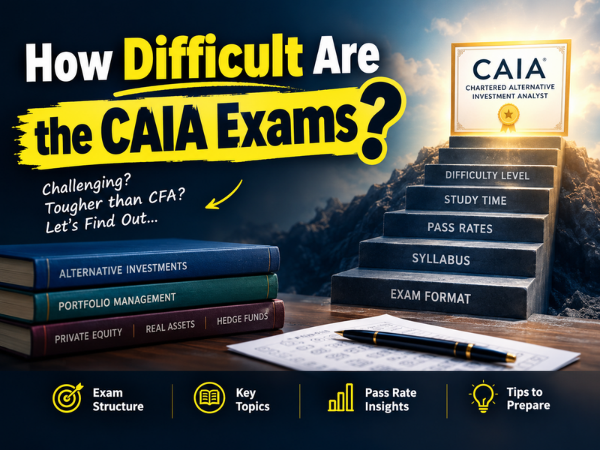
They are demanding, mainly because of the volume of new material rather than the maths. Roughly half of Level I candidates fail on any given attempt. Level II passes more candidates, but it asks you to explain and justify answers in writing, which many multiple-choice-trained candidates find harder than they expect.
What is the CAIA exam pass rate?
The latest pass rates we could verify are from March 2026: 45% for Level I and 64% for Level II. Over recent sittings, Level I has stayed in the mid-40s to high-40s and Level II in the 60s.
| Exam window | Level I pass rate | Level II pass rate |
| March 2026 | 45% | 64% |
| September 2025 | 46% | 60% |
| March 2025 | 48% | 62% |
| September 2024 | 45% | 60% |
| March 2024 | 46% | 59% |
Since 2021, the average has been roughly 48% for Level I and 60% for Level II, based on figures compiled from CAIA Association releases by prep providers.
How to read these numbers
The pass rate is not a measure of how smart candidates are. Many candidates are working full-time and under-prepare, and the pool is self-selected, so a 45% rate does not mean a 45% chance for you. Candidates who put in the CAIA Association’s recommended minimum of 200 hours of study per level, and practise under exam conditions, are in a different group from those who skim the curriculum in two weekends.
If you see a source claiming CAIA Level I pass rates of 60-75%, check its date. Those figures belong to the early years of the programme, not recent exams.
How to prepare for the CAIA exam and clear it on the first attempt
The CAIA Association recommends at least 200 hours of study for each level. That is the number to plan around. Here is what it looks like in practice.
The time maths. If you register today for March 2027, Level I starts on 1 March, about 17 weeks away. Fitting 200 hours into 17 weeks means roughly 12 hours a week, which is tough alongside a full-time job. If you target September 2027, you have around 43 weeks, which brings it under 5 hours a week. For most working professionals, the later window is the safer first attempt.
A practical sequence:
- Study from the right curriculum year. Exams in 2027 use the 2027 curriculum. Older books will miss the 2027 changes.
- Start with the heavy topics. For Level I, that is Introduction to Alternative Investments, Real Assets and Hedge Funds.
- Do not skip the small topics. Ethics and Digital Assets are quick to learn relative to their marks.
- Practise questions early, not only at the end. Switch from reading to question practice by roughly the halfway point.
- Take at least two full mock exams under timed conditions before your window.
- For Level II, write answers by hand or type them under time pressure. Constructed-response sets reward clear, structured explanations, not just correct conclusions.
- Practise with a financial calculator. Check the approved models in the current CAIA candidate handbook before buying one.
A common mistake: treating Level II as “Level I plus a bit more.” Level I teaches you what each asset class is. Level II expects you to decide what to do with it: how to allocate, how to assess a manager, how to judge risk. Candidates who only memorise tend to struggle.
For a deeper breakdown of how self-study compares with a structured course, see our complete CAIA exam guide hub.
Who can take the CAIA exams? Eligibility and charter requirements
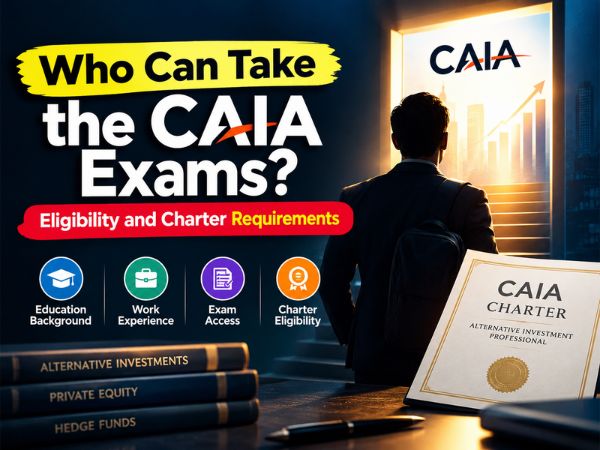
There are no formal education or experience requirements to sit the Level I exam. The requirements apply to earning the charter:
- Pass both Level I and Level II.
- Have a bachelor’s degree (or equivalent) with at least one year of professional experience, or at least four years of professional experience.
- Become a CAIA Association member and agree to its member agreement.
After passing Level I, there is no deadline for passing Level II, unlike some other certifications.
Is the CAIA worth it? Advantages and limitations
Where it helps: it is specialised. If you want to work in private markets, hedge funds, real assets or institutional asset allocation, the CAIA gives you structured knowledge in an area where general finance courses are thin. It is also more affordable than many comparable global certifications.
Where it is limited: it is less widely recognised by recruiters in India than the CFA, and it will not by itself land you a job. It works best combined with relevant experience or a complementary credential. If your goal is general equity research or corporate finance, other certifications may serve you better.
We look at costs, career paths and return on investment in more detail in why choosing a CAIA programme makes sense.
Frequently asked questions
The CAIA exam is a two-level professional exam on alternative investments, run by the CAIA Association. Passing Level I and Level II, along with meeting the experience and membership requirements, earns the Chartered Alternative Investment Analyst charter. It covers hedge funds, private equity, private debt, real assets and digital assets.
It is challenging, particularly Level I, where recent pass rates sit around 45-48%. Level II pass rates have been around 60-64%, but written answers add a different kind of difficulty. Most candidates who pass put in at least the recommended 200 hours of study per level.
There are two levels, Level I and Level II, taken in order and in separate exam windows. Level I is 200 multiple-choice questions. Level II is 100 multiple-choice questions plus three constructed-response sets. CFA charter holders may be eligible to skip Level I.
In March 2026, the pass rate was 45% for Level I and 64% for Level II. Over recent sittings, Level I has ranged from about 45% to 48% and Level II from about 59% to 65%. The CAIA Association does not publish a numeric passing score.
A first-time Level I candidate pays a one-time US$400 enrolment fee plus US$995 (early) or US$1,395 (standard) for registration. Level II exam registration is charged separately. Retakes cost US$795 per level. GST applies for Indian candidates, so check the final amount at checkout.
For 2027, Level I covers seven topics: CAIA Ethical Principles, Introduction to Alternative Investments, Real Assets, Private Equity, Private Debt, Hedge Funds and Digital Assets. Introduction to Alternative Investments carries the largest weight at about 21-27%. Funds of Funds is no longer a separate topic.
Level II covers ten topics, including Asset Allocation, Risk and Risk Management, Methods and Models, Due Diligence and Selecting Managers, and Volatility and Complex Strategies. Ethics and Emerging Topics are tested only through constructed-response questions, at 10% each.
The CAIA Association recommends a minimum of 200 hours per level. At 10 hours a week, that is about 20 weeks per level. Plan more if you are new to finance, and fewer weeks only if you already work in alternatives or have covered similar content through the CFA.
Conclusion
The CAIA exams are worth considering if you want a career in private markets, hedge funds or institutional investing, and they reward candidates who plan their time realistically. Know the real costs, study from the right curriculum year, practise questions early, and treat Level II written answers as a skill to train.
If you are deciding between the March and September 2027 sittings, or comparing the CAIA with other certifications, a conversation with a counsellor can save you months. Fintelligents offers structured preparation for both levels.
Book a free demo class or speak with a Fintelligents course counsellor to get guidance on your CAIA exam journey, course fees and eligibility. Explore the CAIA programme.