Blog
CAIA Exam Pass Rate 2026: How Hard Is It Really and What Do Toppers Do Differently?

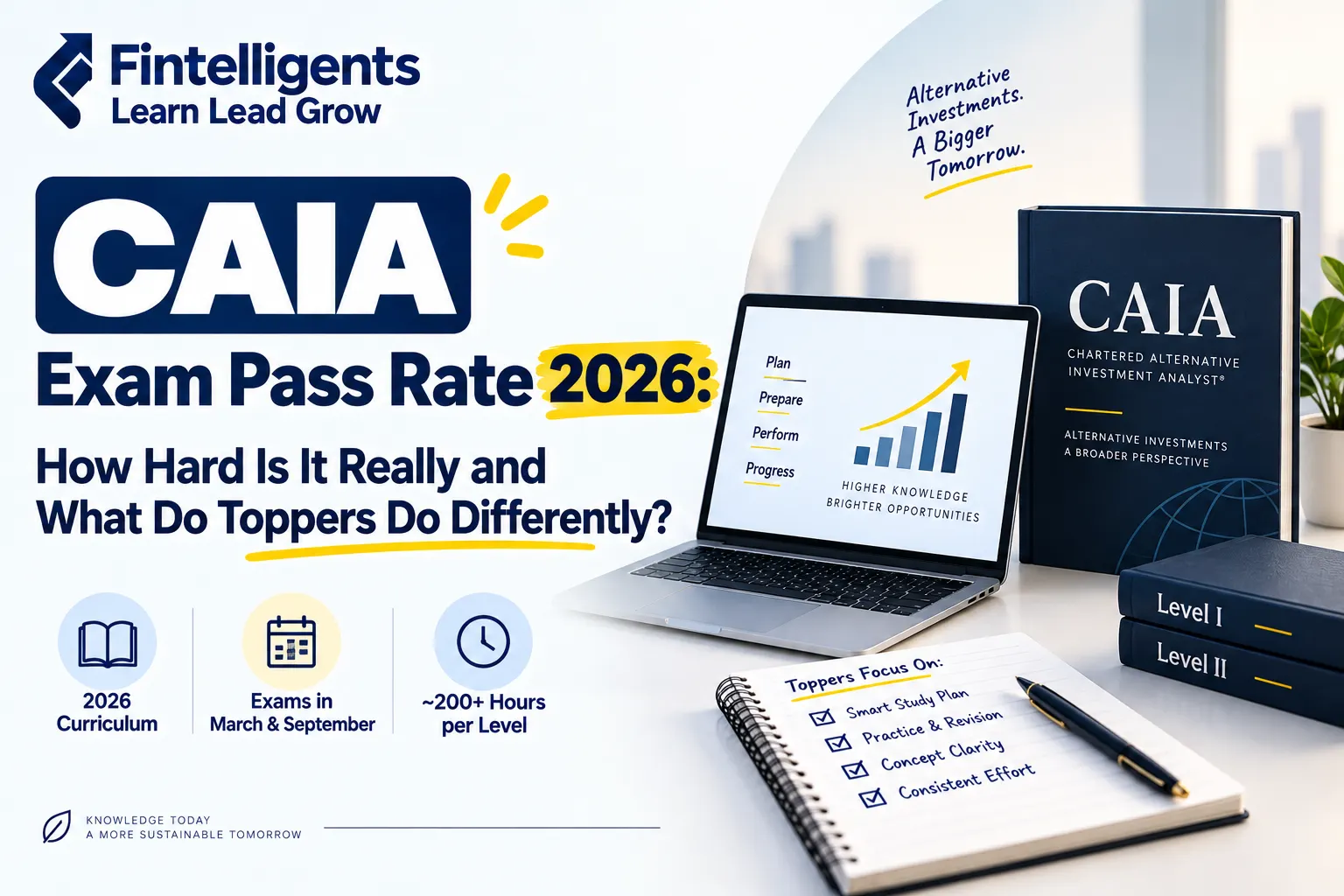
If you are researching the CAIA certification before committing to it, the pass rate is one of the first numbers you will come across. And it should make you take the exam seriously. The March 2026 CAIA Level 1 pass rate was 45%, meaning more than half of all candidates who sat did not pass. Level 2 fared better at 64% but still places the CAIA firmly in the category of challenging professional exams. This blog breaks down what the pass rate actually tells you, what makes the exam difficult, and specifically what candidates who pass do differently from those who do not.
CAIA Exam Pass Rate 2026: The Numbers
The latest March 2026 CAIA exam pass rates are 45% for Level 1 and 64% for Level 2. These numbers deserve some context before you interpret them.
| Exam | March 2026 Pass Rate | Historical Average |
| CAIA Level 1 | 45% | Approximately 51% per attempt |
| CAIA Level 2 | 64% | Approximately 63% per attempt |
The latest CAIA Level 1 pass rate of 45% is one of the lowest since 2010, likely due to a combination of an increase in candidate intake, more challenging exams, and lack of study preparation.
The important thing to understand is that the CAIA is not graded on a curve. The exams are not curved so the grade you get is not impacted by other candidates’ performance. Every candidate who scores above the minimum passing threshold passes, regardless of what percentage that represents. This means your outcome is entirely within your control.
Why Is the CAIA Level 1 Pass Rate Declining?
More candidates are taking the exam than previously, which is one reason the pass rate is declining, but the other is that the exam is becoming more challenging. The CAIA Association updates 10 to 20 percent of the curriculum annually to reflect what is actually happening in alternative markets. Digital assets, AI-driven investment strategies, and evolving private credit structures have all entered the curriculum in recent years. Candidates who prepare with outdated materials or underestimate the scope of the updated curriculum consistently fall on the wrong side of the pass rate.
The 45% pass rate at Level 1 catches a specific type of candidate by surprise: someone who has a finance background, assumes the concepts will feel familiar, and does not invest enough preparation time. The CAIA tests your ability to apply alternative investment concepts to complex portfolio scenarios, not just your ability to recall definitions.
For candidates who have already attempted Level 1, How to Pass CAIA Level I Exam covers the preparation strategies that work for a resit attempt.
How Difficult Is the CAIA Exam Compared to CFA and FRM?
Most candidates who have sat multiple professional exams place the CAIA at a similar difficulty level to CFA Level 1 in terms of content depth, but with a narrower subject scope. The CFA is broader across all investment disciplines. The CAIA goes deeper specifically into alternatives.
| Exam | Pass Rate Range | Preparation Hours Recommended | Levels |
| CAIA Level 1 | 45% to 55% | 200 to 220 hours | 1 of 2 |
| CAIA Level 2 | 60% to 65% | 250 to 280 hours | 2 of 2 |
| CFA Level 1 | 40% to 45% | 300 hours | 1 of 3 |
| FRM Part 1 | 40% to 55% | 200 to 240 hours | 1 of 2 |
The CAIA has a narrower scope than the CFA but goes deeper into alternatives. Its preparation requirement is slightly lower than the CFA but the exam is not easy by any standard. The 45% pass rate confirms this.
For a broader comparison of CAIA against FRM, CAIA vs FRM 2026: Which Certification Pays More and Opens Better Doors in Finance? covers the comparison in detail.
What the CAIA Level 1 Exam Actually Tests
The CAIA Level 1 exam covers Professional Standards and Ethics at 15 to 25 percent weight, Introduction to Alternative Investments at 20 to 28 percent, Real Assets at 11 to 17 percent, Private Equity at 6 to 10 percent, Private Debt at 9 to 14 percent, Hedge Funds at 12 to 17 percent, Digital Assets at 4 to 8 percent, and Funds of Funds at 4 to 8 percent.
Introduction to Alternative Investments and Hedge Funds together carry the most combined weight and are where most candidates either build their advantage or lose the most marks. Ethics consistently surprises candidates who treat it as a lighter section -at 15 to 25 percent it is the single largest topic area and cannot be underweighted in your preparation.
What Toppers Do Differently
Candidates who clear CAIA Level 1 in their first attempt share specific preparation patterns that consistently separate them from those who fail.
They treat Ethics as a priority, not an afterthought. With up to 25 percent weight, Ethics is not a soft topic. Toppers spend dedicated time on the CAIA Member’s Code of Conduct, practice applying it to scenarios rather than memorising it, and revise it in the final week specifically.
They study the current curriculum, not last year’s. The CAIA Association updates the curriculum annually. Candidates who prepare with materials from a previous exam cycle risk studying content that is no longer tested while missing topics that have been added. Toppers always verify their materials are current before beginning preparation.
They do not skip the quantitative sections. Approximately 30 percent of CAIA exam questions involve calculations. Candidates who focus exclusively on conceptual understanding and avoid the numerical sections consistently underperform. Toppers practice calculations regularly throughout preparation, not just in the final week.
They sit the practice exam early, not late. Most candidates who fail do a single practice exam in the final week and use it as a check. Toppers sit the practice exam with four to five weeks remaining, use the results to identify weak areas, and spend those remaining weeks specifically targeting those gaps rather than re-reading material they already know.
They manage exam time properly. With 200 questions in 4 hours, the CAIA Level 1 gives you an average of 72 seconds per question. Toppers practice under timed conditions regularly so this pace feels natural by exam day rather than pressured.
For a preparation strategy that incorporates all of these habits, CAIA Exam Strategy: Smart Ways to Balance Work and Study Before 2026 Exams gives you the full framework.
Enrolling in CAIA Certification in India coaching at Fintelligents gives you faculty-led preparation, regular mock exams, and study material aligned to the current 2026 curriculum -the combination that puts you on the passing side of a 45 percent pass rate. For candidates also evaluating the FRM alongside CAIA, FRM Online Classes at Fintelligents covers both programs.
Book a Free CAIA Counselling Session at Fintelligents
Conclusion
A 45 percent pass rate at CAIA Level 1 is a clear signal that the exam demands genuine preparation, not just familiarity with alternative investments. The declining pass rate over the last decade reflects a harder exam and a growing, more diverse candidate pool. The candidates who pass consistently are those who start early, give Ethics the weight it deserves, practice calculations regularly, use the practice exam to identify gaps with enough time to close them, and manage their exam time deliberately. The exam is genuinely challenging but well within reach for any candidate who prepares the right way.
Frequently Asked Questions (FAQs)
Q. What is the CAIA Level 1 pass rate in 2026?
The March 2026 CAIA Level 1 pass rate was 45%, one of the lowest recorded since 2010. The historical per-attempt average for Level 1 is approximately 51%. Level 2 has a higher pass rate, with March 2026 coming in at 64%.
Q. Is the CAIA exam harder than the CFA?
The CFA is generally considered harder overall due to its broader scope across all investment disciplines and three-level structure. However, the CAIA’s 45% Level 1 pass rate puts it in the same difficulty tier as CFA Level 1 in terms of candidate success rates. The CAIA goes deeper specifically into alternatives while the CFA covers more ground across investment management broadly.
Q. How many hours do I need to study for the CAIA Level 1 exam?
The CAIA Association recommends approximately 200 to 220 hours of study for Level 1. Most candidates spread this across 3 to 4 months. Candidates who report clearing it in their first attempt typically study closer to 220 hours rather than the minimum.
Q. Why is the CAIA Level 1 pass rate declining?
Two factors are driving the decline. More candidates are sitting the exam than in previous years, and the exam itself is becoming more challenging as the CAIA Association updates 10 to 20 percent of the curriculum annually to reflect current alternative investment markets. Candidates using outdated study materials are particularly affected.
Q. Is there negative marking in the CAIA exam?
No. There is no negative marking in either CAIA Level 1 or Level 2. Candidates who score 70 percent or above are assured of passing. This means it is always better to attempt every question rather than leaving any blank.