Blog
FRM Part 1 vs Part 2: What Each Exam Actually Tests

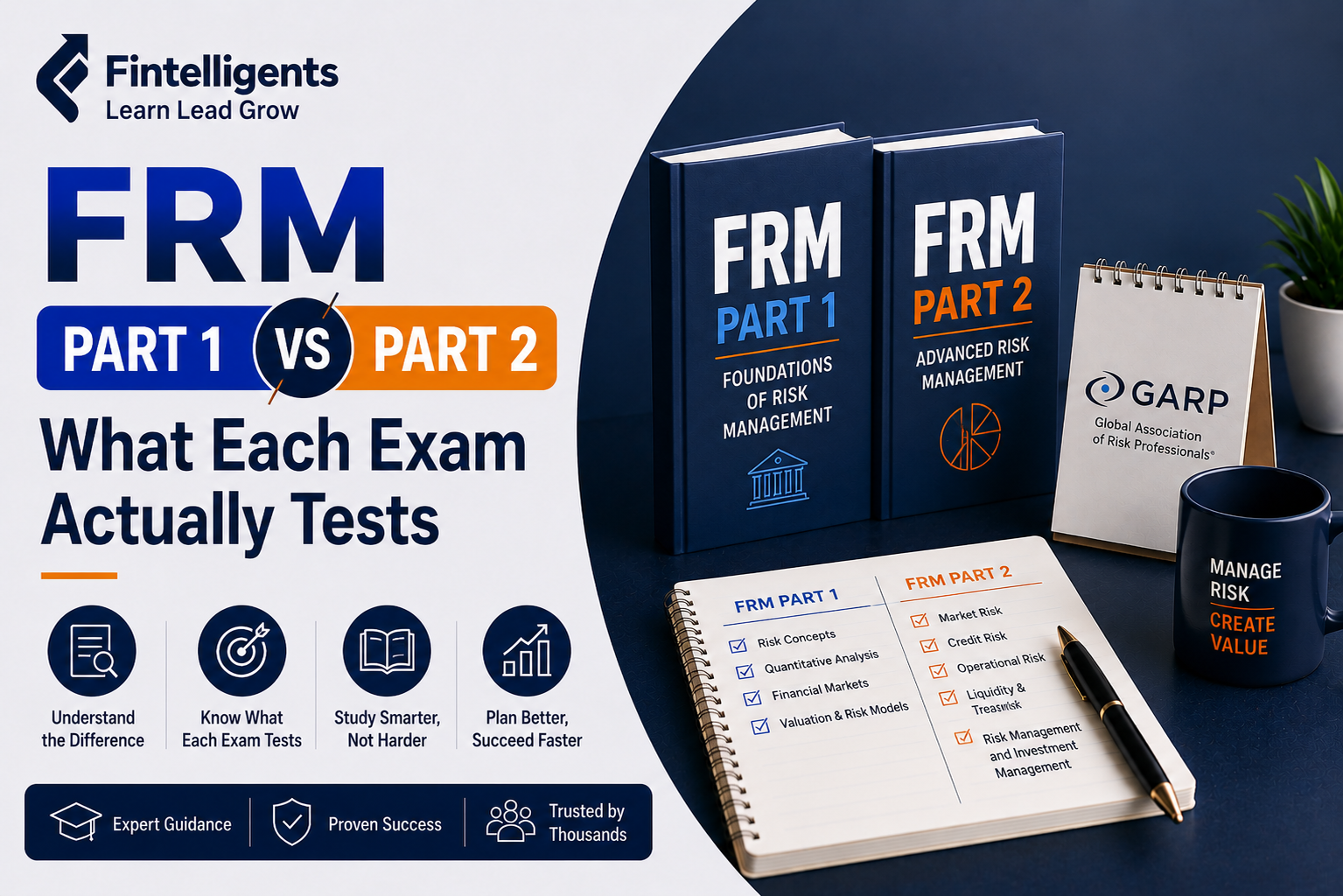
The Financial Risk Manager (FRM) certification, awarded by the Global Association of Risk Professionals (GARP), is one of the most respected credentials in risk management. But before you register for your first attempt, there’s a question almost every candidate asks: what is the actual difference between FRM Part 1 and Part 2, beyond “one comes before the other”?
This guide breaks down exactly what each exam tests, how the syllabus is weighted, what kind of questions you’ll face, and how the two exams connect to build one complete skill set. By the end, you’ll know exactly what you’re walking into, whether you’re just starting your FRM journey or deciding how to plan your study timeline.
What Is the FRM Certification?
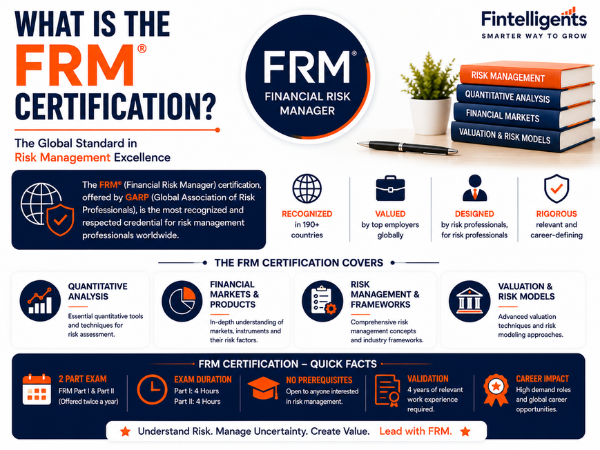
The FRM is a globally recognized credential for professionals working in risk management, banking, asset management, and regulatory compliance. It is administered in two sequential exams Part 1 and Part 2 both of which must be passed to earn the full certification, along with two years of relevant work experience.
Unlike a single comprehensive exam, GARP intentionally split the FRM into two distinct stages. Part 1 builds the theoretical and quantitative foundation. Part 2 tests how that foundation is applied to real-world risk scenarios. Understanding this split is the key to understanding everything else about how the two exams differ.
FRM Part 1 vs Part 2: The Core Difference
If you remember only one idea from this article, remember this: Part 1 is about tools, Part 2 is about application.
Part 1 teaches you the language of risk management quantitative methods, financial products, valuation models, and the basic building blocks of market and credit risk. Part 2 assumes you already know that language and instead asks you to use it: measuring risk exposure, running stress tests, evaluating operational failures, and making risk-based decisions in situations that resemble actual job responsibilities.
This distinction shows up everywhere in the topics covered, in how questions are worded, and in how heavily calculations versus conceptual judgment are weighted.
FRM Part 1: What It Actually Tests
FRM Part 1 is organized around four broad domains:
1. Foundations of Risk Management This section covers the basic principles of risk management, types of risk (market, credit, operational, liquidity), corporate governance, and the role of risk management within a firm. It’s conceptual and sets the stage for everything else.
2. Quantitative Analysis This is the most math-heavy part of Part 1. Expect probability theory, statistics, regression analysis, time series, volatility modeling, and simulation methods. Many candidates find this the most challenging section simply because it requires comfort with formulas and applied statistics rather than memorization.
3. Financial Markets and Products This domain covers derivatives, fixed income instruments, equities, and foreign exchange products. You’ll need to understand how these instruments are structured, priced at a basic level, and used for hedging or speculation.
4. Valuation and Risk Models This section ties the previous three together. It covers option pricing basics, fixed income valuation, and introductory VaR (Value at Risk) concepts.
Part 1 questions are almost entirely calculation-based or definition-based. You are tested on whether you understand the mechanics can you calculate a duration, interpret a regression coefficient, or identify the correct type of risk in a scenario. There is very little judgment-based reasoning required at this stage.
FRM Part 2: What It Actually Tests
FRM Part 2 shifts the focus from “what is this concept” to “how would you apply this concept in a real risk function.” Its domains include:
1. Market Risk Measurement and Management This goes deeper than Part 1’s introduction to VaR, covering advanced VaR methodologies, expected shortfall, and stress testing frameworks used by real trading desks and risk committees.
2. Credit Risk Measurement and Management This section covers credit risk models, counterparty risk, credit derivatives, and how institutions measure default probability and exposure at default in practice.
3. Operational Risk and Resiliency A distinctly Part 2 topic this covers operational risk frameworks, model risk, cyber risk, and business resiliency, all of which have become increasingly central to how regulators and firms assess institutional stability.
4. Liquidity and Treasury Risk Measurement This section examines how firms manage funding risk, liquidity buffers, and balance sheet risk topics highly relevant to treasury and ALM (asset-liability management) functions.
5. Risk Management and Investment Management This covers portfolio construction, performance attribution, and risk budgeting from an asset management lens.
6. Current Issues in Financial Markets This section is updated regularly by GARP to reflect real, current developments in the financial industry recent regulatory changes, market events, and emerging risk themes. It is the clearest sign that Part 2 is designed to test relevance to today’s risk landscape, not static theory.
Part 2 questions frequently present a scenario a fund manager’s portfolio, a bank’s balance sheet, a stress event and ask you to interpret what’s happening and what the appropriate risk response would be. This requires synthesizing multiple concepts from Part 1 and applying judgment, not just recalling a formula.
Side-by-Side Comparison Table
| Aspect | FRM Part 1 | FRM Part 2 |
| Focus | Foundational tools and concepts | Real-world application and judgment |
| Number of questions | 100 multiple-choice | 80 multiple-choice |
| Exam duration | 4 hours | 4 hours |
| Core domains | 4 domains | 6 domains |
| Question style | Formula/definition-based | Scenario/application-based |
| Math intensity | High (quantitative methods heavy) | Moderate (applied, less pure calculation) |
| Prerequisite | None | Must pass Part 1 first |
| Typical candidate experience level | Entry-level to early career | Early to mid-career, often working professionals |
| Content updates | Relatively stable | Includes “Current Issues” updated regularly |
Difficulty Level: Which Part Is Harder?
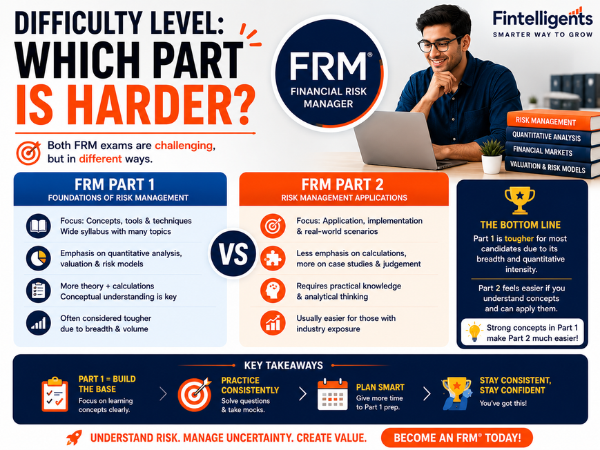
This is one of the most searched questions among FRM candidates, and the honest answer is: it depends on your background.
Candidates with a strong quantitative or engineering background often find Part 1 more approachable because it rewards formula fluency and mathematical comfort. Candidates who struggle with statistics and probability tend to find Part 1 tougher than expected.
Part 2, on the other hand, is often described as “conceptually harder” even by candidates who are good at math, because it demands the ability to connect multiple ideas into one coherent judgment. There’s no single formula to lean on you need to understand why a risk manager would choose one approach over another in a given situation.
Historical pass rates from GARP have generally shown Part 1 and Part 2 pass rates in a similar range, but many candidates report that Part 2 feels more manageable once Part 1 concepts are already internalized, since Part 2 builds directly on that foundation rather than introducing an entirely new skill set.
Question Style and Exam Format Differences
Both exams use multiple-choice questions and are computer-based, but the way questions are constructed differs meaningfully.
Part 1 questions tend to be shorter and more direct: calculate a value, identify a definition, or select the correct formula application. A well-prepared candidate can often solve a Part 1 question in under a minute once the underlying concept is clear.
Part 2 questions tend to be longer, often built around a short case or scenario description, and require you to first interpret the situation before you can even identify which concept applies. This makes time management on Part 2 slightly different even though there are fewer questions (80 vs. 100), the reading and reasoning load per question is higher.
How the Two Exams Build on Each Other
It’s worth being direct about this: Part 2 is not a fresh start. GARP designs the curriculum so that Part 2 assumes fluency in Part 1 material. Valuation concepts from Part 1 reappear in Part 2’s market risk section. Quantitative methods from Part 1 underpin the VaR and credit models tested in Part 2. Candidates who treat Part 1 as “something to forget after passing” often struggle in Part 2 because they have to relearn foundational material while simultaneously tackling new, more complex topics.
This is why most successful candidates recommend attempting Part 2 relatively soon after passing Part 1 ideally within the same year or the next available window while the foundational concepts are still fresh.
Career Relevance: What Each Part Prepares You For
Passing only Part 1 does not grant the full FRM designation, but it does signal that you understand core risk management concepts, which is valuable for entry-level roles in risk, compliance, or analytics. Many candidates list “FRM Part 1 cleared” on their resumes while job hunting, and recruiters in banking and financial services generally recognize this as a strong signal of quantitative aptitude and genuine interest in the risk field, even before the full certification is complete.
The full FRM designation which requires passing both parts plus relevant work experience is what employers in banking, asset management, regulatory bodies, and consulting typically look for when hiring for dedicated risk management roles. Part 2’s emphasis on operational risk, liquidity risk, and current market issues reflects the actual day-to-day responsibilities of a working risk manager, which is why completing both parts matters so much to employers.
In practice, professionals who complete both parts often move into roles such as market risk analyst, credit risk associate, liquidity risk manager, model validation specialist, or regulatory reporting analyst. Some also use the FRM as a stepping stone toward more senior positions like Head of Risk or Chief Risk Officer later in their careers, particularly when combined with an MBA or a CFA charter. Because Part 2 mirrors the actual decision-making risk professionals face interpreting a stress test result, evaluating a liquidity shortfall, or assessing model risk in a new trading strategy it tends to carry more direct weight in interviews, where candidates are often asked to walk through how they would approach a real risk scenario rather than recite a definition.
How to Plan Your Study Timeline for Both Parts
A realistic and commonly recommended approach:
- Part 1 preparation: 200-240 hours of study spread over 4-6 months, with heavy emphasis on practicing quantitative problems until calculations become second nature.
- Part 2 preparation: 200-240 hours as well, but with more time spent on reading comprehension of scenario-based questions and reviewing how Part 1 concepts apply in Part 2 contexts.
- Gap between exams: Many candidates take Part 2 in the exam window immediately following their Part 1 pass, to avoid losing momentum and forgetting foundational material.
Regardless of your schedule, consistent revision of Part 1 concepts while studying for Part 2 will save you significant time compared to relearning them from scratch.

Common Mistakes Candidates Make
- Treating Part 2 as an entirely separate exam instead of a continuation of Part 1 concepts.
- Underestimating the reading load in Part 2, since scenario-based questions take longer to process than direct calculation questions.
- Delaying Part 2 too long after passing Part 1, resulting in having to relearn quantitative foundations.
- Ignoring the “Current Issues” section in Part 2, which is updated regularly and often underweighted in study plans built from older materials.
- Over-focusing on formulas in Part 2 prep instead of practicing applied, scenario-based reasoning.
- Skipping practice exams under timed conditions, which matters even more for Part 2 since scenario-based questions take longer to read and interpret than Part 1’s direct calculation questions.
- Relying solely on question banks without reading the underlying concepts, which can help you pattern-match familiar questions but often fails on Part 2’s case-style questions that combine two or three concepts at once.
- Not reviewing GARP’s official learning objectives, which outline exactly what each reading expects you to be able to do a resource many candidates overlook in favor of third-party notes alone.
FAQs on FRM Part 1 vs Part 2
No. GARP requires candidates to pass Part 1 before they are eligible to sit for Part 2. The curriculum is also sequential, so attempting Part 2 without a solid grasp of Part 1 concepts is generally not advisable even if it were allowed.
It depends on your strengths. Part 1 is more quantitative and formula-heavy, which can be difficult for candidates less comfortable with statistics. Part 2 is more conceptual and scenario-based, requiring you to apply multiple ideas together, which some candidates find more mentally demanding despite having fewer questions.
Most candidates and prep providers recommend attempting Part 2 in the next available exam window after passing Part 1, since the material builds directly on Part 1 concepts that are easiest to apply while still fresh.
Not entirely. Part 2 revisits several Part 1 concepts like VaR, valuation, and quantitative methods but applies them to more advanced, real-world risk scenarios rather than testing them in isolation.
Passing both Part 1 and Part 2 is required, but GARP also requires candidates to submit proof of two years of relevant full-time work experience in risk management or a related field before the full FRM designation is awarded.
FRM Part 1 has 100 multiple-choice questions, while FRM Part 2 has 80 multiple-choice questions. Both exams are 4 hours long.
It’s a section GARP updates periodically to reflect recent, real developments in financial markets and risk management practice, ensuring the exam stays relevant to current industry conditions rather than testing only static theory.
Final Thoughts
FRM Part 1 and Part 2 aren’t two versions of the same test they’re two different mental exercises that together build a complete risk management skill set. Part 1 gives you the vocabulary and tools. Part 2 teaches you to think like a risk manager under real conditions. Understanding this distinction before you start studying will help you approach each exam with the right mindset, allocate your preparation time more effectively, and avoid the common trap of treating Part 2 as a repeat of Part 1 rather than its natural next step.
Whether you’re just starting with Part 1 or gearing up for Part 2, the key is consistency and remembering that every hour spent mastering Part 1 fundamentals directly pays off when you reach Part 2’s real-world scenarios.