Blog
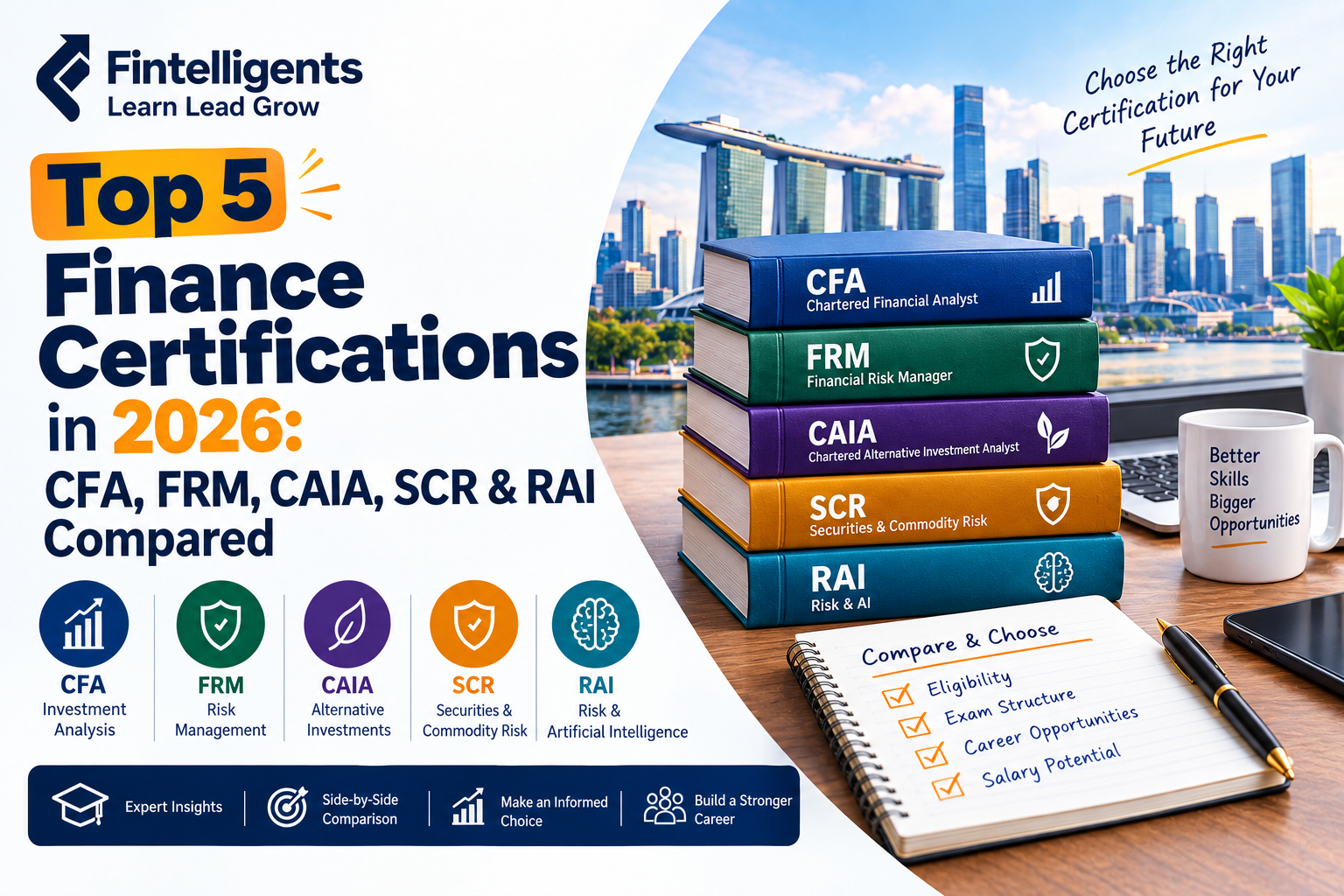
Top 5 Finance Certifications in 2026: CFA, FRM, CAIA, SCR & RAI Compared

Choosing a finance certification in 2026 feels harder than ever. New credentials keep appearing. Old credentials keep evolving. Employers keep raising the bar.
This guide compares five certifications that matter right now: CFA, FRM, CAIA, SCR, and RAI. You will learn what each one covers. You will see exam formats, costs, and career outcomes side by side. By the end, you will know which certification fits your goals.
Why Finance Certifications Matter in 2026
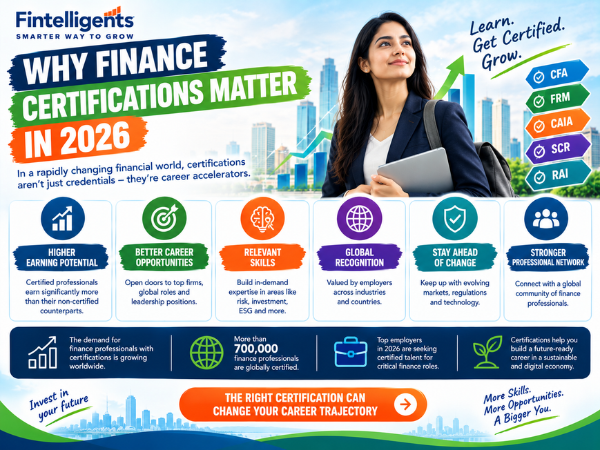
Finance hiring has changed. Firms no longer hire on degrees alone. They want proof of applied skill. A certification gives that proof.
Each credential below signals something specific. CFA signals investment expertise. FRM signals risk mastery. CAIA signals alternative asset knowledge. SCR signals climate risk fluency. RAI signals AI governance skill. Together, they map almost every growth area in modern finance.
The Skills Gap Employers Want Filled
Banks and asset managers face three pressing gaps today. First, they need portfolio and valuation talent. Second, they need risk professionals who understand complex models. Third, they need people who grasp emerging risks like climate change and artificial intelligence.
These five certifications address all three gaps directly. That is why demand for them keeps rising, even as the finance job market tightens elsewhere.
How to Choose the Right Certification
Start with your target role, not the certification’s popularity. Ask yourself what you want to do in five years. Do you want to manage portfolios? Do you want to measure risk? Do you want to work on sustainability or AI governance?
Your answer narrows the list quickly. The sections below give you the detail you need to decide with confidence.
Trends Shaping Finance Certifications in 2026
Three trends stand out this year. First, employers now expect specialization, not just a general finance background. A broad degree no longer separates you from other candidates.
Second, exam bodies keep updating curricula faster than before. GARP added AI and climate content to FRM’s current issues section. CFA Institute keeps refreshing its ESG and technology coverage across all three levels. Staying current matters as much as passing the exam itself.
Third, shorter, focused credentials like SCR and RAI are gaining traction fast. Professionals want targeted skills without a multi-year commitment. This shift explains why GARP launched both certificates within a short span of each other.
1. CFA (Chartered Financial Analyst)
The CFA charter remains the most recognized investment credential worldwide. CFA Institute awards it after candidates clear three exam levels and meet a work experience requirement.
What CFA Covers
The curriculum spans ethics, quantitative methods, economics, financial statement analysis, corporate finance, equity, fixed income, derivatives, alternative investments, and portfolio management. Level 1 builds foundational knowledge. Level 2 tests application through asset valuation. Level 3 focuses on portfolio construction and wealth management.
CFA Exam Structure and Levels
All three levels use computer-based testing at Prometric centers worldwide. Level 1 and Level 2 use multiple-choice and item-set questions. Level 3 adds constructed-response essay questions alongside item sets.
You must pass levels in sequence. There is no shortcut. Most candidates need three to four years to finish the full program.
CFA Fees in 2026
CFA Institute removed the one-time $350 enrollment fee starting with 2026 exam windows. In exchange, per-level fees rose. Early registration now costs $1,140 for Levels 1 and 2, and $1,240 for Level 3. Standard registration costs $1,490 for Levels 1 and 2, and $1,590 for Level 3.
A candidate who registers early and passes every level on the first attempt spends roughly $3,520 in total exam fees. Add a calculator, prep materials, and optional coaching, and the realistic budget runs higher.
Who Should Pursue CFA
CFA suits candidates who want careers in equity research, portfolio management, investment banking, or wealth management. It works well for anyone building a long-term investment career, especially in asset management firms.
Career Paths After CFA
Charterholders commonly move into roles like equity analyst, portfolio manager, research associate, or investment strategist. The charter also opens doors in private wealth management and corporate finance.
CFA Pass Rates and Difficulty
Pass rates vary by level and exam window, but Level 1 historically sees the lowest pass rate among the three. Many candidates underestimate the ethics component, which carries significant weight at every level. Consistent study over months, not weeks, tends to separate passing candidates from repeat test-takers.
2. FRM (Financial Risk Manager)
GARP administers the FRM certification, the leading credential for risk professionals. It has two parts instead of three levels, which makes it faster to complete than CFA.
What FRM Covers
Part 1 builds foundations across risk management principles, quantitative analysis, financial markets and products, and valuation and risk models. Part 2 goes deeper into market risk, credit risk, operational risk, liquidity risk, and current issues like climate and AI-related risk in finance.
FRM Exam Structure
Part 1 runs four hours and includes 100 multiple-choice questions. Part 2 also runs four hours but includes only 80 questions, since each question demands deeper scenario analysis. GARP offers exam windows in May, August, and November each year.
There is no negative marking on either part. Candidates can attempt Part 2 only after passing Part 1.
FRM Fees in 2026
First-time candidates pay a one-time $400 enrollment fee with Part 1 registration. Each part then costs $600 for early registration or $800 for standard registration. The enrollment fee never repeats, even for Part 2 or a retake.
A candidate who registers early for both parts spends about $1,600 in total GARP fees. This makes FRM notably cheaper than CFA.
Who Should Pursue FRM
FRM suits candidates targeting risk management roles at banks, hedge funds, insurance companies, or regulatory bodies. It fits professionals who enjoy quantitative modeling and stress testing more than security selection.
Career Paths After FRM
Common roles include market risk analyst, credit risk manager, operational risk consultant, and model validation specialist. Many FRM holders work inside treasury, compliance, or enterprise risk functions.
FRM Work Experience Requirement
Passing both parts does not grant the FRM designation immediately. GARP requires two years of relevant professional risk experience before you can use the title. This requirement runs separately from the exams, so you can start studying and testing before you meet it.
3. CAIA (Chartered Alternative Investment Analyst)
CAIA is the leading credential for alternative investments. The CAIA Association designed it around hedge funds, private equity, private credit, real assets, and structured products.
What CAIA Covers
Level 1 teaches the tools needed to analyze alternative investments, including quantitative foundations and asset class fundamentals. Level 2 shifts toward portfolio construction, due diligence, and real-world case analysis across alternative strategies.
CAIA Exam Structure
Level 1 includes 200 multiple-choice questions split across two sections, with four hours total. Level 2 adds constructed-response item sets alongside multiple-choice questions. CAIA Association runs exam windows in March and September each year.
CFA charterholders can skip Level 1 entirely through the stackable credential pathway, which shortens the path to the CAIA charter considerably.
CAIA Fees in 2026
New candidates pay a one-time $400 enrollment fee at Level 1. The Level 1 exam fee runs $995 for early registration or $1,395 for standard registration. Level 2 follows the same fee structure. Total cost for both levels typically lands between $2,800 and $3,200 when registering early.
Who Should Pursue CAIA
CAIA fits candidates working in or targeting hedge funds, private equity, endowments, family offices, or institutional allocator roles. It complements CFA well for professionals who want deep alternative asset expertise on top of traditional investment training.
Career Paths After CAIA
CAIA holders often work as alternative investment analysts, due diligence specialists, fund-of-funds managers, or private markets associates. Many roles sit inside institutional investment teams and consulting firms.
CAIA Membership and Eligibility
To fully activate the charter, candidates need a bachelor’s degree plus one year of relevant experience, or four years of experience without a degree. CFA charterholders qualify automatically through the stackable pathway. Membership with the CAIA Association also stays active through annual dues after you earn the charter.
4. SCR (Sustainability and Climate Risk Certificate)
GARP launched SCR to address a fast-growing need: understanding how climate change affects financial risk. It is a single-level certificate, not a multi-part program, which makes it far quicker to earn.
What SCR Covers
The curriculum covers green and sustainable finance, climate risk measurement and management, climate models and scenario analysis, and net-zero transition planning. Case studies come from organizations across banking, insurance, and consulting.
SCR Exam Structure
The SCR exam includes 80 multiple-choice questions, with one multi-part case study, completed within a four-hour window. GARP runs SCR exam windows twice a year, typically in April and October.
Who Should Pursue SCR
SCR suits risk managers, sustainability officers, ESG analysts, and consultants who need working knowledge of climate risk frameworks. It also appeals to professionals moving into ESG-focused roles from traditional finance backgrounds.
Career Paths After SCR
SCR holders often work in climate risk teams at banks, sustainability consulting, ESG research, or corporate sustainability functions. Regulators increasingly expect this expertise inside risk and compliance departments too.
Why SCR Stands Out From Other ESG Credentials
Several ESG-focused certificates exist today, but SCR concentrates specifically on climate and sustainability risk rather than broad ESG investing. This narrow focus makes it especially relevant for risk teams that need climate scenario analysis skills, not just general ESG awareness.
5. RAI (Risk and AI Certificate)
RAI is GARP’s newest certificate, built for the rise of artificial intelligence inside financial risk functions. It addresses a gap that neither CFA, FRM, nor CAIA covers directly.
What RAI Covers
The curriculum spans AI and machine learning fundamentals, AI-related risks and risk factors, responsible and ethical AI principles, and data and AI model governance. Topics include fairness, transparency, explainability, and human oversight of AI systems.
RAI Exam Structure
The RAI exam runs four hours and includes 80 multiple-choice questions, with some case-study components. GARP typically opens registration windows around mid-year, with exams following later in the year.
Who Should Pursue RAI
RAI fits risk managers, model validators, compliance officers, and data scientists who work with AI systems inside financial institutions. It also suits business leaders who want structured knowledge of AI governance rather than purely technical AI skills.
Career Paths After RAI
RAI holders often move into AI risk and governance roles, model risk management teams, or compliance functions focused on algorithmic and AI oversight. Demand for this skill set is rising fast as regulators scrutinize AI use in credit, trading, and fraud detection.
Why RAI Matters Right Now
Banks now deploy AI across credit underwriting, fraud detection, and customer service. Regulators worldwide are drafting new rules for AI use in financial services. Professionals who understand both the technology and the governance side will lead this transition, and RAI builds exactly that combination.
Quick Comparison Table: CFA vs FRM vs CAIA vs SCR vs RAI
| Certification | Levels | Focus Area | Typical Timeline | Approx. Early Total Cost |
| CFA | 3 | Investment management and portfolio strategy | 3–4 years | ~$3,520 |
| FRM | 2 | Financial risk management | 1–2 years | ~$1,600 |
| CAIA | 2 | Alternative investments | 1–2 years | ~$2,800–$3,200 |
| SCR | 1 | Sustainability and climate risk | A few months | Lower than multi-level programs |
| RAI | 1 | AI risk and governance | A few months | Lower than multi-level programs |
Fees and formats can shift between exam cycles. Always confirm current details on the official CFA Institute, GARP, or CAIA Association websites before you register.
Which Finance Certification Should You Choose in 2026?
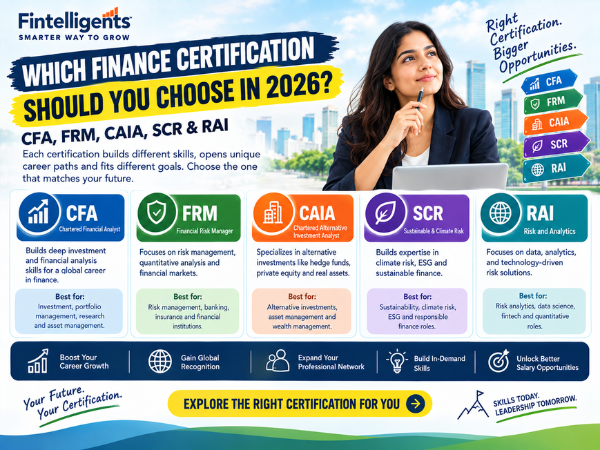
Your ideal certification depends on your career direction. Use the quick guide below to narrow your decision.
Choose CFA If.
You want a long-term career in investment management, equity research, or portfolio strategy. You are comfortable with a multi-year commitment and value the credential’s global brand recognition.
Choose FRM If.
You want to specialize in risk measurement and management. You prefer quantitative modeling and want a faster path than CFA, with lower total cost.
Choose CAIA If.
You work with or want to work with hedge funds, private equity, or real assets. You want deep alternative investment expertise, ideally alongside an existing CFA or industry background.
Choose SCR If.
You need working knowledge of climate risk fast. You work in sustainability, ESG research, or risk management and want a credential that signals climate competence without a multi-year commitment.
Choose RAI If.
Your organization uses AI in credit decisions, trading, or fraud detection. You want to lead AI governance conversations and understand AI-related risk frameworks.
Final Thoughts
No single certification suits everyone. CFA builds broad investment expertise. FRM builds risk management depth. CAIA builds alternative asset specialization. SCR and RAI address two of the fastest-growing risk categories in finance today: climate and artificial intelligence.
Many professionals now combine credentials. A CFA charterholder who adds FRM stands out in risk-adjacent investment roles. An FRM holder who adds RAI positions themselves for AI governance leadership. Think about where finance is heading, not just where it stands today, before you commit your time and money.
A Simple Way to Plan Your Certification Path
Map your next role before you register for any exam. Talk to people already working in that role. Ask which credential actually came up in their hiring process.
Then check the time and cost against your current life stage. A three-year CFA journey suits someone early in their career more than someone juggling a demanding job and family commitments. A single-level credential like SCR or RAI fits better when time is tight but you still need a credible, recognized skill signal fast.
Finally, revisit your plan every year. Finance certifications evolve constantly, and so do employer expectations. What mattered most in 2023 or 2024 may not carry the same weight in 2026 and beyond.
Frequently Asked Questions
There is no single best certification. CFA best serves investment management careers. FRM best serves risk management careers. CAIA best serves alternative investment careers. SCR and RAI serve climate risk and AI governance roles respectively.
Yes. Many candidates pursue both, since the curricula overlap in areas like quantitative methods and risk concepts. Most professionals still complete them sequentially rather than simultaneously, given the study time each demands.
SCR and RAI work best as specialized add-ons to a core credential like CFA or FRM, or as standalone credentials for professionals already working in sustainability or AI-adjacent roles. They rarely replace a foundational finance qualification for early-career candidates.
Most candidates need three to four years to clear all three levels, factoring in study time and exam scheduling. Some finish faster; others take longer due to retakes or work commitments.
Difficulty depends on your background. FRM demands stronger quantitative and statistical comfort. CFA covers a broader range of topics across three levels. Candidates with a strong math background often find FRM more approachable relative to its shorter timeline.
There is some overlap in quantitative foundations and portfolio management concepts. CAIA goes far deeper into alternative asset classes like hedge funds and private equity, an area CFA covers more lightly.
Yes, particularly at banks, asset managers, and consulting firms building out climate risk and AI governance teams. Both credentials come from GARP, the same body behind FRM, which lends them credibility in risk management circles.
Combined early-registration costs for CFA, FRM, CAIA, SCR, and RAI typically run well above $8,000, excluding prep materials, coaching, and retakes. Few professionals pursue all five; most select one or two based on career direction.