Blog
RAI vs SCR: Which GARP Certificate Should You Do First If You Work in Risk or Finance?

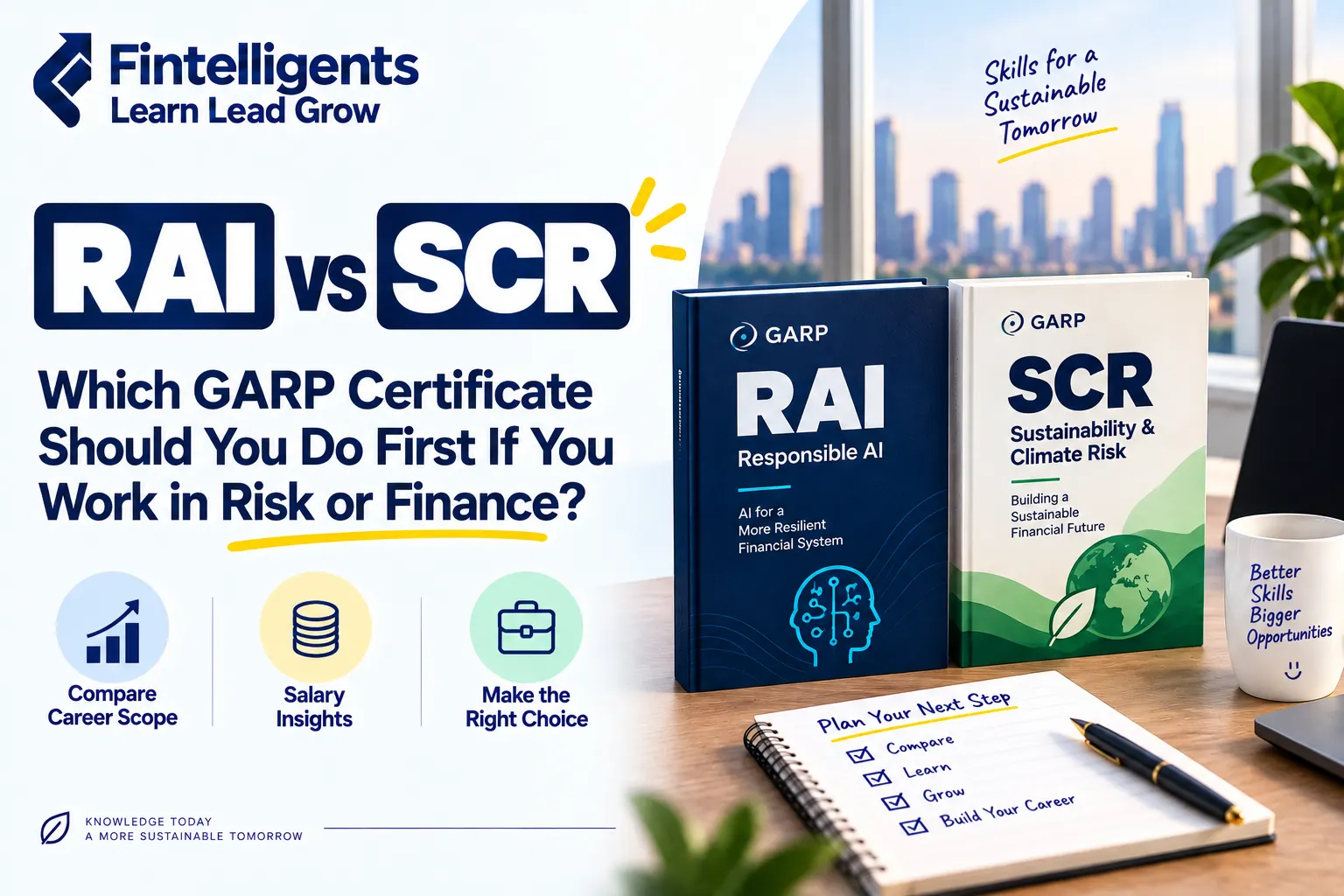
Both the RAI and SCR are single-level certificates from GARP. Both are designed for finance and risk professionals. Both can be completed with 100 to 130 hours of preparation. And yet they are built around completely different areas of expertise and open doors in different parts of the financial services industry. If you are weighing which one to pursue first, this blog gives you a clear, honest answer based on what each certificate covers, what roles it supports, and which makes more sense for your specific career profile.
What the RAI Certificate Covers
The RAI, or Risk and Artificial Intelligence certificate, launched in 2024 and covers how AI is being used in financial services and how the risks it creates are identified, measured, and managed. The curriculum spans five areas: AI and Machine Learning Introduction, Tools and Techniques covering supervised learning, unsupervised learning, NLP, and generative AI, Risks and Risk Factors covering bias, opacity, over-reliance, and unsafe automation, Responsible and Ethical AI covering fairness and accountability frameworks, and Data and AI Model Governance covering model risk management for AI systems and the evolving regulatory landscape for AI in finance.
The exam is 80 equally weighted multiple choice questions taken over 4 hours. The first RAI exam pass rate was 66%. GARP recommends 100 to 130 hours of preparation. The full curriculum and a practice exam are included with registration.
What the SCR Certificate Covers
The SCR, or Sustainability and Climate Risk certificate, covers how climate change creates financial risk and how institutions measure, manage, and disclose that risk. The curriculum covers climate science fundamentals, how climate risk affects credit quality and asset valuations, climate risk management tools including scenario analysis and stress testing, ESG frameworks and sustainability governance, and green and sustainable finance instruments.
The exam is 100 multiple choice questions taken over two hours. GARP recommends approximately 100 hours of preparation. The curriculum is included with registration and covers a range of regulatory frameworks including TCFD, GRI, and SASB.
For a deeper look at exactly what the SCR covers and who benefits most from it, Complete SCR Course: From Basics to Advanced Mastery gives you the full curriculum breakdown.
The Core Difference Between RAI and SCR
Both certificates address emerging risks in finance but they address different types of emerging risk. The SCR addresses the risk that climate change creates for financial systems. The RAI addresses the risk that artificial intelligence creates when deployed within financial systems.
Book a Free Counselling Session at Fintelligents to Decide Which Is Right for You
At the career level, this distinction matters enormously. The SCR is most valuable for professionals in credit risk, enterprise risk, compliance, and sustainability functions at banks and financial institutions who are being asked to integrate climate considerations into their work. The RAI is most valuable for professionals in model risk, technology risk, compliance, and senior risk oversight roles where AI systems are being deployed and someone needs to govern and validate them responsibly.
The two certifications rarely compete for the same role. They tend to be relevant to different people in different departments.
Who Should Do the SCR First
The SCR should be your first choice if climate risk and sustainability are the primary emerging areas in your current role or target role. This is the right call for credit analysts who need to assess how climate risks affect borrower creditworthiness in sectors like energy, real estate, and agriculture. It is right for risk managers at banks and NBFCs being asked by regulators to build climate risk capabilities. It is right for compliance and regulatory professionals dealing with SEBI ESG disclosure requirements or RBI climate risk guidelines. And it is right for investment professionals who want to understand how climate and ESG factors affect portfolio construction.
The regulatory push behind the SCR in India is significant. Both RBI and SEBI have issued guidance that creates internal employer demand for professionals with structured climate risk knowledge. If your employer is a bank, NBFC, or listed company facing regulatory climate disclosure expectations, the SCR is the more immediately applicable credential and the career case for pursuing it first is strong.
For a look at how SCR certification directly addresses what RBI and SEBI are asking Indian financial institutions to do, SCR Certification for Indian Bankers: Why RBI and SEBI Guidelines Are Making This a Must Have in 2026 covers the regulatory context in full.
Who Should Do the RAI First
The RAI should be your first choice if AI governance, model risk, and technology risk are the primary emerging areas in your current role or target role. This is the right call for model risk managers at banks and financial institutions who are being asked to validate and oversee AI models alongside traditional quantitative models. It is right for technology and data professionals in financial services who want to build credibility in risk and governance alongside their technical expertise. It is right for compliance professionals whose institutions are deploying AI in credit scoring, fraud detection, or trading and who need to understand what responsible AI deployment looks like from a regulatory perspective.
The AI regulatory environment in India is also building momentum. RBI has issued guidance on responsible AI use in banking and SEBI has been paying attention to algorithmic trading risks. This regulatory attention is creating employer demand for professionals who understand AI risk governance in a way that did not exist three years ago.
For a look at why AI risk expertise is becoming one of the most valued skills in financial services, Why Risk and AI Will Be the Most Important Skill in FinTech by 2026 gives you the broader market context.
What If You Are Genuinely Unsure?
If your work touches both climate risk and AI risk in roughly equal measure, which is increasingly common for senior risk managers at large banks overseeing both ESG reporting and AI model governance, the sequencing question comes down to which is more urgent in your current role.
A practical way to decide: look at what your employer has hired for in the last 12 months and what your team is being asked to build capabilities in. If the conversations at your organisation are dominated by RBI climate disclosures and SEBI ESG reporting, start with SCR. If the conversations are dominated by AI model governance, responsible AI frameworks, and managing the risks of AI-driven credit decisions, start with RAI.
Enrolling in the Risk and AI certification program at Fintelligents prepares you for the RAI certificate with faculty-guided sessions and mock practice built around the actual exam. For the SCR, SCR coaching online at Fintelligents covers the full curriculum with live and recorded sessions, regular mocks, and faculty support.
For candidates also comparing these two certificates against the FRM before deciding on an overall certification strategy, FRM, CFA, or SCR? Choosing the Right Certification for Risk Management Careers gives you the full landscape.
Conclusion
RAI and SCR are both valuable GARP certificates for finance and risk professionals in 2026, but they address different risks and serve different career profiles. If your work is centred on climate risk, ESG frameworks, and regulatory sustainability expectations, start with SCR. If your work is centred on AI governance, model risk management, and the responsible deployment of AI within financial systems, start with RAI. And if your career touches both, pursue them in sequence because the two credentials complement each other well and together cover two of the most important emerging risk domains in financial services today.
Frequently Asked Questions (FAQs)
Q. What is the main difference between the GARP RAI and SCR certificates?
The SCR covers climate risk and its financial implications, focusing on how climate change affects institutions and how those risks are managed and disclosed. The RAI covers AI risk, focusing on how artificial intelligence is used in financial services and how the risks that AI creates are identified, governed, and managed. They address different types of emerging risk and are most relevant to different types of professionals.
Q. Is the RAI or SCR harder to pass?
The first RAI exam had a pass rate of 66%, which is higher than most professional certifications at their first sitting. The SCR has historically had pass rates in the range of 50 to 65 percent. Both are considered manageable single-level exams with 100 to 130 hours of preparation. Neither is considered as demanding as multi-level programs like the FRM or CFA.
Q. Can I do both the RAI and SCR certificates?
Yes. Both are single-level exams offered multiple times per year and can be pursued in sequence. The RAI is offered in April and October. The SCR is offered in April and October as well. You can complete both within one year by sitting one in each exam cycle. For professionals whose roles span both AI governance and climate risk, holding both credentials is a meaningful differentiator.
Q. Which GARP certificate is more recognised by employers in India?
The SCR currently has stronger employer recognition in India because the regulatory push from RBI and SEBI has created specific internal demand at Indian banks and financial institutions. The RAI is newer and employer recognition is building rapidly as AI deployment in Indian financial services accelerates. Within three to five years, both certifications are likely to be equally recognised in their respective domains.
Q. Do I need to hold the FRM before pursuing the RAI or SCR?
No. Neither the RAI nor the SCR has any prerequisites. Both are open to candidates from any educational or professional background. However, professionals who already hold the FRM may qualify for a discounted registration fee on both the RAI and SCR as FRM holders, so check the current GARP fee structure before registering.