Blog
GARP RAI Certificate: Is It Worth It in 2026? Salary, Jobs and Honest ROI

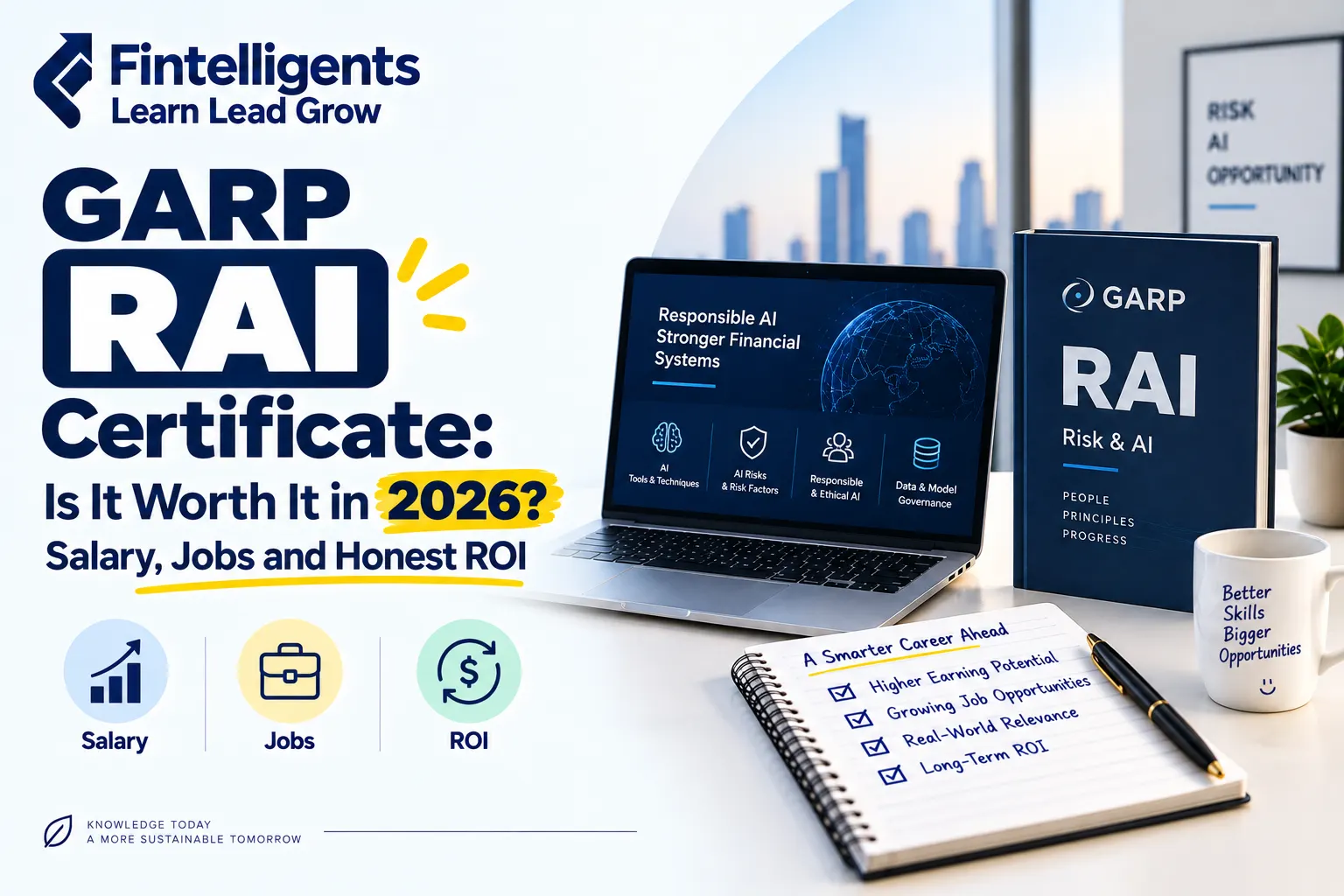
The GARP RAI certificate launched in 2024 and has quickly become one of the most sought new credentials in the risk and finance space. If you are considering it and want to know whether it is actually worth the time and money before committing, this blog gives you an honest answer. Salary data, job market demand, what the certificate costs, how long it takes to prepare, and who it is most likely to benefit. No fluff, just the information you need to make the decision.
What Is the GARP RAI Certificate?
The RAI certificate stands for Risk and Artificial Intelligence. It is offered by GARP, the same body behind the FRM, and is built specifically for finance and risk professionals who want to understand how AI is being used in financial services and how to manage the risks it creates. GARP’s RAI Certificate provides comprehensive coverage of relevant tools and techniques including generative AI, AI risks and risk factors, responsible and ethical AI, and governance frameworks for ensuring AI is deployed effectively and responsibly within organisations.
The exam is 80 multiple choice questions taken over 4 hours. GARP recommends 100 to 130 hours of preparation. The first RAI pass rate was 66%. The full curriculum and a practice exam are included with your registration at no additional cost.
What Does the RAI Certificate Cost?
| Candidate Type | Registration Fee (USD) |
| Non-Member | USD 750 |
| GARP Individual Member | USD 650 |
| FRM, SCR, or ERP Holder | USD 625 |
First-time GARP candidates receive a six-month complimentary GARP membership automatically applied during registration. The curriculum and practice exam are included. With registration fees ranging from USD 525 to USD 750 and an estimated 100 to 130 hours of preparation time required, understanding the return on this investment is essential.
This is where the ROI question gets answered most directly. Current market data indicates strong salary premiums for professionals with specialised AI risk credentials. AI Governance Lead positions command salaries between USD 160,000 and USD 240,000 annually, reflecting the high visibility and liability associated with overseeing entire AI risk and compliance programmes. VP-level AI Risk Management roles at major financial institutions show salary ranges from USD 163,300 upward.
Enrol for RAI Coaching at Fintelligents
In the Indian market specifically, salary data for AI risk professionals in 2026 reflects the growing demand from banks and GCCs.
| Role | India (INR per year) | UAE (AED per year) | Singapore (SGD per year) |
| AI Risk Analyst | Rs 8,00,000 to Rs 14,00,000 | AED 150,000 to AED 250,000 | SGD 80,000 to SGD 120,000 |
| Model Risk Manager (AI) | Rs 18,00,000 to Rs 28,00,000 | AED 300,000 to AED 500,000 | SGD 130,000 to SGD 180,000 |
| AI Governance Lead | Rs 28,00,000 to Rs 45,00,000 | AED 500,000 to AED 800,000 | SGD 180,000 to SGD 280,000 |
| VP AI Risk Management | Rs 50,00,000 plus | AED 800,000 plus | SGD 250,000 plus |
Data suggests that adding specialised certifications like the GARP RAI correlates with a 15 to 20 percent salary premium over peers holding only generalist security or risk management credentials.
What Jobs Does the RAI Certificate Open Up?
The RAI certificate is most directly applicable to five types of roles that are growing fast across financial services in 2026.
Model Risk Manager – Banks and financial institutions deploying AI in credit scoring, fraud detection, and trading need professionals who can validate, monitor, and govern those AI models. Model risk management teams are expanding rapidly as regulators push for more rigorous oversight.
AI Governance Analyst – Dedicated AI governance functions are being built at major financial institutions. These roles sit at the intersection of risk, compliance, and technology and are where the RAI certificate’s governance module is most directly applicable.
Risk Technology Analyst – Professionals who sit between traditional risk teams and technology teams, capable of speaking both languages, are in short supply. The RAI certificate builds credibility on both sides.
Compliance and RegTech Professional – As AI regulation builds momentum across India, UAE, and Singapore, compliance professionals need structured knowledge of what responsible AI deployment looks like and what regulators are expecting. The RAI covers exactly this.
Senior Risk Manager – For professionals already at manager level in risk functions, the RAI certificate adds a layer of AI governance expertise that is increasingly expected at senior levels as AI becomes embedded in more risk decisions.
For a broader view of why the combination of risk and AI skills is one of the most powerful career moves in finance right now, Why Risk and AI Will Be the Most Important Skill in FinTech by 2026 covers the market demand in detail.
Is the RAI Certificate Worth It? The Honest Answer
The answer depends significantly on who you are and where you currently work.
Worth it if you are a risk or compliance professional at a bank or NBFC where AI is being deployed. The certificate directly validates the specific knowledge your employer now needs you to have and will increasingly require. The salary premium data and the growing number of job descriptions listing RAI as preferred or required make the USD 625 to 750 investment straightforward to justify.
Worth it if you are a technology professional in financial services wanting to build risk and governance credibility. The RAI bridges the gap between technical AI knowledge and financial risk frameworks in a way that very few other credentials do. It positions you for roles that currently have very limited competition.
Worth considering but less urgent if you are in a pure quantitative role with no governance or compliance dimension. The FRM may be a better primary credential for this profile and the RAI works better as an addition to it rather than a replacement.
The ROI calculation is straightforward. The certificate costs under USD 750 and takes 100 to 130 hours. A 15 to 20 percent salary premium on a Rs 20 lakh package is Rs 3 to 4 lakhs per year. The investment pays back in under three months of salary premium gains.
For candidates comparing the RAI with the FRM before deciding which to pursue first, RAI vs SCR: Which GARP Certificate Should You Do First If You Work in Risk or Finance? gives you the direct comparison.
Enrolling in the Risk and AI certification program at Fintelligents gives you structured preparation with faculty support for the RAI exam. For candidates who also hold or are pursuing the FRM, FRM Online Classes at Fintelligents gives you a combined preparation pathway across both GARP credentials.
For a look at how AI is already reshaping the traditional risk management role, AI vs Traditional Risk Management: What Future FRMs Must Know covers the shift in detail.
Conclusion
The GARP RAI certificate is worth it in 2026 for the right candidate. The demand for AI risk and governance professionals is growing faster than supply. Salaries for senior AI risk roles are among the highest in financial services globally. The certificate costs under USD 750, takes 100 to 130 hours to prepare for, and has a 66 percent first-sitting pass rate. The financial ROI is fast and the career ROI is real. The question is not really whether the RAI is worth it – it is whether now is the right time for you specifically to pursue it.
Frequently Asked Questions (FAQs)
Q. Is the GARP RAI certificate worth pursuing in 2026?
For risk, compliance, and technology professionals in financial services where AI is being deployed, yes. The RAI certificate directly validates the specific knowledge employers are looking for, the salary premium data supports the investment, and the 66% first-sitting pass rate makes it an achievable goal with 100 to 130 hours of preparation.
Q. What is the GARP RAI certificate first sitting pass rate?
The first RAI pass rate was 66%, which is higher than most professional finance certifications at their first-sitting pass rate. This reflects the targeted nature of the curriculum and the fact that the early candidate pool skewed toward professionals who were already working in related areas.
Q. How much does the GARP RAI certificate cost?
Registration fees are USD 750 for non-members, USD 650 for GARP Individual Members, and USD 625 for FRM, SCR, or ERP holders. The full RAI curriculum and a practice exam are included with registration at no additional cost. First-time GARP candidates receive a six-month complimentary GARP membership automatically during registration.
Q. What salary can I expect after getting the RAI certificate?
The RAI certificate correlates with a 15 to 20 percent salary premium over peers with generalist risk credentials. In India, Model Risk Manager roles with AI focus command Rs 18 to Rs 28 lakhs per year. Senior AI Governance Lead roles at major financial institutions command significantly higher. In the UAE and Singapore, AI risk roles at VP level command USD 160,000 and above annually.
Q. Do I need a technology background to pursue the GARP RAI certificate?
No. The RAI is designed for finance and risk professionals, not data scientists or engineers. The exam tests conceptual understanding of AI tools and their risks rather than technical programming knowledge. Candidates from risk management, credit analysis, compliance, and investment functions complete the program successfully without any technical AI background.