Blog
CFA Certification in Singapore: Career Opportunities & Salary Guide

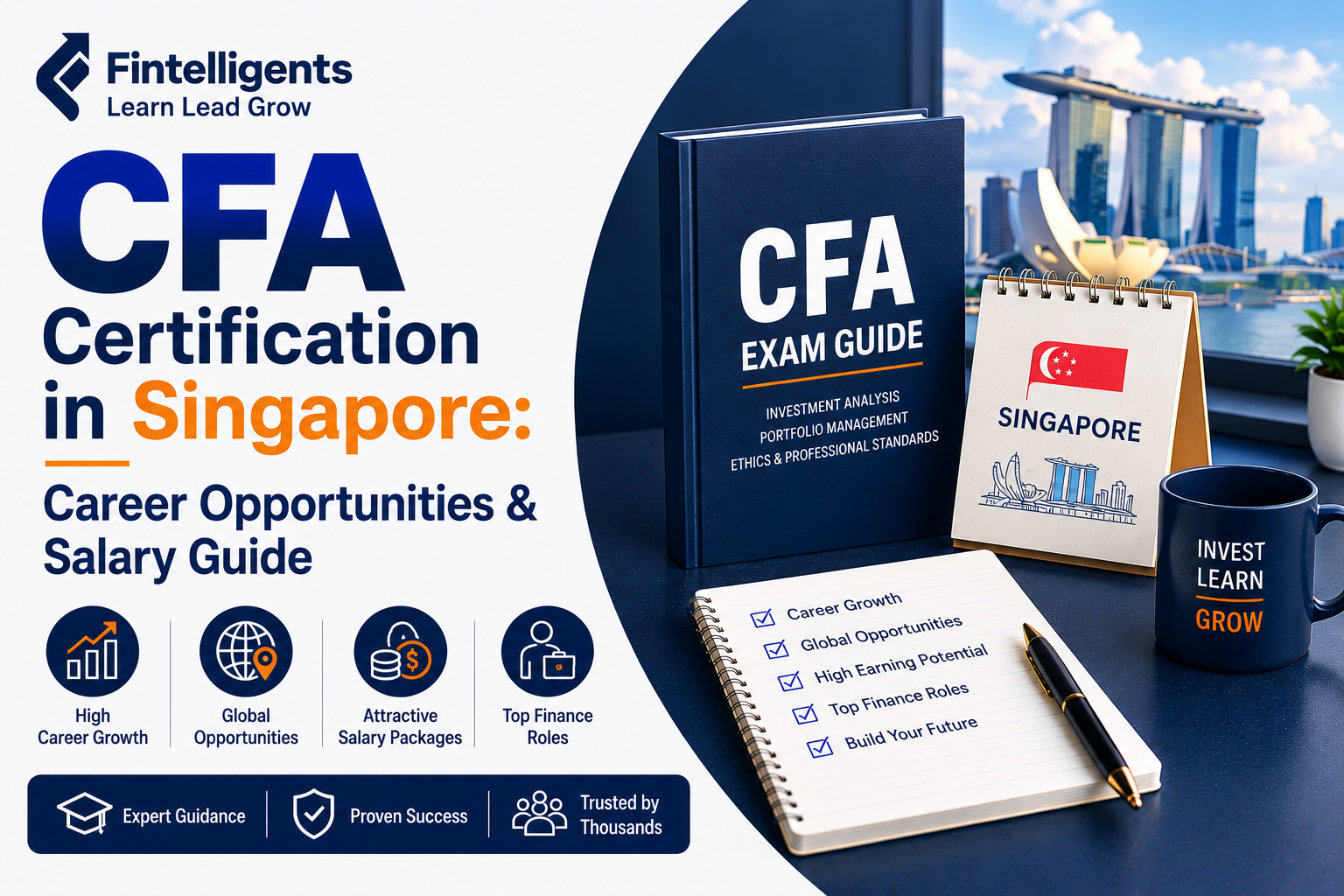
Singapore has spent the last two decades building itself into one of Asia’s two dominant wealth and asset management hubs, sitting alongside Hong Kong at the centre of the region’s private banking, fund management, and fintech industries. For finance professionals based here or looking to relocate here the Chartered Financial Analyst (CFA) charter remains one of the most recognised credentials for proving investment competence to employers.
But is it still worth the time, money, and roughly 900 hours of study it typically demands? This guide walks through exactly what the CFA certification involves, which industries in Singapore actually hire charterholders, how compensation stacks up by role and seniority, and how the credential compares to alternatives like the FRM and an MBA.
What Is the CFA Certification?
The Chartered Financial Analyst designation is administered globally by the CFA Institute and is widely regarded as the gold-standard credential for investment analysis, portfolio management, and research roles. It’s held by professionals across asset management, equity research, private wealth, and corporate finance in more than 160 countries.
Earning the charter requires passing three sequential exams Level I, Level II, and Level III each testing progressively deeper knowledge of topics such as ethics, quantitative methods, economics, financial statement analysis, corporate issuers, equity investments, fixed income, derivatives, alternative investments, and portfolio management. Candidates also need a combination of a bachelor’s degree (or equivalent) and 4,000 hours of qualified, relevant work experience completed over a minimum of three years before the charter is officially awarded.
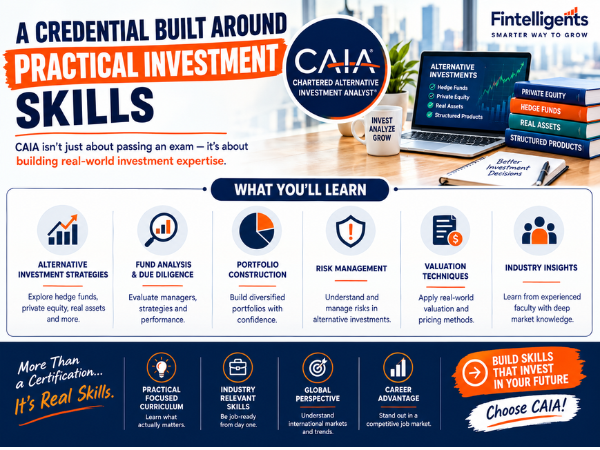
A Credential Built Around Practical Investment Skills
Unlike a general finance degree, the CFA curriculum is deliberately narrow and applied. It’s built to mirror the actual day-to-day decisions an analyst or portfolio manager makes valuing a company, assessing risk in a bond portfolio, or building an asset allocation strategy. That practical orientation is part of why employers in investment-heavy markets like Singapore continue to treat it as a meaningful signal during hiring.
Why the CFA Charter Matters in Singapore
Singapore’s Monetary Authority (MAS) has actively positioned the country as Asia’s leading centre for asset and wealth management, and the numbers reflect that ambition the city-state manages trillions of dollars in assets across banks, family offices, hedge funds, and sovereign wealth vehicles. That concentration of institutional capital creates sustained demand for professionals who can demonstrate rigorous investment analysis skills.
A Talent Pool That Employers Actively Filter For
Job postings for research analyst, portfolio management, and private banking roles in Singapore frequently list the CFA charter (or progress toward it) as a preferred or required qualification. For candidates competing against a large, well-educated finance talent pool, the charter functions as a differentiator it signals discipline, technical depth, and a long-term commitment to the investment profession that a degree alone doesn’t communicate.
Regional Hub Advantage
Because many global and regional financial institutions run their Asia-Pacific investment functions out of Singapore, charterholders based here often have exposure to regional and global mandates rather than purely domestic ones. This broadens the type of experience a Singapore-based CFA charterholder can build compared to smaller, more localised markets.
CFA Program Structure and 2026 Fees
Before committing to the CFA path, it helps to understand the real financial and time investment involved, since costs have shifted for the 2026 exam cycle.
Exam Levels and Format
- Level I: Multiple-choice questions covering the full curriculum breadth. Offered multiple times a year.
- Level II: Item-set (vignette-based) questions requiring applied analysis.
- Level III: A mix of constructed-response (essay) and item-set questions, plus a specialised pathway choice candidates can select tracks such as Portfolio Management, Private Markets, or Private Wealth depending on career direction.
Updated Fee Structure for 2026
The CFA Institute removed the one-time USD 350 enrollment fee starting with the February 2026 exam window, offsetting it with a moderate increase to per-level registration fees. As of 2026, candidates can expect to pay roughly:
- Level I & II: USD 1,140 (early registration) to USD 1,490 (standard registration)
- Level III: USD 1,240 (early registration) to USD 1,590 (standard registration)
Across all three levels, most candidates who register early and pass on the first attempt spend somewhere between USD 3,500 and USD 4,600 on registration fees alone. Add a financial calculator, third-party study materials, and potential retake costs, and the realistic all-in budget for many candidates lands between USD 5,000 and USD 9,000. Singapore-based candidates should also factor in local study material providers, prep courses, and any GST implications on locally purchased resources.
Time Commitment
CFA Institute research and prep providers consistently estimate around 300 hours of study per level, which most working professionals in Singapore spread across 6 to 9 months per attempt meaning the full three-level journey typically takes between 2.5 and 4 years for someone studying alongside a full-time job.
Career Opportunities for CFA Charterholders in Singapore
The CFA charter opens doors across a wide spread of finance functions in Singapore, not just traditional asset management. Below are the sectors where charterholders are most actively recruited.
Asset and Fund Management
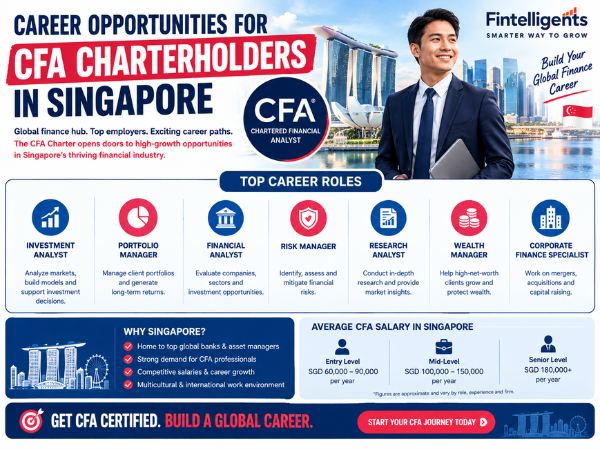
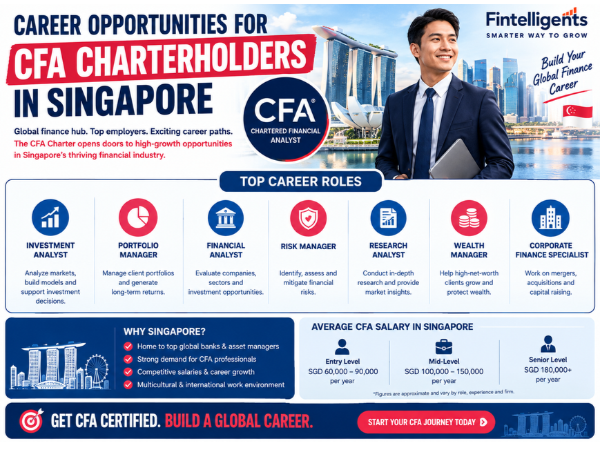
Singapore hosts a large concentration of global and boutique asset managers, along with a growing number of licensed family offices. CFA charterholders here typically work as research analysts, portfolio managers, or investment associates covering equities, fixed income, or multi-asset strategies.
Private Banking and Wealth Management
With Singapore positioned as a leading private banking hub for Asian and global high net-worth clients, charterholders are heavily represented in relationship management, investment advisory, and product structuring roles at private banks and wealth management divisions.
Equity and Credit Research
Sell-side and buy-side research teams at investment banks and brokerages rely on CFA-trained analysts to produce company valuations, sector coverage, and credit assessments used by institutional clients.
Corporate Finance and Treasury
Multinational corporations with regional headquarters in Singapore often hire CFA charterholders into corporate finance, treasury, and investor relations roles, where the credential’s grounding in valuation and capital markets is directly applicable.
Fintech and Digital Investment Platforms
Singapore’s fast-growing fintech sector including robo-advisory platforms, digital banks, and quantitative investment startups increasingly seeks CFA charterholders who can bridge investment knowledge with product and technology teams.
Risk Management and Consulting
Some charterholders move into enterprise risk, model validation, or financial consulting roles, particularly where their skill set overlaps with regulatory or valuation work though candidates focused specifically on risk careers often pair the CFA with the FRM (covered later in this guide).
CFA Salary Guide: Singapore, 2026
Compensation data for CFA charterholders in Singapore varies depending on the source, role, and seniority band, but several independent salary surveys converge on a similar overall range.
Entry-Level Compensation
Professionals in the first one to three years after starting the CFA journey often analysts or associates who have passed Level I or Level II typically earn in the range of SGD 60,000 to SGD 85,000 annually in base salary, with total compensation pushed higher by performance bonuses depending on the employer and division.
Mid-Career Compensation
Charterholders with roughly five to eight years of relevant experience, often working as senior analysts, associate portfolio managers, or investment advisors, commonly earn between SGD 90,000 and SGD 150,000 in total annual compensation. Independent compensation data platforms place the average CFA-credentialed salary in Singapore in a similar band, broadly around SGD 100,000 to SGD 120,000 for professionals with a moderate level of experience.
Senior-Level Compensation
At the senior end portfolio managers, heads of research, senior private bankers, and directors total compensation (including bonus) frequently exceeds SGD 200,000, with some specialised roles at global asset managers and family offices reported well above that figure. Salary benchmarking data for 2026 also shows that, once adjusted for cost of living and personal taxation, Singapore’s net purchasing power for senior finance professionals compares favourably even against higher-headline-salary markets like the United States.
Salary Progression by Exam Level
Passing individual CFA exam levels even before completing the full charter tends to correlate with compensation increases. Recent 2026 data suggests candidates who pass Level I see average compensation increases of around 30%, while those passing Level II see increases closer to 36%, reflecting how employers reward demonstrated progress through the program, not just the finished credential.
Factors That Influence CFA Salaries in Singapore
Not every CFA charterholder in Singapore earns the same amount, even at similar experience levels. Several factors consistently move the needle.
Industry and Function
Portfolio management and private equity roles generally command higher pay than back-office or compliance-adjacent finance roles, even when both employ CFA charterholders.
Employer Type
Global asset managers, bulge-bracket investment banks, and large private banks typically pay more than smaller boutique firms or domestic institutions, though boutique roles sometimes offer more attractive bonus structures or faster progression.
Years of Relevant Experience
As with most finance credentials, compensation growth accelerates significantly after the five-to-ten-year mark, when professionals move from execution-focused roles into strategic or client-facing leadership positions.
Additional Skills
Charterholders who combine the CFA with complementary skills ESG investment analysis, data science, or fintech product knowledge are increasingly commanding a premium as demand grows for professionals who can operate at the intersection of traditional finance and newer investment approaches.
CFA vs MBA vs FRM: Which Is Right for You?
Many candidates in Singapore weigh the CFA against other credentials before committing years of study. Here’s how the three compare.
CFA vs MBA
An MBA tends to open doors in consulting, general management, and leadership-track roles, and often carries more weight for candidates aiming for broad executive positions. The CFA, by contrast, tends to deliver stronger returns specifically within investment-focused roles equity research, portfolio management, and asset allocation where its technical depth is directly relevant. For candidates certain they want a long-term investment career, the CFA is generally the more cost-efficient path; for those aiming at general management or a career pivot, an MBA may serve better.
CFA vs FRM
The Financial Risk Manager (FRM) certification, also globally recognised, focuses specifically on risk measurement, market risk, credit risk, and operational risk making it the more relevant choice for candidates targeting risk management, model validation, or regulatory roles rather than investment analysis. Some professionals in Singapore’s banking sector pursue both credentials over time, using the CFA for investment breadth and the FRM for specialised risk expertise.
Making the Decision
The right choice ultimately depends on the specific function a candidate is targeting rather than which credential is “better” in the abstract. Candidates should map their intended career path first, then choose the credential or combination of credentials that most directly supports it.
How to Get Started With the CFA Program in Singapore
For readers ready to begin, here’s a practical starting sequence.
Step 1: Confirm Eligibility
Check that you meet the CFA Institute’s education and professional experience requirements before registering for Level I.
Step 2: Register Early
Early registration for each level offers meaningful savings compared to standard registration, so locking in exam dates as soon as the window opens is generally worth it.
Step 3: Build a Realistic Study Plan
Budgeting around 300 hours per level, spread over several months, tends to produce stronger outcomes than compressed, last-minute preparation particularly for working professionals balancing a full-time job.
Step 4: Choose Supplementary Study Materials
Many Singapore-based candidates supplement the official curriculum with third-party prep providers for structured practice questions and mock exams.
Step 5: Plan for the Full Journey, Not Just Level I
Since the full charter typically takes two-and-a-half to four years to complete alongside full-time work, candidates should think about how each level fits into their broader career timeline including how completed levels might already influence salary conversations before the full charter is earned.
Frequently Asked Questions
For professionals targeting investment management, equity research, portfolio management, or private banking roles, most data suggests the charter continues to correlate with stronger compensation and career progression. Its value is more limited for professionals aiming at general management, consulting, or non-investment finance functions.
Most candidates studying alongside full-time work complete all three levels in two-and-a-half to four years, assuming they pass each level on the first attempt.
Independent salary data places the average total compensation for CFA-credentialed professionals in Singapore broadly in the range of SGD 90,000 to SGD 150,000, with senior roles frequently exceeding SGD 200,000.
Yes. Data from recent salary studies shows candidates typically see compensation increases even after passing individual levels, since employers view exam progress as a meaningful signal of commitment and competence.
It depends on the target role. The CFA tends to deliver stronger returns for investment-specific careers, while an MBA often performs better for consulting, general management, and broader leadership tracks.
As of 2026, registration fees across all three levels typically total between USD 3,500 and USD 4,600, with total costs including materials and a calculator often reaching USD 5,000 to USD 9,000 depending on study resources chosen and number of attempts.
Asset and fund management, private banking and wealth management, equity and credit research, corporate finance, and increasingly fintech and digital investment platforms are the leading employers of CFA charterholders in Singapore.
Final Thoughts
Singapore’s position as a leading Asian financial hub means the CFA charter continues to carry real weight for professionals targeting investment-focused careers particularly in asset management, private banking, and research. Compensation data for 2026 shows a steady, if gradual, upward trajectory across experience levels, with the sharpest gains typically arriving after five to ten years in the industry.
That said, the charter isn’t a universal solution. Candidates should weigh their specific career direction investment analysis versus risk management versus general leadership before committing to the CFA, the FRM, an MBA, or some combination of credentials that fits their long-term goals.