
Blog
ESG and Climate Risk Careers: Top Roles, Employers, skills

Introduction: Why ESG and Climate Risk Careers Matter Now
ESG and climate risk careers are among the fastest-growing paths in finance. Banks, asset managers and corporates need people who can measure climate exposure and report it with confidence. Regulators now ask for this data. Investors now price it in. As a result, skilled professionals are hard to find.
This guide shows you where the jobs are. You will see the top roles, the main employers and the skills they want. You will also get a clear plan to enter the field.
Quick Answer: What Are ESG and Climate Risk Careers?
ESG and climate risk careers are jobs that measure, manage and report environmental, social and governance risks. Common roles include ESG analyst, climate risk analyst, sustainability reporting manager and sustainable finance associate. Employers include banks, asset managers, consultancies, rating agencies and regulators. Key skills are data analysis, risk modelling and disclosure standards. Certifications such as FRM, SCR and the CFA ESG Certificate help.
What Are ESG and Climate Risk Careers?
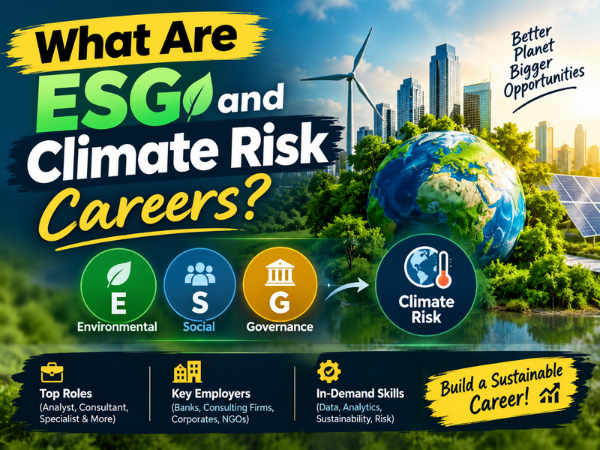
These careers sit where finance meets sustainability. They turn environmental and social issues into numbers that leaders can act on.
ESG Careers Explained
ESG stands for environmental, social and governance. ESG professionals assess how a company handles emissions, workers, supply chains and board oversight. They score firms, write reports and advise investors. In short, they show whether a business is built to last.
Climate Risk Careers Explained
Climate risk professionals study how weather and policy changes hit balance sheets. They look at two main risks. Physical risk covers floods, heat and storms. Transition risk covers new carbon rules, taxes and shifting demand. Banks and insurers then use these results in stress tests and credit decisions.
How the Two Fields Overlap
The two fields share data, tools and reporting standards. An ESG analyst may review a firm’s emissions. A climate risk analyst may then model what those emissions cost under a carbon price. Therefore, many professionals move between both tracks. That flexibility is a big advantage.
Why Demand for ESG and Climate Risk Jobs Is Growing
Three forces push hiring higher. Each one is likely to stay for years.
Regulation Drives Hiring
Governments and standard setters now require climate and sustainability disclosure. Frameworks such as the ISSB standards and the EU CSRD ask firms for audited data. Supervisors also expect banks to run climate stress tests. Consequently, compliance teams need new specialists.
Investors Want Reliable Data
Asset owners ask hard questions about climate exposure. They want proof, not slogans. Fund managers therefore hire analysts who can verify claims and spot greenwashing. This trend lifts demand for sustainable finance careers.
Companies Need Transition Plans
Firms must cut emissions and still grow. That task needs planners, modellers and reporting experts. Energy, utilities, manufacturing and retail all hire for it. Moreover, supply chain pressure pushes small firms to build these teams too.
Top ESG and Climate Risk Roles
The table below compares the most common roles. Use it to match your background to a target job.
| Role | What You Do | Common Background |
| ESG analyst | Scores companies, reviews data and writes research | Finance, economics, CFA |
| Climate risk analyst | Models physical and transition risk for portfolios | Risk, maths, FRM or SCR |
| Climate risk manager | Leads stress tests and reports to senior risk teams | Senior risk, FRM |
| Sustainability reporting manager | Builds disclosures under ISSB, CSRD and similar rules | Accounting, audit |
| Sustainable finance associate | Structures green bonds and sustainability-linked loans | Banking, capital markets |
| ESG data analyst | Cleans, tests and automates sustainability datasets | Data science, Python, SQL |
| Carbon markets analyst | Tracks credits, prices and offset quality | Commodities, environmental science |
| Stewardship and engagement officer | Talks to companies and votes on shareholder proposals | Asset management, governance |
Entry-Level Roles
Graduates often start as ESG analysts or data analysts. These jobs build core skills fast. You learn data sources, scoring methods and report writing. Most teams also welcome candidates from finance, engineering and policy backgrounds.
Mid-Level and Senior Roles
With three to five years of experience, you can lead workstreams. Typical titles are climate risk manager and sustainability reporting manager. Senior leaders then become heads of sustainable finance or chief sustainability officers. Pay and influence rise with each step.
Top Employers Hiring for ESG and Climate Risk Jobs
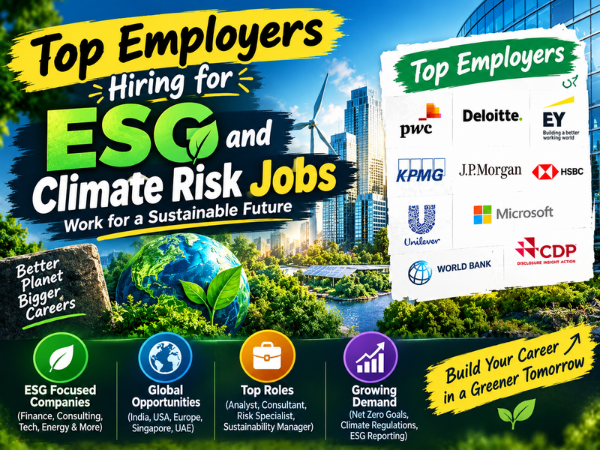
Hiring comes from several sectors. Knowing them helps you target your applications.
Banks and Insurers
Large banks run climate risk teams inside their risk and credit functions. Insurers model catastrophe and climate exposure. Both groups value the FRM and strong quantitative skills.
Asset Managers and Pension Funds
Investment firms hire ESG analysts, stewardship officers and portfolio specialists. Pension funds also build in-house teams. They focus on research, voting and fund reporting.
Rating Agencies and Data Providers
Firms such as MSCI, S&P Global, Moody’s and Morningstar Sustainalytics sell ESG and climate data. They hire analysts, data engineers and product specialists. These roles suit candidates who love research and data.
Consultancies and the Big Four
Consulting firms help clients prepare disclosures and transition plans. Deloitte, PwC, EY and KPMG all run sustainability practices. You get varied projects and fast learning. However, hours can be long.
Regulators and Development Banks
Central banks, financial supervisors and development banks also hire climate specialists. They write rules, run scenario exercises and fund green projects. Public sector roles offer stability and policy impact.
Corporates in High-Impact Sectors
Energy, utilities, manufacturing, real estate and retail build internal sustainability teams. They need reporting managers, carbon accountants and supply chain analysts. Many of these firms are now expanding their teams.
ESG and Climate Risk Skills in Demand
Employers look for a mix of technical, analytical and people skills. Build all three.
Technical Skills
- Disclosure standards: Learn ISSB, TCFD-based reporting, CSRD and the GHG Protocol.
- Climate scenario analysis: Understand physical and transition risk pathways.
- Carbon accounting: Know Scope 1, 2 and 3 emissions and how to measure them.
- Sustainable finance products: Study green bonds, sustainability-linked loans and transition finance.
Data and Analytical Skills
- Excel and SQL: Most teams still rely on both.
- Python or R: Automate data cleaning and build simple models.
- Visualisation: Tools such as Power BI help you tell the story.
- Risk modelling: Link climate data to credit, market and operational risk.
Soft Skills
Communication matters as much as modelling. You must explain complex data to executives in plain words. Likewise, you need curiosity, ethical judgement and strong project habits. Teams trust people who write clearly and meet deadlines.
Certifications and Education Paths
Credentials prove your knowledge. They also help you pass résumé filters.
| Credential | Best For | Focus |
| FRM (Financial Risk Manager) | Risk professionals | Core market, credit and operational risk, with climate topics growing |
| SCR (Sustainability and Climate Risk Certificate) | Risk and finance staff | Climate risk, scenarios and supervisory expectations |
| CFA Certificate in ESG Investing | Investment staff | ESG analysis and portfolio integration |
| CFA Charter | Analysts and portfolio managers | Broad investment analysis with ESG integration |
| IFRS Sustainability (FSA) Credential | Reporting and audit staff | ISSB standards and disclosure |
How to Choose the Right Credential
Start with your target job. If you want a risk role, pair the FRM with the SCR. If you want investment research, choose the CFA ESG Certificate. If you want reporting, pick the sustainability disclosure credential. Browse the FRM and CFA articles on Fintelligents to plan your study.
A 90-Day Roadmap to Start Your ESG and Climate Risk Career

A clear plan beats random effort. Follow these steps in order.
Days 1 to 30: Build the Foundation
- Read the basics of ESG, climate risk and the main disclosure standards.
- Pick one target role from the table above.
- Audit your skills and list the gaps.
- Start one certification track, such as the SCR or the CFA ESG Certificate.
Days 31 to 60: Build Proof
- Complete a small project. For example, analyse one company’s emissions and write a two-page note.
- Practise Excel, SQL and basic Python on public sustainability data.
- Publish your note on LinkedIn to show real work.
- Join finance and sustainability communities to learn from peers.
Days 61 to 90: Go to Market
- Rewrite your résumé with ESG and climate keywords.
- Apply to ten roles that match your target job.
- Reach out to professionals in your chosen employer type.
- Prepare for interviews with scenario and disclosure questions.
Common Mistakes to Avoid
Many beginners slow themselves down. Avoid these traps.
- Chasing every certificate: Pick one or two that match your goal.
- Ignoring data skills: Theory alone rarely wins a job.
- Using vague résumé language: Show numbers, tools and outcomes instead.
- Skipping networking: Many roles are filled through referrals.
- Following hype: Focus on regulation and real demand, not buzzwords.
Career Outlook and Pay for ESG and Climate Risk Professionals
The outlook is strong but varies by region and sector. Disclosure rules keep expanding, and banks keep building climate teams. Meanwhile, some markets debate how fast rules should move. Therefore, choose skills that stay useful in any policy climate. Risk modelling, data and reporting skills travel well.
Pay depends on location, employer type and seniority. Banks and consultancies often pay more than non-profits. Specialist roles with risk or quantitative skills tend to earn a premium. Check current job listings in your target city for accurate ranges.
Frequently Asked Questions About ESG and Climate Risk Careers
ESG and climate risk careers are finance and sustainability jobs that measure and manage environmental, social and governance risks. They include analyst, risk manager, reporting and sustainable finance roles in banks, funds, consultancies and companies.
ESG and climate risk careers are finance and sustainability jobs that measure and manage environmental, social and governance risks. They include analyst, risk manager, reporting and sustainable finance roles in banks, funds, consultancies and companies.
Senior climate risk managers, sustainable finance leads and chief sustainability officers usually earn the most. Roles that combine risk modelling, regulation and leadership tend to pay a premium. Pay varies by country and employer.
No. Many professionals come from engineering, environmental science, law, policy and data science. However, finance knowledge helps in banks and funds. A certification can close the gap.
Yes. The FRM builds core risk skills that climate teams use every day. Pair it with the GARP SCR Certificate to show climate-specific knowledge.
An ESG analyst scores companies across environmental, social and governance factors. A climate risk analyst models how climate events and policy changes affect financial outcomes. The first role is broader. The second role is more quantitative.
Start with disclosure standards, carbon accounting and Excel. Next, add SQL and Python. Finally, practise explaining results in simple language.
Yes, although hiring varies by region and policy. Disclosure rules, investor questions and bank supervision keep demand steady. Skills in risk, data and reporting stay useful in every market.
Most motivated candidates can prepare in about three to six months. The 90-day roadmap above gives you a fast start. Your timeline depends on your background and study pace.
Yes. Risk, audit, banking and research professionals switch often. Highlight transferable skills, add one ESG credential and complete a small project to prove your interest.
Conclusion: Take the Next Step in Your ESG and Climate Risk Career
ESG and climate risk careers offer growth, purpose and strong job security. The best roles reward people who combine finance knowledge, data skills and clear communication. Start with one target role. Then build skills, earn a credential and show real work.
You do not need to plan alone. Fintelligents helps finance learners move from confusion to a clear career path.