Blog
CFA ESG Certificate in India 2026: Fees, Eligibility, Exam and Career Opportunities

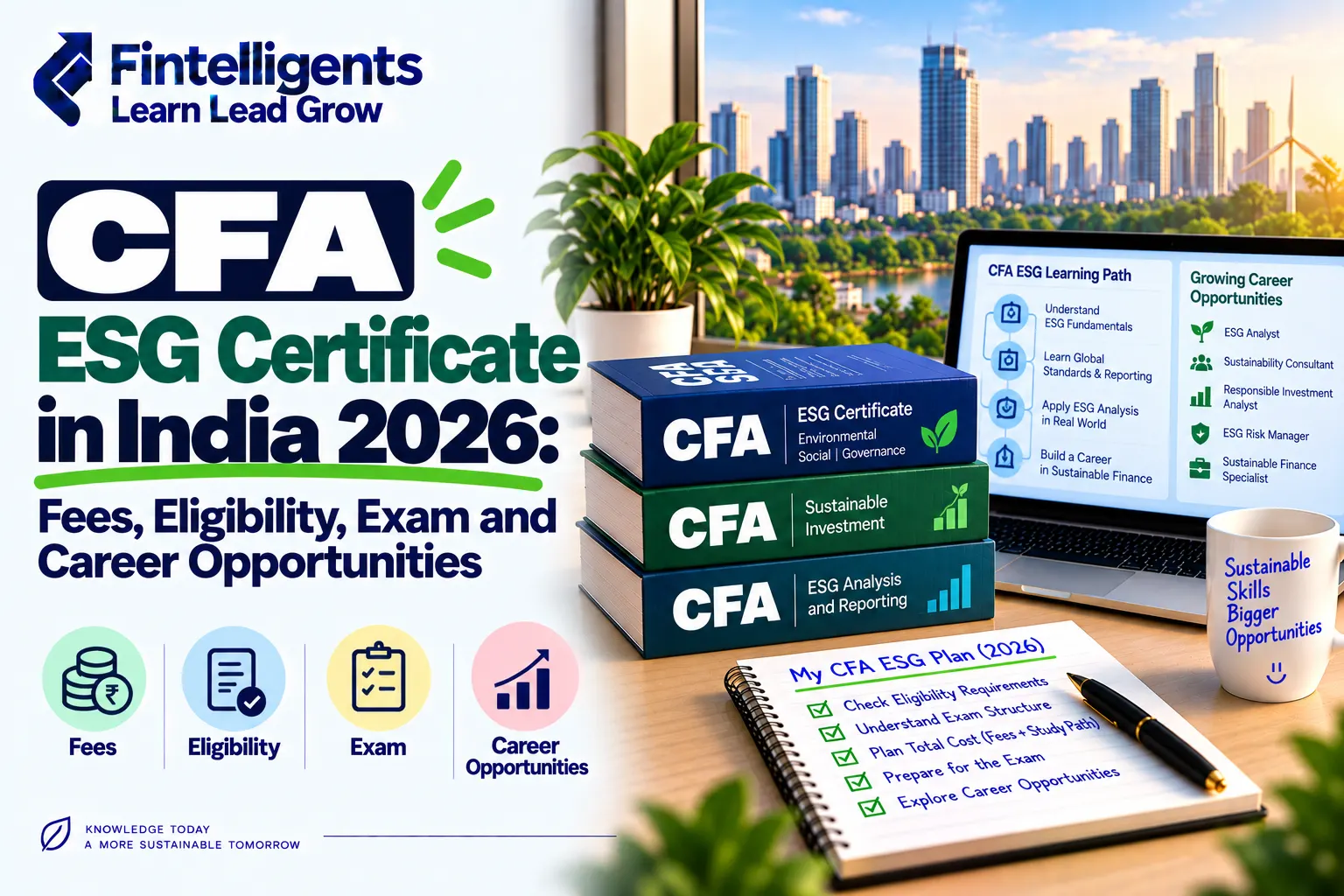
The CFA Institute’s sustainability credential has gone through a significant change in 2026. The Certificate in ESG Investing was officially rebranded as the CFA Sustainable Investing Certificate in April 2026. However, most professionals, employers, and candidates continue to refer to it as the CFA ESG certificate, and that name still carries full recognition across global financial services. If you are considering this credential in India in 2026 and want a clear picture of what it involves, how much it costs, and what it does for your career, this guide covers all of it.
What Is the CFA ESG Certificate?
The CFA Sustainable Investing Certificate, widely known as the CFA ESG certificate, is a standalone professional credential offered by the CFA Institute. It is separate from the main CFA program and does not require you to be pursuing or to have completed any CFA level to sit for it.
The credential is designed for investment and finance professionals who want to understand how environmental, social, and governance factors affect investment decisions, portfolio construction, and financial risk assessment. The curriculum is practical and investment-focused, covering ESG data and research, how ESG analysis integrates into different asset classes, corporate governance, climate risk within investment portfolios, and stewardship and engagement.
The CFA Institute is explicit about who the certificate is best suited for: individuals in finance who want to understand and be able to speak to ESG factors in their role, especially those actively managing an organisation’s investments and wishing to account for ESG factors in their decisions or analyses.
CFA ESG Certificate Fees in India 2026
The CFA ESG certificate has a straightforward, all-in fee structure unlike the main CFA program which has separate registration fees per level.
First-time registration costs USD 890, which translates to approximately Rs 75,650 at current exchange rates using a rate of Rs 85 per USD. If you do not pass and need a retake, the retake fee is USD 690, approximately Rs 58,650. The rescheduling fee for changing your exam appointment more than 72 hours before the exam is USD 30.
Your registration fee includes the official digital curriculum from the CFA Institute and one exam attempt. Third-party study material is optional and not required to sit the exam.
Indian candidates should note that your bank may charge a foreign transaction fee of 1.5 to 3.5 percent on the USD payment. Always check the current exchange rate at the time of registration since the INR equivalent will vary.
For comparison, the full three-level CFA program costs a minimum of USD 3,520 across all levels at early registration rates. The CFA ESG certificate at USD 890 is considerably more affordable and faster to complete for professionals who want targeted ESG expertise without committing to the full CFA journey.
CFA ESG Certificate Eligibility in India 2026
One of the most accessible aspects of the CFA ESG certificate is its eligibility criteria. There are no formal prerequisites. Anyone can register, including students who have just finished Class 12, recent graduates, working professionals, and career changers.
The CFA Institute recommends that candidates have some foundational understanding of the investment process before sitting, since the exam tests application of ESG concepts within investment contexts rather than basic financial literacy. However, this is a recommendation, not a requirement.
Indian candidates register directly through the CFA Institute website. There are no geographic restrictions on eligibility and Indian candidates are fully eligible on the same terms as candidates anywhere else globally.
CFA ESG Exam Format and Dates
The CFA ESG exam has a format that sets it apart from most professional certification exams. There are no fixed exam dates. Once you register, you receive a six-month window within which to schedule and sit the exam at a time of your choosing.
The exam can be taken either at a Pearson VUE test centre in person or online with remote proctoring from a location of your choice. This gives candidates full flexibility to prepare at their own pace and schedule the exam when they feel ready rather than waiting for a specific exam window.
The exam itself consists of 100 multiple choice questions completed within 2 hours and 20 minutes. Questions test whether candidates can apply ESG concepts to real investment analysis scenarios rather than just recall definitions. The current pass rate is approximately 81 percent, which reflects genuine difficulty while remaining achievable with proper preparation.
Most candidates report spending 100 to 130 hours preparing for the CFA ESG exam. At 10 to 15 hours per week, this translates to 6 to 12 weeks of preparation time, which is manageable alongside a full-time job.
What the CFA ESG Exam Covers
The CFA ESG curriculum is organised around how ESG analysis integrates into investment decision-making across different asset classes and investment approaches.
The core topic areas include Introduction to ESG, covering the rationale for ESG investing and how ESG factors affect investment risk and return. Environmental factors are covered in depth including climate change, carbon emissions, water, waste, and how physical and transition climate risks affect investment portfolios. Social factors cover labour standards, human rights, data privacy, and community impact. Governance covers board structures, executive compensation, shareholder rights, and corporate transparency. ESG integration covers how ESG data and research are incorporated into equity, fixed income, and alternative investment analysis. Engagement and stewardship covers how investors interact with companies on ESG issues to drive better outcomes.
The Integration and Valuation section carries the most weight on the exam and tests whether candidates can apply ESG factors to actual investment decisions rather than just describe what ESG frameworks say. This is the area candidates should prioritise in their preparation.
For candidates who are also considering the SCR certification alongside the CFA ESG and want to understand how the two credentials compare for India-focused career paths, SCR vs CFA ESG: Which Climate Risk Certification Gets You Hired Faster and Pays More in 2026? covers the comparison directly.
Career Opportunities After the CFA ESG Certificate in India
India’s ESG landscape has shifted significantly in 2026. SEBI’s Business Responsibility and Sustainability Reporting requirements for the top 1,000 listed companies, RBI’s climate risk guidance for banks, and growing institutional investor pressure on Indian companies around ESG disclosure have all created sustained demand for professionals with structured ESG expertise.
The career paths where the CFA ESG certificate is most valuable in India include ESG Analyst roles at asset managers, mutual funds, and institutional investors responsible for integrating ESG considerations into portfolio analysis and stock selection. Sustainability Research roles at brokerages and investment banks providing ESG research to clients are another growing category. ESG advisory roles at the Big Four and consulting firms helping corporates build ESG frameworks and reporting structures represent a third track. Responsible Investment Officer roles within pension funds, insurance companies, and sovereign wealth vehicles are emerging as companies build dedicated ESG oversight functions.
Beyond the Indian market, the CFA ESG certificate is particularly relevant for Indian professionals targeting Singapore and the UAE, both of which have active sustainable finance regulatory frameworks and growing demand for ESG-credentialed professionals. For a look at how the SCR and CFA ESG credentials compare in the UAE job market specifically, SCR vs CFA ESG in the UAE: Which Climate Finance Certification Gets You Hired Faster? covers both markets.
CFA ESG vs SCR: A Quick Guide
The two most common single-level sustainability credentials for Indian finance professionals in 2026 are the CFA ESG certificate and the GARP SCR. They are often considered together but serve different career profiles.
The CFA ESG certificate is investment-focused. It covers how ESG factors affect portfolio construction, investment analysis, and asset selection. It is best suited for portfolio managers, equity analysts, investment advisors, and wealth management professionals. The SCR is risk-focused. It covers how climate change creates financial risk and how institutions measure, manage, and disclose that risk. It is best suited for risk managers, credit analysts, and compliance professionals at banks and financial institutions.
If your work is in investment management, the CFA ESG is the more directly relevant credential. If your work is in financial risk management, credit, or compliance, the SCR is the stronger choice. Enrolling in SCR coaching online at Fintelligents gives you structured preparation for the SCR if that is the path that fits your role.
Enrolling in the best cfa online course in india at Fintelligents gives you structured preparation for the CFA ESG certificate with faculty support and mock practice tailored to what the exam actually tests.
For candidates also pursuing the main CFA program who want to understand how the CFA ESG certificate fits alongside the charter, CFA ESG vs CFA: Which Path Offers Better Career Growth in 2026? covers the relationship between both credentials.
Conclusion
The CFA ESG certificate in India in 2026 is one of the most cost-effective sustainability credentials available. At USD 890 for first-time registration, approximately Rs 75,650, it is significantly more affordable than multi-level professional programs while carrying the global recognition of the CFA Institute brand. There are no formal eligibility prerequisites. The exam is 100 multiple choice questions over 2 hours and 20 minutes with an 81 percent pass rate. No fixed exam dates — you schedule within a six-month window from registration. Career opportunities are strongest in asset management, equity research, ESG advisory, and sustainable finance functions both in India and internationally.
Frequently Asked Questions (FAQs)
Q. What is the CFA ESG certificate called in 2026?
The CFA Institute officially rebranded the Certificate in ESG Investing as the CFA Sustainable Investing Certificate in April 2026. The credential is widely still referred to as the CFA ESG certificate by candidates and employers, and carries the same global recognition under either name.
Q. What is the CFA ESG certificate fee in India in 2026?
First-time registration costs USD 890, approximately Rs 75,650 at current exchange rates. A retake costs USD 690, approximately Rs 58,650. A rescheduling fee of USD 30 applies if you change your appointment more than 72 hours before the exam. Indian candidates may also pay a bank foreign transaction fee of 1.5 to 3.5 percent on the USD payment.
Q. What is the eligibility for the CFA ESG certificate in India?
There are no formal prerequisites. Any candidate regardless of educational background, work experience, or location can register. The CFA Institute recommends foundational knowledge of the investment process but does not make this a requirement.
Q. What is the pass rate for the CFA ESG exam?
The current CFA ESG exam pass rate is approximately 81 percent. This reflects a challenging but achievable exam for candidates who prepare properly. Most candidates spend 100 to 130 hours preparing and complete their preparation within 6 to 12 weeks.
Q. Is the CFA ESG certificate better than the GARP SCR?
They serve different career profiles. The CFA ESG certificate is best for investment management, equity research, and portfolio management professionals who want to integrate ESG factors into investment decisions. The SCR is best for risk managers, credit analysts, and compliance professionals who need to manage climate risk within financial risk frameworks. The right choice depends on your specific role and career direction.