Blog
SCR vs CFA ESG: Which Climate Risk Certification Gets You Hired Faster and Pays More in 2026?

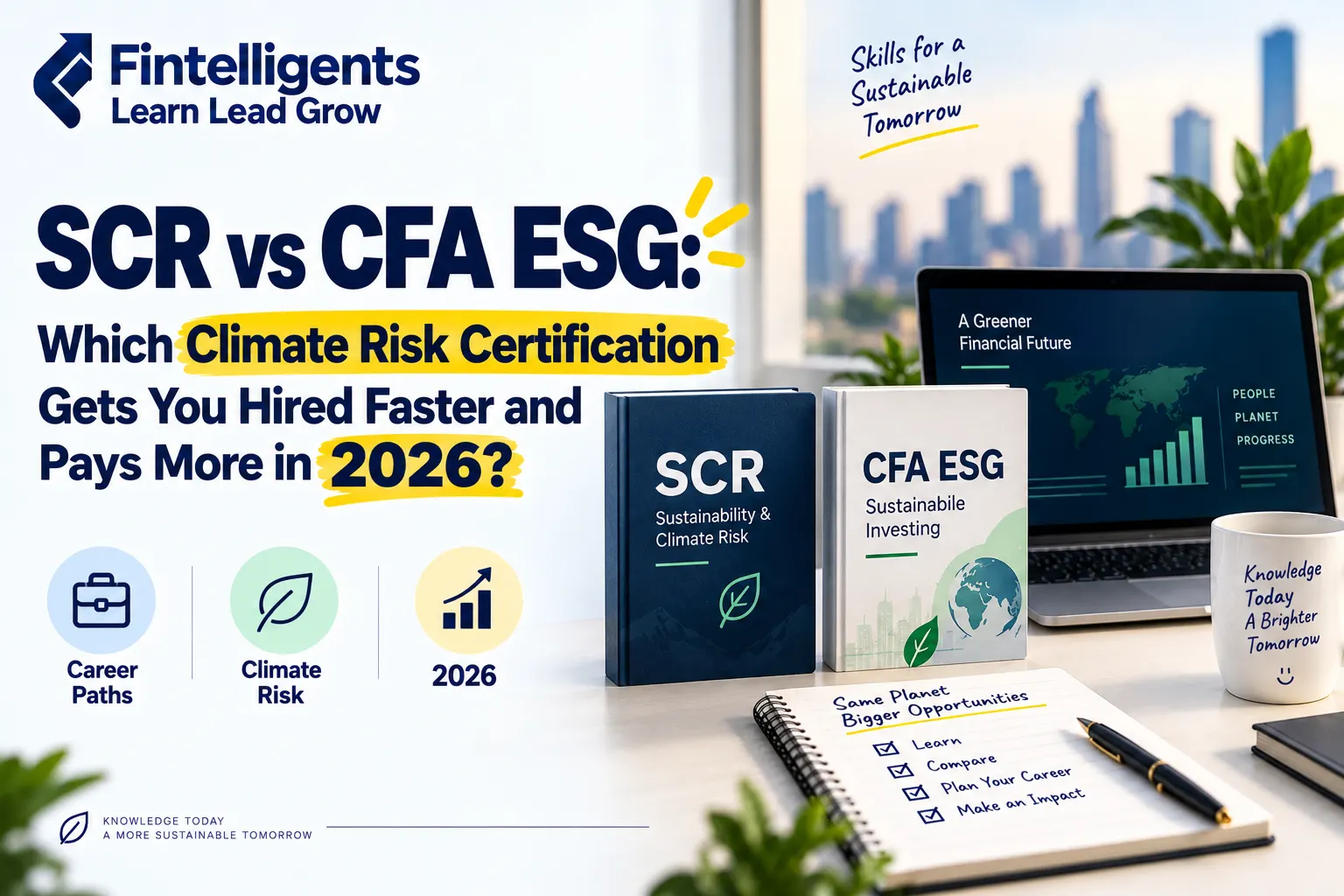
If you work in finance and are thinking about adding a sustainability or climate risk credential, two names keep coming up: the GARP SCR and the CFA ESG certificate. Both are globally recognised, both are single-level exams, and both open doors in the fast-growing ESG and climate finance space. But they are not the same credential, they do not target the same roles, and the one that gets you hired faster depends entirely on where you currently work and where you want to go. This blog gives you an honest comparison.
What Each Certification Actually Is
The SCR, or Sustainability and Climate Risk certificate, is awarded by GARP. It is built specifically for finance and risk professionals who want to understand how climate change creates financial risk, how institutions measure and manage that risk, and how to integrate climate considerations into existing risk frameworks. The content leans heavily toward risk, regulation, and scenario analysis. The curriculum covers climate science, physical and transition risk, climate risk management tools, ESG frameworks, and green finance instruments.
Book a Free Counselling Session at Fintelligents to Decide Which Is Right for You
The CFA ESG certificate was renamed the CFA Sustainable Investing Certificate in April 2026 but continues to be widely referred to as the CFA ESG certificate. It is awarded by the CFA Institute and is built for investment professionals who want to integrate ESG factors into investment analysis, portfolio construction, and client advisory work. The content leans toward investment decision-making, ESG data and research, stewardship, and engagement rather than risk management specifically.
Both certifications require approximately 100 hours of preparation and are considered manageable single-sitting exams relative to multi-level programs like the CFA or FRM.
Who Each Certification Is Actually For
This is where the decision becomes clearer. The CFA Institute is explicit that its certificate is best for individuals who are in finance and want to understand and be able to speak to ESG factors in their role, especially those actively managing an organisation’s investments and wishing to account for ESG factors in their decisions or analyses. The SCR certificate is best for individuals who specialise in risk management and are seeking to include in-depth analyses of climate and sustainability risks in their reporting.
In practice, this means portfolio managers, equity analysts, wealth managers, and investment advisors are better served by the CFA ESG certificate. Credit risk professionals, market risk managers, enterprise risk officers, compliance professionals, and sustainability report writers at banks and financial institutions are better served by the SCR.
The overlap between the two credentials is smaller than their subject areas suggest. If your day-to-day work involves investment decisions and client portfolios, choose CFA ESG. If your work involves risk frameworks, regulatory compliance, and financial risk assessment, choose SCR.
For a detailed side-by-side breakdown of both certifications including exam format, CFA ESG vs. GARP SCR: Which Is Best for You? covers the comparison in depth.
Which Gets You Hired Faster in 2026?
The honest answer here depends on what kind of roles you are targeting. In terms of sheer volume of job postings, ESG-related job postings grew by over 40 percent between 2021 and 2023 and the trend has continued into 2026. However, the nature of those roles has shifted. As the ESG sector has moved from voluntary to regulatory, the demand for professionals who can do technical climate risk work, not just talk about sustainability, has grown faster than the demand for general ESG communicators.
This shift works in the SCR’s favour for certain hiring cycles. Financial institutions being pushed by RBI, MAS, and other regulators to conduct climate risk stress testing and scenario analysis need people who can actually do it. The SCR validates exactly these skills. The CFA ESG certificate is more broadly recognised and has a larger community behind it due to the CFA Institute’s global network, which gives it an advantage in terms of visibility with employers who are looking for investment-side ESG expertise.
For Indian professionals specifically, the RBI and SEBI regulatory push has created internal hiring demand at banks and NBFCs for climate risk roles. For those roles, the SCR is the more directly relevant credential. For roles in asset management, wealth management, or equity research where ESG integration into investment decisions is the focus, the CFA ESG positions you better.
Enrolling in SCR coaching online at Fintelligents gives you structured preparation for the SCR. For candidates pursuing the CFA ESG path, the best cfa online course in india program at Fintelligents covers the CFA ESG curriculum with faculty support and mock practice.
Which Pays More?
Certified ESG professionals broadly see 20 to 30 percent pay premiums over non-certified peers according to multiple sources tracking ESG hiring trends in 2025 and 2026. The CFA ESG certificate shows a consistent 10 to 15 percent salary premium for roles requiring specialised sustainability knowledge in 2026 hiring data. The SCR positions holders to command the upper end of a salary band because they require significantly less training to handle complex regulatory shifts than a standard hire.
In terms of absolute compensation, junior ESG roles start at USD 60,000 to 80,000 globally and senior roles exceed USD 150,000 at the higher end, particularly in asset management and corporate sustainability leadership. In India, mid-career professionals in climate risk and ESG management earn between Rs 15 and Rs 25 lakhs and senior roles at major financial institutions move well above this.
The salary premium from either credential is not instant. The real salary impact typically appears during negotiation cycles, performance reviews, or internal promotion decisions rather than immediately upon passing the exam. What both certifications do in the near term is make you more competitive for shortlisting, help you bypass automated screening filters in HR systems, and position you at the upper end of an offer range rather than the lower end.
For a broader view of how SCR certification positions professionals for high-paying climate risk roles across markets, SCR Jobs in India: Career Opportunities and Growth in the Financial Sector covers the full picture.
For context on how the SCR fits alongside other risk credentials in terms of career decisions, FRM, CFA, or SCR? Choosing the Right Certification for Risk Management Careers gives you a useful additional framework.
Can You Do Both?
Yes, and for certain career profiles pursuing both makes genuine sense. A risk manager at a bank who wants to move into a hybrid risk and investment role, or an investment professional who wants to add quantitative climate risk skills to their ESG knowledge, would benefit from holding both credentials. Both are single-level exams with manageable preparation windows. Pursuing them in sequence, with one in each exam cycle, is achievable alongside full-time work.
Conclusion
SCR and CFA ESG are both strong credentials in the climate finance space but they serve different career profiles. The SCR gets you hired faster in risk, credit, and regulatory functions at financial institutions. The CFA ESG gets you hired faster in investment, portfolio management, and client advisory roles. Both deliver salary premiums in the 15 to 30 percent range. The right choice is the one that aligns with what your actual work involves today and where you want to be in three years.
Frequently Asked Questions (FAQs)
Q. What is the main difference between SCR and CFA ESG?
The SCR is a risk-focused credential from GARP covering climate risk measurement, scenario analysis, and sustainability risk frameworks. The CFA ESG certificate is an investment-focused credential from the CFA Institute covering ESG integration into investment analysis, portfolio construction, and stewardship. They target different career profiles and the right choice depends on whether your work is in risk management or investment management.
Q. Which certification is better for getting a job at an Indian bank?
For roles within Indian banks in risk, credit, and compliance functions, the SCR is the more directly relevant credential. RBI climate risk guidelines have created specific internal demand for professionals who can conduct scenario analysis and integrate climate risk into financial risk frameworks, which is exactly what the SCR covers.
Q. How long does it take to prepare for SCR vs CFA ESG?
Both the CFA Institute and GARP recommend at least 100 hours of preparation for their respective sustainability certificates. Most candidates spread this across 3 to 4 months while working full time.
Both deliver salary premiums in the 15 to 30 percent range over non-certified peers according to 2025 and 2026 hiring data. The CFA ESG carries a broader employer recognition advantage due to the CFA Institute’s global network while the SCR commands a stronger premium specifically in risk and regulatory functions.
Q. Can I pursue both the SCR and CFA ESG?
Yes. Both are single-level exams with manageable preparation windows and pursuing them in sequence is achievable alongside full-time work. Holding both makes the most sense for professionals in hybrid risk and investment roles or those building a comprehensive sustainability finance profile.