Blog
SCR Study Plan: A Week-by-Week Timeline for Working Professionals

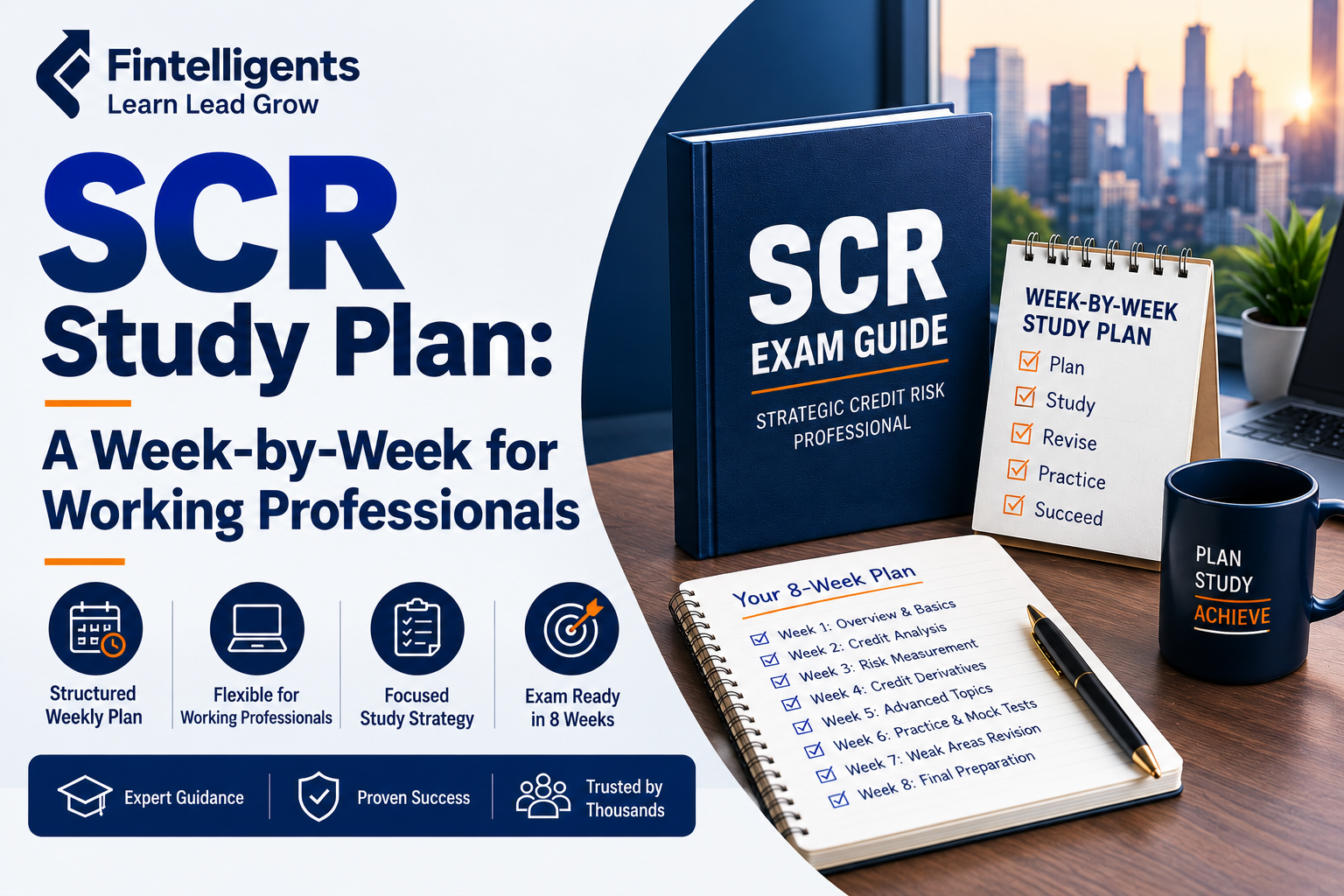
Preparing for the GARP Sustainability and Climate Risk (SCR) Certificate exam while holding down a full-time job is one of the biggest challenges candidates face. Unlike students who can dedicate entire days to study, working professionals have to fit exam preparation around meetings, deadlines, and family time. The good news is that with a realistic SCR study plan, you can cover the entire syllabus, retain what you learn, and walk into the exam hall with confidence without burning out along the way.
This article lays out a practical, week-by-week SCR study plan designed specifically for working professionals. Whether you have 10 weeks or 12 weeks before your exam date, this timeline will help you pace your preparation, avoid last-minute cramming, and build genuine understanding of climate risk concepts rather than surface-level memorization.
Why a Structured SCR Study Plan Matters
The SCR curriculum is broad. It covers everything from the physical science of climate change to sustainable finance instruments, climate risk measurement, scenario analysis, regulatory frameworks, nature-related risks, and transition planning. Without a plan, most working professionals either front-load easy topics and rush through the harder, calculation-heavy sections, or they study inconsistently and forget material before exam day.
A structured SCR study plan solves three problems at once:
- It breaks an overwhelming syllabus into manageable weekly targets.
- It builds in revision time so concepts move from short-term to long-term memory.
- It protects your evenings and weekends by telling you exactly what to study, so you don’t waste time deciding where to start.
Who This SCR Study Plan Is For
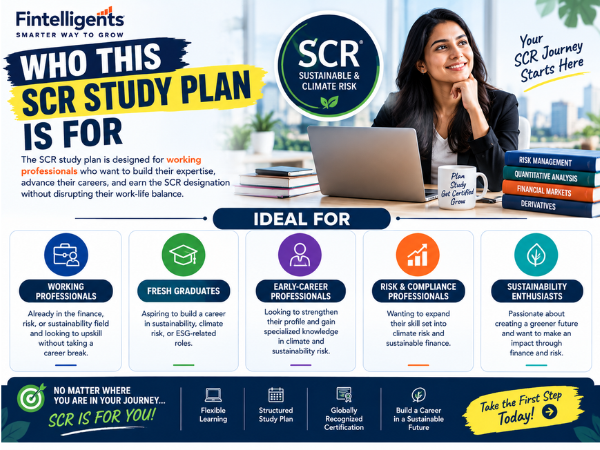
This timeline is built for candidates who can realistically commit 8 to 10 hours per week to SCR preparation a pace that suits people working full-time in risk, banking, sustainability, or finance roles. If you have more or less time available, the same structure can be compressed into 8 weeks or extended to 14 weeks; the sequence of topics stays the same.
Understanding the SCR Exam Format
Before building a study plan, it helps to understand what you’re preparing for. The SCR exam consists of 80 multiple-choice questions, including case-study-based questions, and candidates are given four hours to complete it. The exam is delivered as a computer-based test, available either at a Pearson VUE test center or remotely through online proctoring.
The official SCR curriculum is organized around roughly ten core content areas, spanning:
- Foundations of climate change and climate science
- Sustainability, ESG principles, and disclosure frameworks
- Physical and transition climate risks
- Green and sustainable finance instruments
- Climate risk measurement and scenario analysis
- Governance and regulatory developments
- Nature-related risk
- Transition planning and net-zero strategy
Most candidates are advised to put in somewhere between 100 and 150 hours of total preparation time. That range is exactly why a week-by-week SCR study plan matters spread across 10 to 12 weeks, that becomes a manageable 8 to 12 hours a week rather than an impossible cram session.
How Many Hours Do You Need to Study for the SCR Exam?
There’s no single right answer, since it depends on your existing background. A candidate already working in ESG or climate risk may need closer to 100 hours, while someone new to sustainability topics may need 130 to 150 hours.
For a working professional, the practical approach is to reverse-engineer your weekly commitment from your exam date:
- 10-week plan: roughly 10-12 hours per week
- 12-week plan: roughly 8-10 hours per week
- 8-week plan (fast-track): roughly 15 hours per week
This article uses the 10-week structure as the default template, since it offers the best balance between pace and sustainability for most working professionals.
Before You Start: Setting Up Your SCR Study Plan
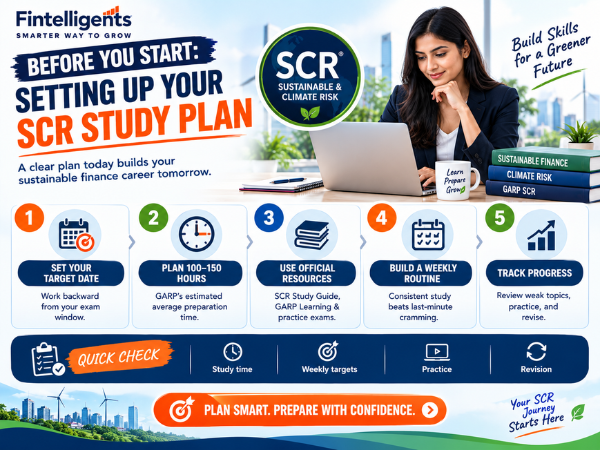
A few small setup steps make a big difference once your weekly plan is underway.
Gather the Right Study Material
Rely on the official SCR curriculum readings as your foundation, and supplement with structured notes, practice question banks, and mock exams. Trying to prepare from scattered online articles alone tends to leave gaps, especially in the more technical scenario-analysis and risk-measurement sections.
Block Fixed Study Slots on Your Calendar
Treat your study sessions like unmissable meetings. Working professionals who succeed with the SCR exam almost always block recurring calendar slots for example, early mornings before work or a fixed two-hour window on weekend mornings rather than trying to “find time” each day.
Take a Diagnostic Look at the Syllabus
Skim the full topic list once before Week 1 begins. You don’t need to study anything yet; you just need a mental map of where the ten topic areas are headed, so each week’s material has context.
Week-by-Week SCR Study Plan Timeline
Here is a complete 10-week SCR study plan, broken down topic by topic.
Week 1: Foundations of Climate Change
Start with the physical science of climate change greenhouse gas mechanisms, global warming trends, the role of bodies like the IPCC in synthesizing climate science, and the difference between mitigation and adaptation. This foundational week matters because almost every later topic, from transition risk to scenario analysis, builds on these basic climate science concepts.
Weekly focus: Read foundational chapters, watch supporting video content if available, and summarize key definitions in your own words.
Week 2: Sustainability and ESG Frameworks
Move into sustainability principles, ESG (Environmental, Social, and Governance) integration, and the major disclosure frameworks such as TCFD, ISSB IFRS S1/S2, and related reporting standards. This is one of the most heavily tested areas of the SCR exam, so give it extra attention.
Weekly focus: Build a comparison table of the different disclosure frameworks what each one requires, who uses it, and how they differ.
Week 3: Physical Climate Risk
Study how physical climate risks acute events like floods and hurricanes, and chronic changes like rising sea levels or shifting rainfall patterns translate into financial risk for banks, insurers, and corporates.
Weekly focus: Practice identifying whether a given scenario is an acute or chronic physical risk, since the exam frequently tests this distinction through applied examples.
Week 4: Transition Climate Risk
Cover transition risk: how policy changes, technology shifts, and evolving market preferences create financial exposure as economies move toward lower-carbon models. Pay attention to how transition risk differs by sector and geography.
Weekly focus: Create short case notes linking transition risk drivers (policy, legal, technology, market) to real-world examples from carbon-intensive industries.
Week 5: Green and Sustainable Finance
This week focuses on green bonds, sustainability-linked loans, transition finance instruments, and the broader sustainable finance ecosystem. Understand how these instruments are structured and what makes them different from conventional finance products.
Weekly focus: Memorize the defining features of each finance instrument type, and practice distinguishing green bonds from sustainability-linked bonds a common point of confusion.
Week 6: Climate Risk Measurement and Scenario Analysis
This is typically the most technical and calculation-heavy section of the SCR curriculum, covering climate scenario analysis, climate value-at-risk concepts, and stress-testing approaches used by financial institutions. Many candidates find this the hardest topic, so this week’s plan allows extra buffer time.
Weekly focus: Slow down here. Work through practice questions daily rather than only reading theory, since scenario-analysis questions on the exam are usually applied rather than definitional.
Week 7: Governance and Regulatory Developments
Study how regulators and supervisory bodies including central banks and international bodies like the NGFS are integrating climate risk into prudential regulation and financial oversight. Understand the direction of regulatory travel across major jurisdictions.
Weekly focus: Build a simple timeline of key regulatory milestones to anchor your understanding of how climate governance has evolved.
Week 8: Nature-Related Risk and Transition Planning
Cover nature-related financial risk including biodiversity loss and ecosystem dependencies alongside corporate transition planning and net-zero strategy frameworks. These are newer additions to the SCR curriculum and are often under-prepared by candidates, making them a good source of easy marks if studied properly.
Weekly focus: Compare corporate transition plans against net-zero commitments to understand what separates a credible plan from a symbolic one.
Week 9: Full Syllabus Review and Weak-Area Targeting
By Week 9, you’ve covered all ten core topic areas. Use this week to take a full-length practice exam under timed conditions, then analyze your results by topic to identify weak areas.
Weekly focus: Spend roughly 60% of this week’s hours revisiting your two or three weakest topics, and 40% on general mixed-topic practice questions.
Week 10: Final Revision and Mock Exams
The last week before your exam should be almost entirely revision and practice, not new content. Take at least one more full-length mock exam, review the explanations for every question you got wrong, and revisit your personal summary notes from each of the previous nine weeks.
Weekly focus: Light, focused review sessions rather than long marathon days. Prioritize sleep and rest in the final 48 hours before the exam.
Weekday vs Weekend Study Strategy for Working Professionals
Since most working professionals can’t dedicate large weekday blocks to studying, splitting your effort differently across weekdays and weekends tends to work best.
Weekdays: Short, Focused Sessions
On weekdays, aim for 45 to 60 minutes of focused study early morning before work, during a lunch break, or right after dinner. Use this time for reading new material or reviewing flashcard-style summaries. Avoid trying to tackle scenario-analysis practice questions when you’re mentally drained after a long workday.
Weekends: Deep-Work Blocks
Reserve weekends for longer, 2-to-3-hour deep-work sessions. This is the best time to work through practice question sets, review case studies, and consolidate the week’s learning into summary notes. Weekends are also the ideal time to take timed mock exams, since you need an uninterrupted four-hour block to simulate real exam conditions.
Revision Strategy in the Final Two Weeks
The final two weeks of any SCR study plan should shift from learning new material to reinforcing what you already know.
Prioritize Practice Questions Over Re-Reading
Passive re-reading of chapters is one of the least effective revision methods. Instead, spend most of your remaining time answering practice questions and reviewing the reasoning behind both correct and incorrect answers.
Take at Least Two Full-Length Mock Exams
Simulating the real four-hour, 80-question format at least twice before exam day helps you build stamina and refine your time-management approach roughly three minutes per question, with slightly more time reserved for case-study questions.
Revisit Your Weak-Topic Notes Daily
Keep a running list of concepts you repeatedly get wrong throughout your preparation. In the final two weeks, review this list every single day, even if only for 15 minutes.
Common Mistakes Working Professionals Make While Preparing for SCR
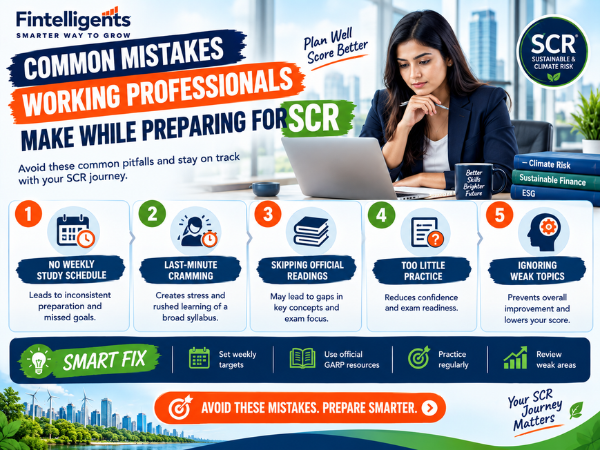
Starting Too Late
Many candidates underestimate the breadth of the SCR curriculum and start seriously studying only four or five weeks before the exam. This forces cramming through technical topics like scenario analysis, which genuinely require time to absorb.
Ignoring Practice Questions Until the End
Practice questions shouldn’t be saved only for the final revision phase. Working them in from Week 3 or 4 onward helps you understand how concepts are actually tested, not just how they’re defined.
Studying Only on Weekends
Relying solely on weekend study sessions creates long gaps between exposure to material, which hurts retention. Even short weekday sessions help keep concepts fresh.
Skipping the Newer Topics
Nature-related risk and transition planning are relatively newer additions to the curriculum, and some candidates assume they’re less important. In practice, skipping them means leaving easy, gettable marks on the table.
Tips to Stay Consistent With Your SCR Study Plan
- Track your weekly hours against your plan so you can catch slippage early rather than discovering a gap in Week 8.
- Study with a peer or join a study group of other SCR candidates for accountability.
- Break each week’s topic into smaller daily sub-goals rather than one vague weekly target.
- Build in one buffer day every two weeks to absorb unexpected work deadlines without derailing your whole plan.
- Reward yourself at the end of each completed week to reinforce the habit.
Final Thoughts on Your SCR Study Plan
Passing the SCR exam as a working professional isn’t about finding extra hours in the day it’s about using the hours you do have with intention. A structured, week-by-week SCR study plan turns an intimidating ten-topic curriculum into a series of achievable weekly goals, while still leaving room for proper revision and mock exams before the big day. Start early, stay consistent, and treat your weekly study blocks as non-negotiable, and the SCR Certificate is well within reach alongside a full-time career.
Frequently Asked Questions
Most candidates need between 100 and 150 hours of total preparation, which typically translates to a 10-to-12-week study plan for working professionals studying part-time.
Yes. A 10-week plan spreading roughly 10-12 hours of study per week across weekdays and weekends is realistic for most full-time professionals, provided study sessions are scheduled consistently rather than left to chance.
Climate risk measurement and scenario analysis is generally considered the most technical and time-consuming topic, since it involves applied, calculation-based questions rather than pure definitions.
There’s no fixed number, but working through practice questions across every topic area, plus at least two full-length timed mock exams, is a strong benchmark before exam day.
It’s possible but harder, since long gaps between study sessions hurt retention. Combining short weekday sessions with deeper weekend study blocks tends to produce better results than weekends alone.
Focus almost entirely on revision: review weak-topic notes, take a final mock exam, go over your mistakes, and prioritize rest in the last 48 hours rather than cramming new material.
No. While a finance or risk background is helpful, this study plan structure works for candidates from sustainability, ESG, or general finance backgrounds, since each topic is introduced from its foundations before moving into applied risk concepts.