Blog
SCR vs CFA ESG in the UAE: Which Climate Finance Certification Gets You Hired Faster?

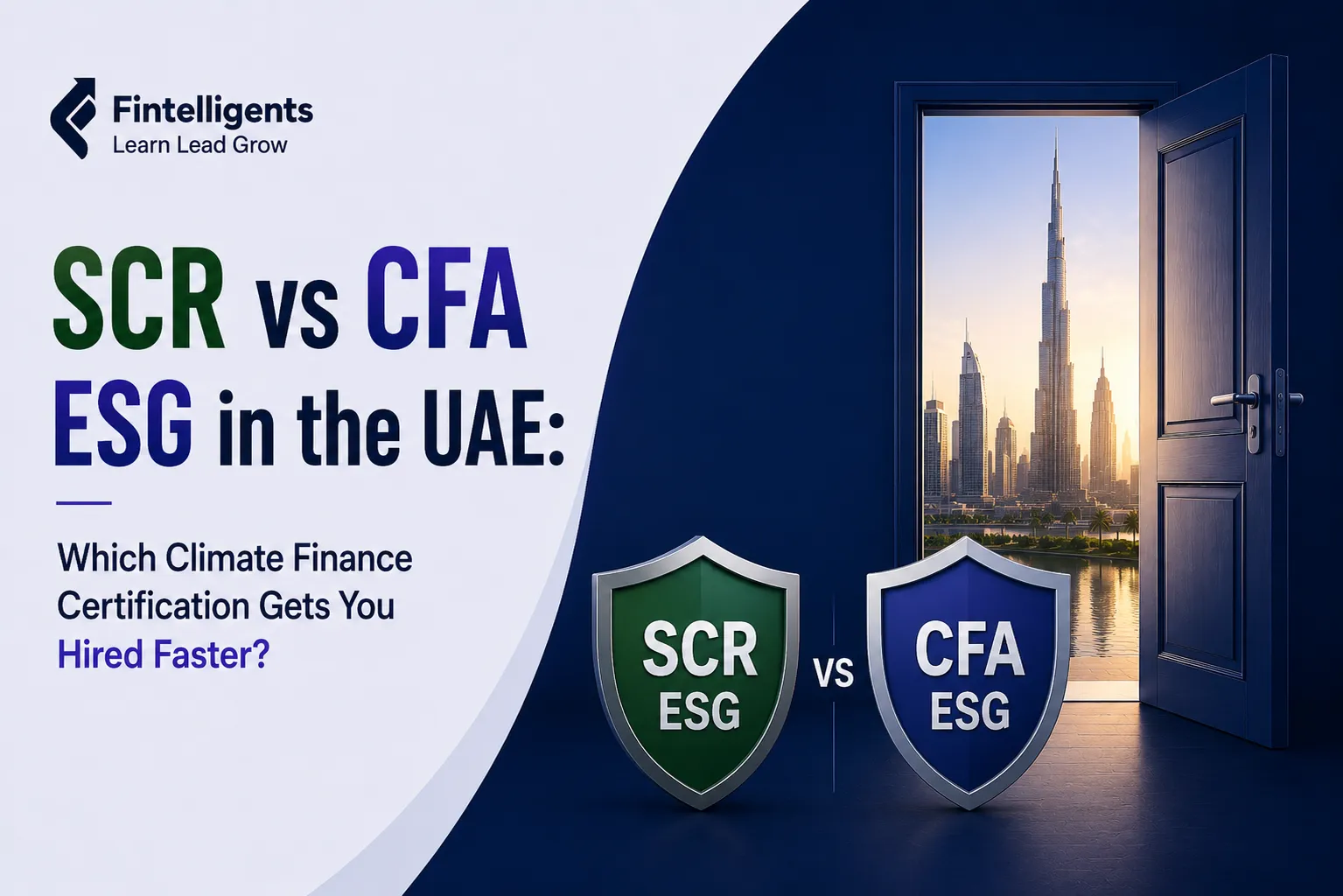
The UAE has positioned itself as one of the fastest growing hubs for climate finance talent, and that shift did not happen by accident. Since hosting COP28 in Dubai, the Central Bank of the UAE has pushed banks to mobilise AED 1 trillion in sustainable finance by 2030 and has issued formal principles requiring financial institutions to manage climate related risk as part of core governance. For professionals trying to break into this market, the SCR vs CFA ESG UAE question comes up constantly, and the honest answer is that it depends on which side of the industry you are trying to enter.
What the SCR Certification Actually Covers
The GARP Sustainability and Climate Risk certificate is built around how climate risk shows up on a bank or financial institution’s balance sheet. It covers physical and transition risk assessment, climate scenario analysis, stress testing, and how green finance instruments like sustainability linked loans fit into a lender’s book. It is a single level exam of 100 multiple choice questions, and most candidates prepare over three to four months.
What the CFA ESG (Sustainable Investing) Certificate Actually Covers
The CFA Institute’s Sustainable Investing Certificate, still widely referred to as CFA ESG, is built for the investment side rather than the lending side. It focuses on ESG data and analysis, integrating ESG factors into portfolio construction, and reporting standards that asset managers and analysts use when evaluating companies. It is also a single exam, 100 questions over 2 hours 20 minutes, and candidates typically need 100 to 130 study hours depending on their finance background.
For a full side by side breakdown of curriculum and exam structure, our detailed SCR vs CFA ESG comparison covers the differences in more depth than this UAE specific angle can.
SCR vs CFA ESG UAE: Key Differences at a Glance
| Factor | SCR (GARP) | CFA ESG (CFA Institute) |
| Built for | Banking, credit risk, treasury, compliance | Asset management, equity research, portfolio roles |
| Core focus | Climate risk management and regulatory alignment | ESG data integration and investment analysis |
| Exam format | 100 MCQs, single sitting | 100 MCQs, single sitting, flexible 6 month window |
| Regulatory tie-in | Aligns with CBUAE climate risk principles | Aligns with ESG disclosure and reporting expectations |
| Best fit in UAE | DIFC and ADGM banks, risk and credit teams | Asset managers, family offices, sell side research |
Which Certification UAE Employers Actually Want
The SCR certification lines up closely with what UAE banks are being asked to build internally. The Central Bank of the UAE’s principles on climate related financial risk require institutions to identify, measure, and report climate exposure as part of enterprise risk management, and SCR holders walk in already speaking that language. Credit risk analysts, enterprise risk teams, and compliance functions at DIFC and ADGM based banks are the roles where SCR shows up most often as a preferred qualification.
CFA ESG sits on the other side of the same trend. As UAE asset managers and family offices respond to investor demand for ESG integrated portfolios, they need analysts who can read ESG disclosures and build them into valuation and stock selection. If your target role is on the investment or research side rather than the lending side, CFA ESG is the more direct fit.
If you already hold or are pursuing a risk credential and are weighing this against other GARP options, SCR vs FRM: which risk certification should you choose is a useful next read before you commit.
Which One Gets You Hired Faster in the UAE
Neither certification works as a standalone ticket into a UAE job. What actually gets you hired faster is picking the one that matches the function you are targeting and then being able to speak to it in an interview. That said, two patterns show up consistently in the current UAE market.
- If you are targeting banking, credit, or risk roles, SCR tends to move faster because it maps almost one to one to what CBUAE guidelines are asking banks to build. Hiring managers in risk and credit functions recognise it immediately.
- If you are targeting investment, research, or ESG advisory roles, CFA ESG tends to open doors faster because it is the credential asset managers already associate with ESG integrated analysis, and it requires less prior finance background to start.
Climate finance in the UAE is still an evolving field, which is discussed further in the future of SCR education and emerging trends, and the demand for both credentials is only expected to grow as regulatory expectations tighten further through 2030.
Making the Decision
If you are unsure which side of the industry you want to be on, ask where you already have exposure. Candidates coming from a credit, treasury, or risk background usually find SCR the more natural extension of their existing work. Candidates coming from equity research, portfolio management, or wealth advisory tend to get more immediate value from CFA ESG.
Structured preparation makes a real difference either way, since both exams reward candidates who understand how the concepts apply to real institutions rather than just memorising definitions. Enrolling in SCR coaching online gives you a study plan built around the actual GARP curriculum, with faculty who understand how the certification is being used across UAE and Indian financial institutions.
Conclusion
The SCR vs CFA ESG UAE decision is not about which certification is objectively better. It is about which function you want to work in. SCR is the stronger choice for banking, credit, and risk roles that are being reshaped by CBUAE climate guidelines. CFA ESG is the stronger choice for investment and research roles where ESG integration is becoming standard practice. Picking the one aligned to your target role, rather than the one that sounds more prestigious, is what actually gets you hired faster.
Enroll for your SCR coaching at Fintelligents and build the credential that matches where you actually want to work in the UAE climate finance market.
Frequently Asked Questions (FAQs)
Q. Is SCR or CFA ESG better recognised in the UAE?
Both are recognised, but in different functions. SCR is more closely tied to how UAE banks are responding to Central Bank climate risk guidelines, while CFA ESG is more closely tied to how asset managers and investment teams evaluate ESG factors.
Q. Can I do both SCR and CFA ESG?
Yes. Many climate finance professionals in the UAE and India eventually hold both, since they cover different sides of the industry. Most candidates start with the one that matches their current role and add the other once they have more clarity on their career direction.
Q. Which certification is cheaper and faster to complete?
Both are single level exams that most candidates complete in three to four months of preparation. Costs are broadly comparable, though candidates should check current GARP and CFA Institute fee pages since these are revised periodically.