
Blog
FRM Course in India 2026: Fees, Eligibility, Levels, Exam Pattern and Career Scope

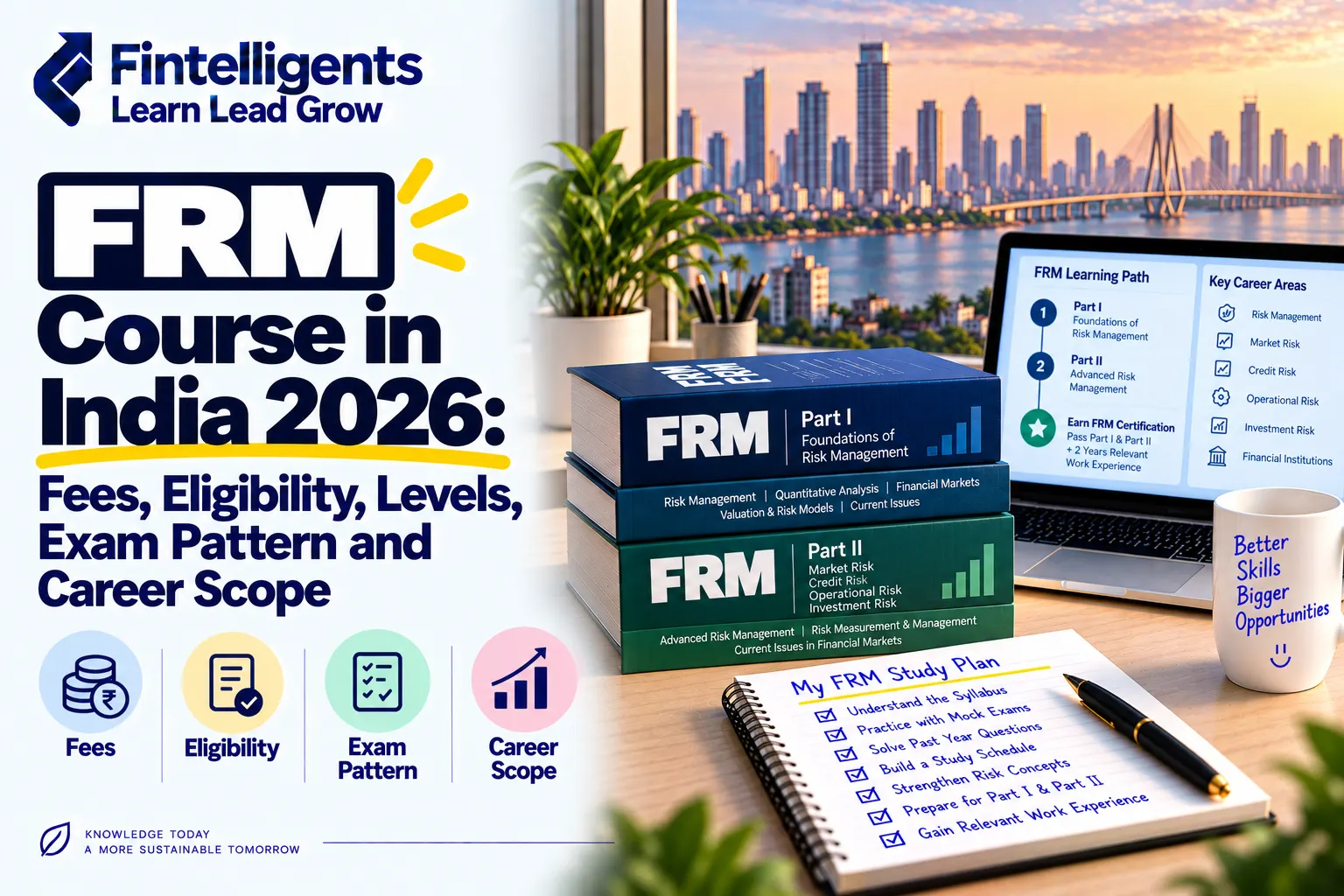
The Financial Risk Manager certification, widely referred to as the FRM, is the global benchmark qualification for risk management professionals. In India, it is pursued by candidates across banking, financial services, consulting, and investment management who want to build structured, internationally recognised expertise in financial risk. If you are researching the FRM course in India and want a complete guide before committing, this blog covers everything from eligibility and exam structure to fees, duration, and what the certification does for your career.
What Is the FRM?
The FRM is a two-part professional certification awarded by GARP, the Global Association of Risk Professionals. GARP is headquartered in the United States and is one of the most widely recognised bodies in the global risk management community. The FRM credential is specifically designed for professionals who work in or want to work in financial risk management functions, covering market risk, credit risk, operational risk, liquidity risk, and investment risk management across financial institutions.
In India, the FRM has become the leading credential for professionals targeting risk management careers at banks, NBFCs, asset managers, insurance companies, and financial consulting firms. GARP reports that India is consistently among the top five countries globally in terms of FRM exam registrations.
For a complete introduction to what the FRM involves and what to expect before enrolling in a course, FRM Course Explained: Everything You Need to Know Before Enrolling covers it in full.
FRM Eligibility in India 2026
The FRM has no formal eligibility requirements. GARP does not impose any minimum educational qualification, age limit, or prior work experience requirement to register for either part of the FRM exam. Anyone can register.
This open eligibility makes the FRM one of the most accessible globally recognised finance certifications available. A school leaver, a first-year undergraduate student, a BCom graduate, an engineer, a CA, or a working professional with no finance background can all register and sit for the FRM exam.
The only requirement that comes after the exam, not before, is the work experience requirement for certification. To receive the official FRM designation from GARP after passing both parts, you need to demonstrate two years of relevant full-time professional work experience in financial risk management or a related field. This experience can be accumulated before, during, or after clearing the exams. You do not need work experience to appear for the exam – you need it only when claiming the final designation.
Enrol for FRM Coaching at Fintelligents
FRM Course Structure: Two Parts
The FRM program is divided into two sequential parts. Part 1 must be passed before Part 2 is graded.
FRM Part 1
Part 1 covers the foundational tools and concepts of financial risk management. The curriculum is organised across four topic areas with the following official weightings.
Foundations of Risk Management accounts for 20 percent of the exam. This covers the nature of financial risk, corporate risk governance, risk culture, and the financial crisis case studies that have shaped modern risk thinking.
Quantitative Analysis accounts for 20 percent. This is the most mathematically intensive section of Part 1 and covers statistical methods, probability distributions, regression, time series analysis, Monte Carlo simulation, and machine learning applications in risk.
Financial Markets and Products accounts for 30 percent. This covers fixed income instruments, equity markets, currencies, commodities, forwards, futures, options, and swaps – the products that underlie virtually all financial risk measurement.
Valuation and Risk Models account for 30 percent. This covers how financial instruments are valued and how risk is measured across those instruments including Value at Risk methodologies, stress testing, and bond duration and convexity.
The Part 1 exam is 100 equally weighted multiple choice questions completed over 4 hours.
FRM Part 2
Part 2 builds on Part 1 and focuses on applying risk management frameworks to real institutional scenarios. The exam is 80 equally weighted multiple choice questions completed over 4 hours.
The six topic areas in Part 2 are Market Risk Measurement and Management at 20 percent, Credit Risk Measurement and Management at 20 percent, Operational Risk and Resilience at 20 percent, Liquidity and Treasury Risk at 15 percent, Risk Management and Investment Management at 15 percent, and Current Issues in Financial Markets at 10 percent.
Part 2 is where the certification demands genuine depth of application rather than foundational knowledge. Candidates who approach Part 2 as a continuation of Part 1 rather than as a distinct step up in difficulty typically underperform.
For a realistic assessment of whether FRM Part 1 alone is enough to advance your career while you work toward Part 2, Is FRM Part 1 Enough to Get a Job in India? Real Employer Expectations gives you an honest employer perspective.
FRM Exam Dates in India 2026
The FRM exam is offered in May, August, and November each year for both Part 1 and Part 2 at Pearson VUE test centres across India. Test centres are available in Mumbai, Delhi, Bengaluru, Hyderabad, Chennai, Kolkata, Pune, and Ahmedabad among other cities.
The remaining 2026 window is November, with Part 1 running November 14 to 20 and Part 2 running November 21 to 25. The next available window after November 2026 is May 2027, with early registration for May 2027 opening approximately December 1, 2026.
GARP also permits candidates to sit Part 1 and Part 2 in the same exam window. However, Part 2 will only be graded if Part 1 is passed. Candidates must pass Part 2 within four years of passing Part 1.
FRM Exam Pattern and Grading
Both parts are computer-based multiple choice exams taken at Pearson VUE test centres. Online proctoring is also available subject to GARP’s approval for each exam cycle. All questions are equally weighted and there is no negative marking. GARP does not disclose a numerical pass score but provides quartile performance data showing how your score compares to other candidates in that window across topic areas.
Pass rates for the FRM have historically ranged between 40 and 55 percent for Part 1 and 40 and 55 percent for Part 2, though actual rates vary by exam window. The fact that more than half of all candidates in some windows do not pass Part 1 reflects the depth of the exam and the consequences of inadequate preparation.
FRM Fees in India 2026
All FRM fees are charged by GARP in USD. Indian candidates pay based on the exchange rate at the time of payment, with 18 percent GST added on top for Indian transactions.
There is a one-time enrollment fee of USD 400 that first-time Part 1 candidates pay when they register for their first FRM exam. This fee is paid only once across your entire FRM journey.
For 2026, Part 1 and Part 2 exam fees are USD 725 per part during early registration and USD 900 per part during standard registration. At standard registration rates, a candidate sitting both parts for the first time pays USD 400 in enrollment fees plus USD 900 for Part 1 plus USD 900 for Part 2, totalling USD 2,200 in GARP fees alone before GST and exchange rate conversion.
Always verify current fee amounts directly on the official GARP FRM fees and payments page before registering since fees are updated periodically and exchange rate fluctuations affect the INR amount at the time of payment.
Beyond GARP fees, most candidates also invest in coaching and study material. FRM coaching in India typically ranges from Rs 40,000 to Rs 1,00,000 per part depending on the institute and format. Third-party study materials from providers like Schweser cost an additional Rs 20,000 to Rs 40,000 per part.
FRM Course Duration in India
GARP recommends 200 to 300 hours of preparation per part. At 15 to 20 hours per week, this translates to approximately 3 to 4 months of preparation per part. Most candidates in India take 12 to 24 months to complete both parts, accounting for preparation time, failed attempts, and scheduling gaps between windows.
Candidates who sit Part 1 and Part 2 in the same window and pass both complete the exam portion in a single cycle, though the preparation demands of doing this are high and it suits only candidates who are fully committed to sustained study intensity over 4 to 5 months.
Career Scope After FRM in India
The FRM opens access to a wide range of risk management roles across India’s financial services sector. The primary roles and salary ranges for FRM professionals in India in 2026 are as follows.
Risk Analyst and Credit Analyst roles at entry level with 0 to 3 years of experience pay Rs 4 to Rs 8 lakh per year. Risk Manager and Credit Manager roles at mid-career with 4 to 8 years of experience pay Rs 10 to Rs 20 lakh per year. Senior Risk Manager roles at 8 to 12 years of experience pay Rs 20 to Rs 35 lakh per year. Deputy CRO and CRO-level roles at major banks and financial institutions pay Rs 35 lakh and above.
The top employers of FRM professionals in India include HDFC Bank, ICICI Bank, Kotak Mahindra Bank, Axis Bank, the India offices of JP Morgan, Deutsche Bank, HSBC, and Goldman Sachs, and major financial consulting firms including PwC and KPMG in their risk advisory practices.
For a complete breakdown of the roles that open up after completing the FRM and what each pays, Top Job Roles After FRM Certification covers the full career landscape.
The FRM is also one of the most internationally portable risk credentials available. FRM certified professionals from India are actively hired in Singapore, UAE, UK, USA, and Hong Kong, making it one of the most valuable certifications for professionals who have international career ambitions.
For candidates in risk roles who also want to add AI governance expertise alongside the FRM, the Risk and AI certification from GARP is the natural next credential that covers how AI systems are governed and validated within financial institutions – a growing employer demand in India and globally.
Enrolling in FRM Online Classes at Fintelligents gives you structured preparation for both FRM parts with live and recorded sessions, faculty support, full-length mock exams, and a study plan calibrated to the actual exam weightage and format.
For a look at why risk management expertise is becoming more valuable rather than less as AI reshapes financial services, Why FRM Certification Matters More Than Ever in an AI-Driven Finance World gives you the broader market context.
Conclusion
The FRM course in India in 2026 is one of the most directly applicable professional certifications available for anyone targeting a career in financial risk management. Eligibility is completely open with no age limit, no minimum marks, and no degree requirement for the exam itself. The two-part structure covers foundational and applied risk management across market, credit, operational, and liquidity risk. Exam fees in 2026 are USD 725 per part at early registration plus a USD 400 one-time enrollment fee. Career outcomes range from Rs 4 lakh at entry level to Rs 35 lakh and above at senior levels, with international markets paying significantly more. For anyone serious about risk management as a career in India, the FRM is the credential that opens the most doors.
Frequently Asked Questions (FAQs)
Q. What are the eligibility requirements for the FRM course in India?
There are no formal eligibility requirements to register for the FRM exam. Anyone can register regardless of educational background, age, or work experience. The only post-exam requirement is two years of relevant full-time work experience, which is needed to claim the official FRM designation after passing both parts.
Q. How many parts does the FRM exam have and what is the format?
The FRM has two parts. Part 1 is 100 equally weighted multiple choice questions completed over 4 hours. Part 2 is 80 equally weighted multiple choice questions completed over 4 hours. Both parts are computer-based and available at Pearson VUE test centres in India.
Q. What is the total cost of the FRM course in India?
GARP charges a one-time enrollment fee of USD 400 for first-time candidates plus USD 725 per part at early registration or USD 900 per part at standard registration. Total GARP fees for both parts at standard rates with the enrollment fee come to USD 2,200. Indian candidates also pay 18 percent GST on top of these amounts. Coaching and study material costs are additional, typically adding Rs 80,000 to Rs 1,50,000 for both parts combined.
Q. How long does it take to complete the FRM in India?
GARP recommends 200 to 300 hours of preparation per part. At 15 to 20 hours per week this translates to 3 to 4 months per part. Most candidates in India complete both parts in 12 to 24 months, factoring in preparation time and scheduling across exam windows.
Q. What is the FRM salary in India after completing both parts?
Entry-level FRM professionals in risk and credit analysis roles earn Rs 4 to Rs 8 lakh per year. Mid-career Risk Managers with 4 to 8 years of experience earn Rs 10 to Rs 20 lakh. Senior Risk Managers and senior credit professionals earn Rs 20 to Rs 35 lakh. CRO-level professionals at major banks earn Rs 35 lakh and above in total compensation.