Blog
CFA Level 1 November 2026: Last-Minute Tips to Maximise Your Score This Week

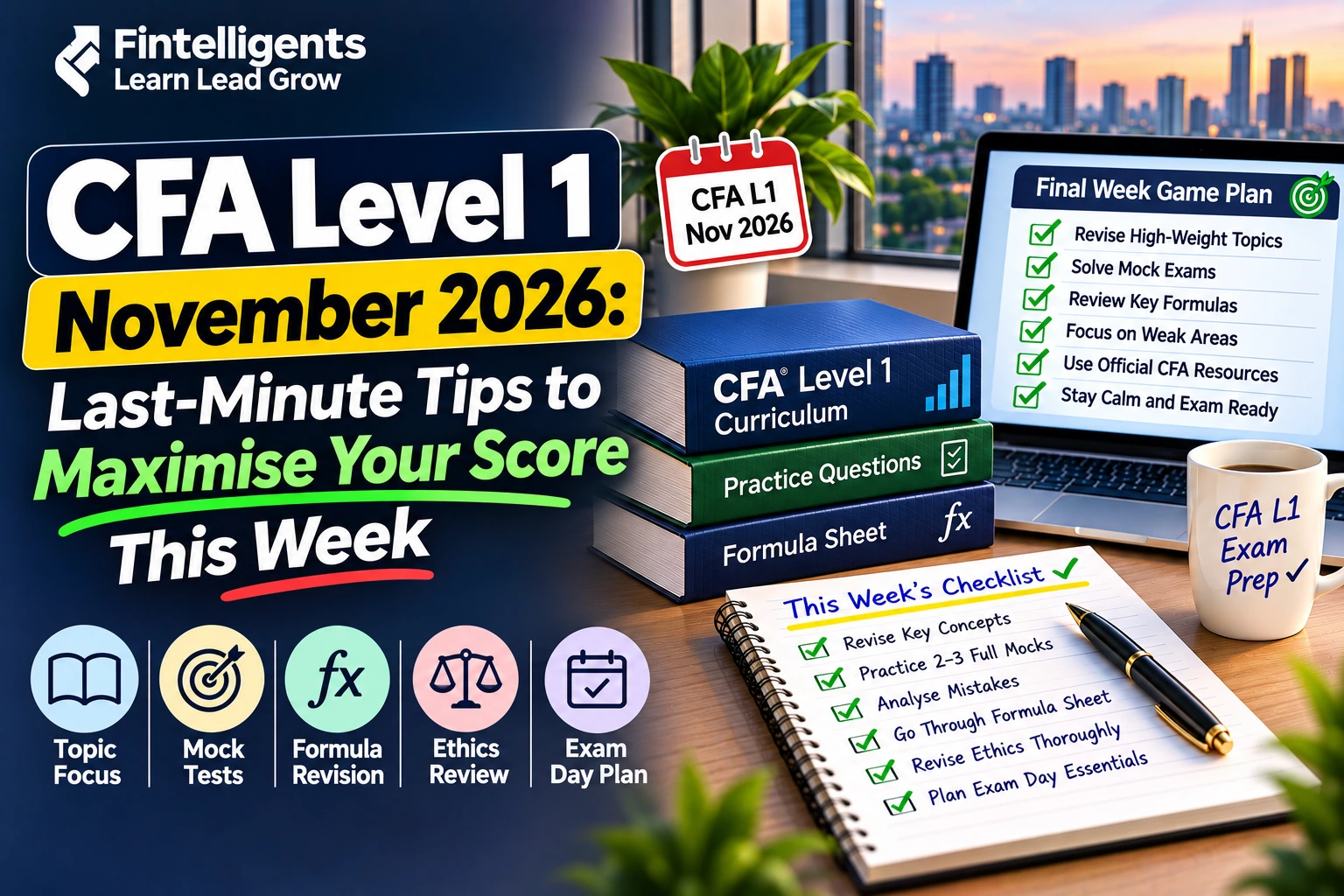
The CFA Level 1 November 2026 exam window opens in a matter of days. If you are reading this in the final week before your exam, the time for learning new material is over. What matters now is how you use each remaining hour to protect the work you have already done and walk into the test centre in the best possible state.
This guide is built entirely around the final week before the CFA Level 1 November 2026 sitting. No new content, no broad study strategies – only specific, actionable steps for the last few days.
What to Do Today: Stop Absorbing, Start Retrieving
The biggest mistake candidates make in the final week is continuing to read notes and re-watch recordings as if they still have time to learn. At this point, the only studying that moves the needle is active retrieval – doing questions, not reading answers.
Spend the entire first part of your remaining time on past mock exams and question bank problems. Mark every question you get wrong, but do not deep-dive into the underlying concept. Flag it, note the topic area, and move on. You are building a list of your highest-probability errors, which will be the focus of your final review.
If you have not yet done a full timed mock exam under real exam conditions, do one today. Sitting for a full session forces your brain to work in the sustained, sequential way the actual CFA Level 1 exam demands.
Two Days Before: Lock In Your Weak Spots
Review Your Error Log, Not Your Notes
Pull every wrong answer from the mocks you have done and work through the same type of question again from your question bank. The goal is not to memorise solutions but to confirm that you understand why the correct answer is correct and why the distractors are wrong.
Calculator Fluency Check
Run through every CFA Level 1 calculator function you have used this year – TVM, NPV, IRR, standard deviation, bond pricing, duration. Do each one twice from memory. If you hesitate on any step, work through it five more times. At the exam, hesitation on calculator operations costs minutes you cannot recover.
For a full breakdown of which functions matter most and how to use them without errors, CFA Calculator Guide: Allowed Calculators, Usage Rules and Tips covers every function tested.
Topic Weightage Reality Check
If you are going to prioritise anything in these final two days, it should be the highest-weighted topics in the CFA Level 1 November 2026 curriculum. Ethical and Professional Standards runs at 15 to 20 percent. Financial Statement Analysis runs at 11 to 14 percent. Equity Investments runs at 10 to 12 percent. These three areas alone account for over a third of your score. Spending your last hours on alternative investments or derivatives at the expense of ethics is a poor trade.
The Night Before: Protect Your State
Set a Hard Stop Time
Stop all exam preparation by 8 PM the night before. Reviewing material past this point adds nothing except anxiety and sleep disruption. What you do not know at this stage, one more hour of notes will not fix.
Physical Preparation
Lay out everything you need: your admit card and ID, both calculators (bring a backup), fresh batteries if you are using a BA II Plus, pencils and an eraser. Pack your bag before you sleep. Remove every variable you can control the night before so the morning is routine.
Sleep is not optional. Research on exam performance is unambiguous: sleep deprivation reduces your ability to recall information and to reason under time pressure, both of which are exactly what the CFA Level 1 November 2026 exam tests.
Exam Day: Managing Time and Energy
Session-by-Session Strategy
The CFA Level 1 exam runs in two sessions of 90 questions each with a break in between. Enter each session with a plan: spend roughly one minute per question. If a question takes more than a minute, mark it and move on. Return to marked questions in the time remaining.
Do not let one difficult question derail your pace through an entire session. Some questions are genuinely hard. Mark them, guess if necessary, and keep moving.
How to Use the Break
Eat something small. Drink water. Do not discuss questions with other candidates – it is a waste of your mental energy and can undermine your confidence. Use the break to reset, not to debrief.
For detailed exam day strategy including how to approach item sets under time pressure, CFA Exam Strategy: How to Manage Time in the Exam Hall gives you a full framework.
After the Exam: What Comes Next
Results for the CFA Level 1 November 2026 sitting will be released in January 2027. If this is your first attempt and you are concerned about the outcome, the CFA Level 1 Study Plan: What to Prioritise in the Final 60 Days at Fintelligents provides a structured approach for a second sitting if needed. If you pass, the February 2027 Level 2 registration window is worth exploring immediately.
Enrolling in the best CFA online course in India at Fintelligents gives you structured preparation for every level. If fees are a consideration, the CFA need-based scholarship is worth exploring before you begin.
Frequently Asked Questions
How many hours should I study in the final week before CFA Level 1?
Aim for two to three hours of focused, active practice per day. Beyond three hours, the return on investment drops sharply. Quality of practice matters far more than volume at this stage.
Should I attempt new topics the week before the exam?
No. Attempting to learn new material in the final week increases anxiety without adding meaningful knowledge. Focus entirely on consolidating what you already know through question practice and error review.
What if I feel underprepared going into the exam?
Most candidates feel underprepared in the final week – this is normal and not necessarily predictive of your result. Focus on what you can control: your sleep, your calculator fluency, your error patterns, and your time management on exam day.
Can I bring food into the CFA exam hall?
Food and water are permitted during the break, not during the exam session itself. Check the CFAI candidate rules for the specific test centre you are attending, as policies can vary slightly by location.
What is a good score to pass CFA Level 1?
The CFA Institute does not publish a fixed passing score. The minimum passing score is determined after each exam window using a standard-setting process. Historically, candidates who answer roughly 60 to 65 percent of questions correctly have a reasonable chance of passing, but this varies by cohort.