

Blog
FRM Level 1 vs Level 2: Differences, Difficulty, Syllabus, Fees and Preparation

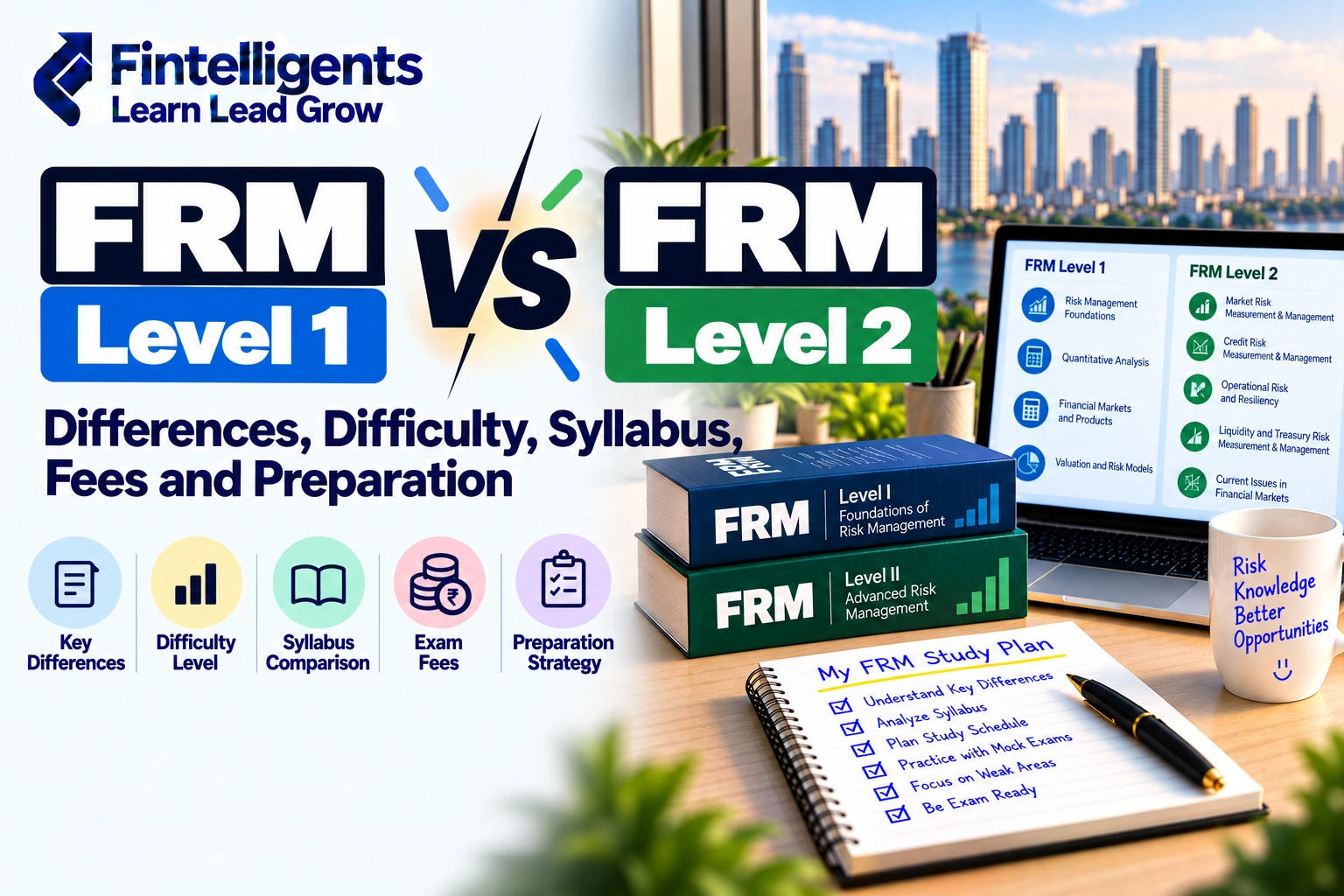
The FRM is a two-part certification and understanding how Part 1 and Part 2 differ before you begin is one of the most useful investments of time you can make in your preparation. Many candidates go into Part 1 treating it as a standalone exam and only think about Part 2 after they pass. The candidates who clear both parts efficiently are usually the ones who understood the relationship between the two levels from the start and planned accordingly. This guide covers everything you need to know about FRM Level 1 vs Level 2 across syllabus, difficulty, fees, exam format, and how to prepare for each.
The Core Difference Between FRM Part 1 and Part 2
The most important thing to understand about the difference between FRM Part 1 and Part 2 is the shift from knowledge to application. Part 1 tests whether you know the fundamental tools and concepts of financial risk management. Part 2 tests whether you can use those tools in real-world risk management scenarios at the institutional level.
Part 1 is broader in scope, covering quantitative methods, financial products, and foundational risk management concepts. Part 2 is narrower in topic count but goes significantly deeper into how specific risk types market, credit, operational, and liquidity risk are actually measured and managed within banks, asset managers, and financial institutions.
Candidates who approach Part 2 with the same reading-and-recall preparation style that worked for Part 1 typically struggle. Part 2 questions are more scenario-based and require you to connect multiple concepts to evaluate a risk management situation. The shift in question style is as important as the shift in content.
A confirmed prerequisite separates the two levels from every other aspect: you must pass Part 1 before GARP will grade your Part 2 exam. There is no option to sit both simultaneously and have both graded, even though they can be taken in the same August window.
FRM Part 1 Syllabus and Topic Weights 2026
Part 1 has four topic areas. GARP has kept the 2026 weightings stable compared to previous years.
Foundations of Risk Management: 20%
Covers the core principles of risk management including risk governance, enterprise risk management, the CAPM framework, risk measurement concepts, and financial disasters and the lessons they provide. This section is relatively conceptual and establishes the professional and ethical framework that underpins everything else in the curriculum.
Quantitative Analysis: 20%
Covers the statistical and mathematical tools used in risk management. Probability distributions, hypothesis testing, regression analysis, time series analysis, Monte Carlo simulations, and machine learning fundamentals in risk contexts. This is the section that trips up candidates from non-quantitative backgrounds most significantly. The 2026 curriculum includes minor revisions around hypothesis testing and stationary time series, with a slightly heavier emphasis on numerical questions.
Financial Markets and Products: 30%
The highest-weighted Part 1 topic. Covers the mechanics and characteristics of key financial instruments including bonds, equities, futures, forwards, swaps, options, and mortgage-backed securities. Understanding how each instrument is structured, priced, and used is foundational to the risk management content in both Part 1 and Part 2.
Valuation and Risk Models: 30%
The second highest-weighted area. Covers bond valuation, options pricing including the Black-Scholes model, futures and forward pricing, and risk measures including Value at Risk, Expected Shortfall, and stress testing. This section connects the financial products knowledge from the previous topic to how those products are valued and their risks are quantified.
FRM Part 2 Syllabus and Topic Weights 2026
Part 2 has six topic areas, all focused on the application of risk management within financial institutions.
Market Risk Measurement and Management: 20%
Goes deep into how market risk is measured and managed at the trading desk and portfolio level. Covers VaR methodologies, Expected Shortfall, backtesting and model validation, stress testing for market risk, and regulatory capital requirements for market risk under the Basel framework.
Credit Risk Measurement and Management: 20%
Covers how credit risk is measured across lending and investment portfolios. Probability of default, loss given default, credit exposure, counterparty credit risk, credit derivatives including CDS and CDOs, and regulatory capital requirements for credit risk. For candidates who work in credit functions at banks, this section is the most directly applicable to their daily work.
Operational Risk and Resilience: 20%
Covers how non-financial risks system failures, process breakdowns, fraud, legal risks, and conduct risks are identified, measured, and managed within financial institutions. Includes the Basel operational risk capital framework and principles of operational resilience.
Liquidity and Treasury Risk: 15%
Covers liquidity risk management, liquidity metrics including the Liquidity Coverage Ratio and Net Stable Funding Ratio, funding risk, and the role of treasury in managing a financial institution’s balance sheet risk.
Risk Management and Investment Management: 15%
Covers risk management within the investment management context including portfolio risk, factor models, performance attribution, and risk budgeting. This section bridges the gap between risk management techniques and their application in asset management.
Current Issues in Financial Markets: 10%
The most dynamic Part 2 topic, updated every year to reflect current developments in financial risk. In 2026 this includes content around AI and machine learning risks in financial services, climate risk frameworks, and regulatory developments post-SVB.
For a broader look at what the FRM involves from the perspective of professionals considering the certification, FRM Course Explained: Everything You Need to Know Before Enrolling gives you the full picture.
Exam Format Comparison
The exam formats for Part 1 and Part 2 differ in question count, which is worth noting when planning your exam time management strategy.
Part 1 consists of 100 multiple choice questions to be completed in 4 hours. At 2.4 minutes per question, the pace is brisk but manageable. Part 2 consists of 80 multiple choice questions to be completed in 4 hours. At 3 minutes per question, you have slightly more time per question in Part 2 but the questions themselves demand more analytical work.
Neither part has negative marking. Both use the same standalone multiple choice format where each question is independent. The August window runs both parts on the same day Part 1 in the AM session and Part 2 in the PM session.
FRM Part 1 vs Part 2 Pass Rates
The pass rates for the two parts have consistently differed since the FRM moved to computer-based testing.
FRM Part 1 has a historical pass rate ranging from approximately 40 to 55 percent, with a five-year average of around 49 percent. The November 2025 Part 1 pass rate was 47 percent according to GARP data. Recent windows have generally trended toward the higher end of the historical range.
FRM Part 2 has a historical pass rate ranging from approximately 55 to 60 percent, with a five-year average of around 56 percent.
The higher Part 2 pass rate does not mean Part 2 is easier. It reflects self-selection. Only candidates who have already passed Part 1 can sit Part 2, so the Part 2 candidate pool is already filtered toward more prepared and capable candidates. Among the candidates who sit Part 2, the difficulty is real and the pass rate of 55 to 60 percent means approximately 40 percent of those who sit do not pass.
FRM Level 1 vs Level 2 Fees
All FRM fees are charged by GARP in USD. The fee structure for Part 1 and Part 2 is the same for registration, with one additional charge for first-time Part 1 candidates.
One-time Enrollment Fee of USD 400 applies only to first-time Part 1 candidates. This is a one-off charge paid at the time of your first Part 1 registration. You never pay it again.
Registration Fees are the same for both parts. Early registration costs USD 600 per part, standard registration costs USD 800 per part, and late registration (where available) costs USD 1,000 per part. Registering during the early window saves you USD 200 per part compared to standard registration, which across both parts amounts to USD 400 or approximately Rs 33,600 at current exchange rates.
At standard registration, the total exam fee for a first-time candidate sitting both parts is USD 400 enrollment plus USD 800 for Part 1 plus USD 800 for Part 2, totalling USD 2,000, approximately Rs 1,68,000 before GST. After the 18% GST applicable to Indian candidates, the total comes to approximately Rs 1,98,240.
Always confirm the current fee amounts on the official GARP FRM fees page before registering since fees are subject to change and GST amounts depend on your registered address.
How to Prepare for FRM Part 1
GARP recommends approximately 200 to 240 hours of preparation for Part 1. Given that the two highest-weighted topics, Financial Markets and Products and Valuation and Risk Models, together account for 60 percent of the exam, your preparation time should be skewed toward these areas.
The most common preparation mistake for Part 1 is spending time equally across all four topics. Foundations of Risk Management, at 20 percent, deserves thorough coverage but not the same time investment as Financial Markets and Products. Quantitative Analysis is the most technically demanding section for candidates from non-quantitative backgrounds and often needs more time than its 20 percent weight suggests because weak QA performance undermines your ability to answer questions in other sections.
Aim to complete at least two to three full mock exams under timed conditions before exam day. Candidates who skip mock practice consistently underperform relative to their knowledge level because the exam’s pace is different from chapter-by-chapter preparation.
For strategies on managing FRM preparation alongside a full-time job, which is the reality for most Indian candidates, How to Manage Work and FRM Exam Prep Together: Expert Tips covers practical approaches that actually work.
How to Prepare for FRM Part 2
Part 2 preparation requires a different mindset from Part 1. The content is more applied and the questions are more scenario-based. Reading and memorising the curriculum is not sufficient preparation for Part 2 at the level required to pass.
Start Part 2 preparation as soon as you pass Part 1 rather than waiting for the result first. The quantitative and financial markets knowledge from Part 1 fades quickly without reinforcement and Part 2 builds directly on it. The earlier you start Part 2 after completing Part 1, the more your Part 1 knowledge works in your favour rather than needing to be rebuilt.
Market Risk and Credit Risk together carry 40 percent of the Part 2 exam. These are the sections that reward deep understanding over surface familiarity and where most of the scenario-based questions are concentrated. Give these two sections priority in your preparation timeline.
The Current Issues in Financial Markets section, at 10 percent, is updated annually and requires keeping up with the most recent GARP reading list rather than relying on prior study notes alone. Check the official 2026-2027 GARP Study Guide for the current reading list before beginning Part 2 preparation.
Enrolling in FRM Online Classes at Fintelligents gives you structured preparation for both parts with live and recorded sessions, faculty who have helped candidates clear both parts across multiple exam cycles, and full-length mock exams calibrated to the actual exam difficulty.
For a look at where the FRM takes you after clearing both parts, Top Job Roles After FRM Certification covers the full career landscape across banking, risk advisory, and investment functions.
Conclusion
FRM Part 1 and Part 2 are fundamentally different in what they test, how questions are framed, and what preparation approach they reward. Part 1 builds your foundational knowledge of risk tools and financial products. Part 2 tests how well you can apply those tools to real institutional risk management scenarios. The fees are the same per part but Part 1 carries a one-time enrollment fee for first-timers. The pass rates differ not because Part 2 is easier but because the candidate pool is more filtered. The most efficient path through both parts is to understand these differences from the start and prepare for each on its own terms rather than treating them as two versions of the same exam.
Frequently Asked Questions (FAQs)
Q. What is the main difference between FRM Part 1 and Part 2?
FRM Part 1 tests foundational knowledge across quantitative methods, financial markets and products, and risk modelling tools. FRM Part 2 tests the application of those tools to real-world risk management at the institutional level, covering market risk, credit risk, operational risk, and liquidity risk in depth. Part 1 is conceptually broader and Part 2 is more applied and scenario-based.
Q. Is FRM Part 2 harder than Part 1?
Not necessarily, though the question style is more demanding. Part 2 has a higher pass rate (55 to 60 percent) compared to Part 1 (40 to 55 percent), but this reflects the self-selection of the candidate pool rather than lower difficulty. Part 2 requires more analytical thinking and scenario application, which makes it harder for candidates who rely primarily on memorisation.
Q. Can I sit FRM Part 1 and Part 2 in the same window?
In the August window, yes. Both parts are taken on the same day, Part 1 in the AM session and Part 2 in the PM session. However, GARP will not grade your Part 2 result if you fail Part 1. In the May and November windows, Parts 1 and 2 are held in separate weeks and you must have a confirmed Part 1 pass before sitting Part 2.
Q. How much do FRM Part 1 and Part 2 cost in India?
At standard registration rates, both Part 1 and Part 2 cost USD 800 each. First-time Part 1 candidates also pay a one-time enrollment fee of USD 400. The total for both parts at standard registration comes to USD 2,000, approximately Rs 1,68,000 before the 18% GST applicable to Indian candidates. Early registration at USD 600 per part saves USD 400 across both parts. Always confirm current fees on the official GARP website before registering.
Q. How many hours should I study for FRM Part 1 and Part 2?
GARP recommends 200 to 240 hours for Part 1 and a similar or slightly higher commitment for Part 2. Most candidates who clear both parts in fewer attempts report studying at the higher end of this range and completing regular mock exams under timed conditions throughout their preparation rather than only in the final weeks.
