Blog
Best Finance Certifications to Get a Job in Singapore in 2026: CFA, FRM, CAIA, SCR and RAI Ranked

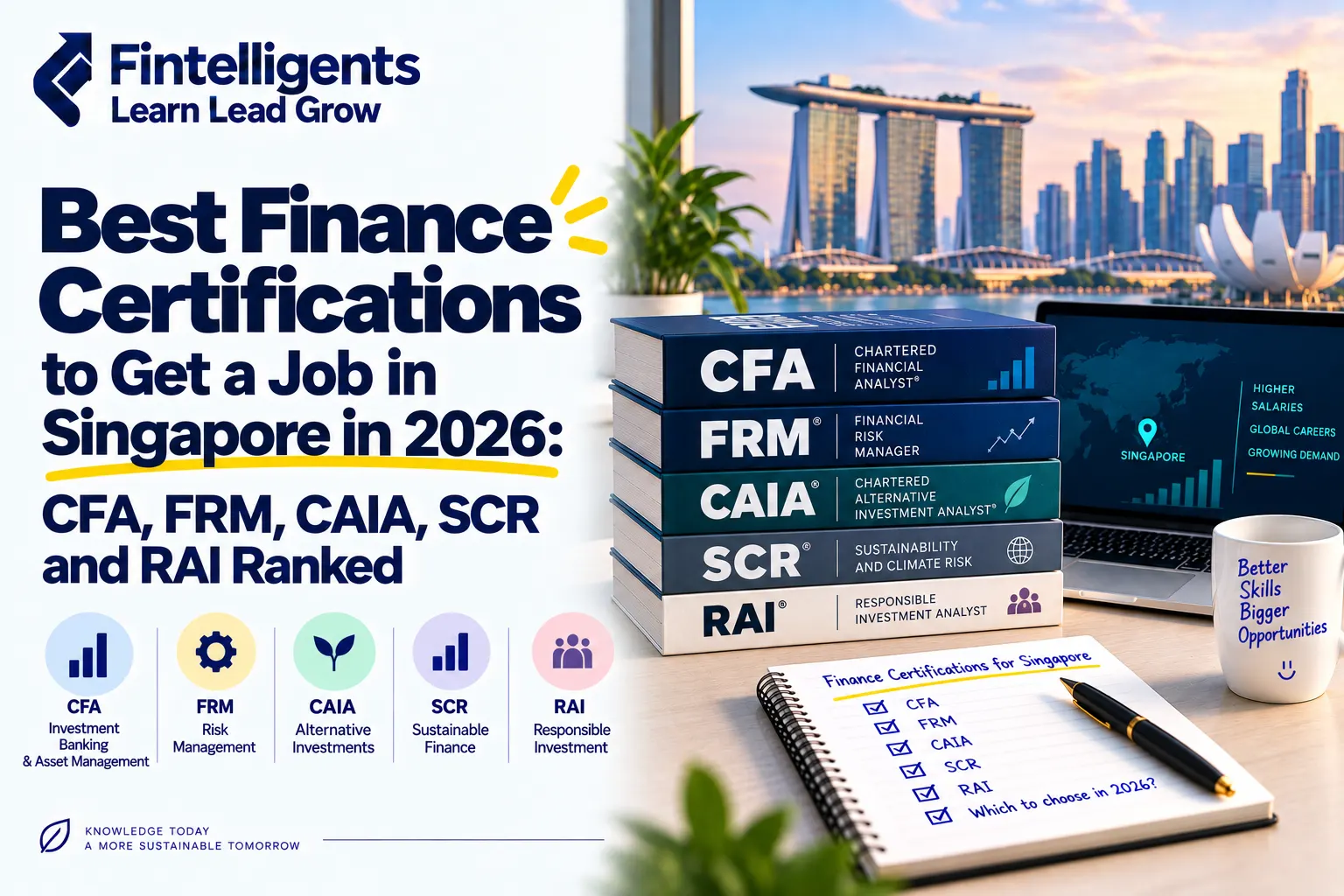
Singapore’s financial sector is one of the most credentialed job markets in the world. The Monetary Authority of Singapore sets rigorous expectations for the professionals working in its financial institutions and employers reflect those expectations in what they ask for at the hiring stage. If you are targeting a finance job in Singapore in 2026 and are trying to figure out which certification gives you the best chance, this blog ranks the five most relevant credentials for the Singapore market and tells you which one is right for your specific career profile.
Why Certifications Matter More in Singapore Than in Most Markets
Singapore’s financial sector operates under one of the most rigorous regulatory frameworks in Asia Pacific. MAS has consistently set standards around risk management, investment governance, sustainable finance, and increasingly AI governance that require financial institutions to demonstrate that their professionals have structured, validated expertise rather than just experience. This regulatory environment creates a job market where credentials carry more weight than in less regulated markets, and where the right certification can meaningfully separate your application from equally experienced candidates without one.
The Singapore market also has a unique mix of global banks, sovereign wealth vehicles, family offices, asset managers, and fintech firms that each value different credentials. Understanding which credential speaks to which employer type is as important as knowing which certification is generally prestigious.
For a broader look at how Singapore has become one of the most important markets for Indian finance professionals, How Indian CFA and FRM Holders Are Shaping Global Banking Hubs gives you the full context.
Ranked: The 5 Best Finance Certifications for Singapore Jobs in 2026
Rank 1: CFA – The Gold Standard for Investment Roles
The CFA is the most widely recognised and universally valued finance certification in Singapore across the broadest range of employers and roles. DBS, UOB, OCBC, GIC, Temasek, and the Singapore offices of Goldman Sachs, JPMorgan, Morgan Stanley, and BlackRock all actively recruit CFA charterholders for investment management, equity research, private banking, wealth management, and senior analytical roles.
The CFA Society Singapore is one of the most active CFA Institute member societies in the world, with a strong employer network and regular events that connect charterholders with hiring managers at major firms. In terms of raw job market impact, no other certification in Singapore opens as many doors across as many employer types as the CFA.
The CFA is best for professionals targeting investment banking, equity research, portfolio management, private banking, wealth management, or any role where investment analysis and portfolio judgement are central to the work. The full charter requires clearing three levels and completing four years of relevant work experience, which makes it a multi-year commitment but one that delivers the highest return in the broadest range of Singapore finance roles.
Book a Free Career Counselling Session at Fintelligents
Rank 2: FRM – The Benchmark for Risk Roles
The FRM is the leading credential for risk management professionals in Singapore and carries the strongest recognition among Singapore’s most rigorous regulatory and risk-focused employers. MAS has been building out its expectations around Basel III implementation, climate risk stress testing, and model risk management, all of which create sustained hiring demand for FRM-certified professionals who understand these frameworks.
The primary employers for FRM professionals in Singapore are DBS, UOB, OCBC, Standard Chartered, HSBC, JPMorgan, Deutsche Bank, GIC, and Temasek, particularly for risk management, credit risk, market risk, and operational risk functions. FRM professionals in Singapore earn on average just over SGD 105,000 per year, with CROs at major banks earning up to SGD 325,000.
The FRM is best for professionals targeting market risk, credit risk, enterprise risk, model risk, and regulatory risk management roles at Singapore’s banks and financial institutions. If the CFA is the credential for investment management in Singapore, the FRM is the credential for risk management and the two serve adjacent but distinct career paths.
Rank 3: CAIA – The Alternatives Specialist Credential
The CAIA is the most targeted credential for Singapore’s fast-growing alternatives investment sector. Family offices in Singapore have more than doubled since 2020, Variable Capital Companies have proliferated as the preferred fund vehicle, and GIC and Temasek’s alternatives activity creates consistent demand for professionals who understand private equity, hedge funds, real assets, and private credit at a deep level.
The CAIA functions as a preferred credential and tiebreaker in alternatives hiring rather than a hard requirement in most cases. It appears consistently across institutional allocation, family office, and fund-of-funds roles and distinguishes candidates who have demonstrated structured expertise in alternatives from those who have only general finance backgrounds. Major financial centres including Singapore are among the strongest markets globally for CAIA holders given the depth and diversity of their alternatives ecosystems.
The CAIA is best for professionals targeting family offices, PE firms, hedge funds, fund-of-funds, or sovereign wealth alternatives functions in Singapore. For those already working in these environments, it is one of the most directly applicable credentials available.
Rank 4: SCR – The Climate Risk Credential Growing Fastest in Singapore
The SCR is the fastest-growing credential in terms of Singapore relevance in 2026. MAS has been among the most proactive financial regulators globally in setting expectations around climate risk integration, sustainable finance taxonomy, and TCFD-aligned disclosure for financial institutions. This regulatory push has created direct internal hiring demand at Singapore banks and asset managers for professionals who understand climate risk frameworks.
SCR-certified professionals in Singapore work in climate risk management functions at banks, ESG integration roles at asset managers, sustainability advisory at consulting firms, and green finance structuring at investment banks. The SCR is not yet as broadly recognised as the CFA or FRM in Singapore but its relevance is growing faster than either in the specific climate risk and sustainable finance functions that MAS regulation is building out.
The SCR is best for professionals in or targeting risk, credit, compliance, or investment roles where climate risk integration and ESG frameworks are becoming central to the work. For those already in Singapore’s financial sector who see their role shifting toward sustainability dimensions, the SCR is the most efficient credential to add.
Rank 5: RAI – The Emerging Credential for AI Governance Roles
The RAI is the newest of the five credentials on this list and has the narrowest current recognition in Singapore. However, it is targeting one of the fastest-growing demand areas in Singapore’s financial sector. MAS has been building out its responsible AI framework for financial institutions and has published guidelines around the responsible use of AI in financial services through its Fairness, Ethics, Accountability, and Transparency framework. This regulatory attention is creating internal hiring demand for professionals who can govern AI systems responsibly within financial institutions.
RAI-certified professionals in Singapore are best positioned for model risk management roles, AI governance functions, technology risk at banks, and compliance roles dealing with algorithmic decision-making oversight. The credential is newest and least widely known but it is the most forward-looking of the five in terms of where Singapore’s regulatory attention is heading.
The RAI is best for professionals in model risk, technology risk, compliance, or senior risk oversight functions where AI deployment is central to what their institution is doing.
Which Should You Choose?
The right certification depends entirely on which kind of work you do or want to do in Singapore. If you want the broadest access to the most employers across investment roles, choose CFA. If you want the strongest credential for risk management at Singapore’s banks and financial institutions, choose FRM. If you are specifically targeting the alternatives ecosystem at family offices, PE firms, or sovereign wealth vehicles, choose CAIA. If you are in or moving toward climate risk and sustainable finance functions, the SCR is gaining fast. If you are in model risk, technology risk, or AI governance at financial institutions, the RAI is the most forward-looking choice.
Enrolling in the best cfa online course in india at Fintelligents gives you structured preparation for the CFA across all three levels. For FRM preparation, FRM Online Classes at Fintelligents covers both parts with live and recorded sessions, faculty support, and full-length mock exams.
For a comparison of how each of these certifications stacks up when choosing between them, CFA vs FRM vs CAIA: Which Certification Will Matter Most in 2026? gives you the full comparison in one place.
Conclusion
Singapore’s finance job market rewards certified professionals more consistently than most markets because of the MAS regulatory framework that pushes financial institutions to demonstrate structured expertise. The CFA leads for investment roles, the FRM leads for risk roles, and the CAIA is the strongest choice for alternatives-specific careers. The SCR is growing fastest in regulatory relevance and the RAI is the most forward-looking for AI governance functions. Whichever credential fits your career path, Singapore’s depth as a financial centre means the investment in the right certification returns more there than in most other markets.
Frequently Asked Questions (FAQs)
Q. Which is the best finance certification for getting a job in Singapore in 2026?
For the broadest access across the most employer types and roles, the CFA is the most widely recognised and valued certification in Singapore. For risk management roles specifically, the FRM is the benchmark credential. For alternative investment roles at family offices, PE firms, and sovereign wealth vehicles, the CAIA is most directly relevant. The right choice depends on which sector and role type you are targeting.
Q. Is the FRM or CFA more valued in Singapore?
Both are highly valued but in different contexts. The CFA carries the broadest recognition across investment management, research, private banking, and wealth management roles at Singapore financial institutions. The FRM carries the strongest recognition specifically for market risk, credit risk, enterprise risk, and regulatory risk management roles. Many professionals in senior Singapore roles eventually hold both.
Q. Is the SCR certification useful for getting a finance job in Singapore?
Yes and its relevance is growing faster than any other credential on this list in 2026. MAS has been one of the most proactive global regulators in mandating climate risk integration and sustainable finance frameworks for financial institutions, creating direct internal demand for SCR-certified professionals in climate risk and sustainable finance functions.
Q. How much do certified finance professionals earn in Singapore?
Salaries vary significantly by credential, role, and experience level. CFA charterholders in portfolio management and research earn SGD 100,000 to SGD 200,000 at mid-career. FRM professionals in risk management earn on average just over SGD 105,000 with CROs earning up to SGD 325,000. CAIA holders in senior PE and family office roles earn SGD 180,000 to SGD 300,000 and above.
Q. Can Indian finance professionals get a job in Singapore with these certifications?
Yes. Singapore has a large and established Indian finance professional community and English is the primary business language across Singapore’s financial sector. The Employment Pass sponsorship process is more straightforward than the US H-1B system. Indian professionals with the CFA, FRM, or CAIA combined with relevant experience have strong track records of successfully entering the Singapore finance job market through both internal transfers at global banks and direct applications.