Blog
RBI FREE-AI Framework Explained: What It Means for Risk and AI Professionals in India

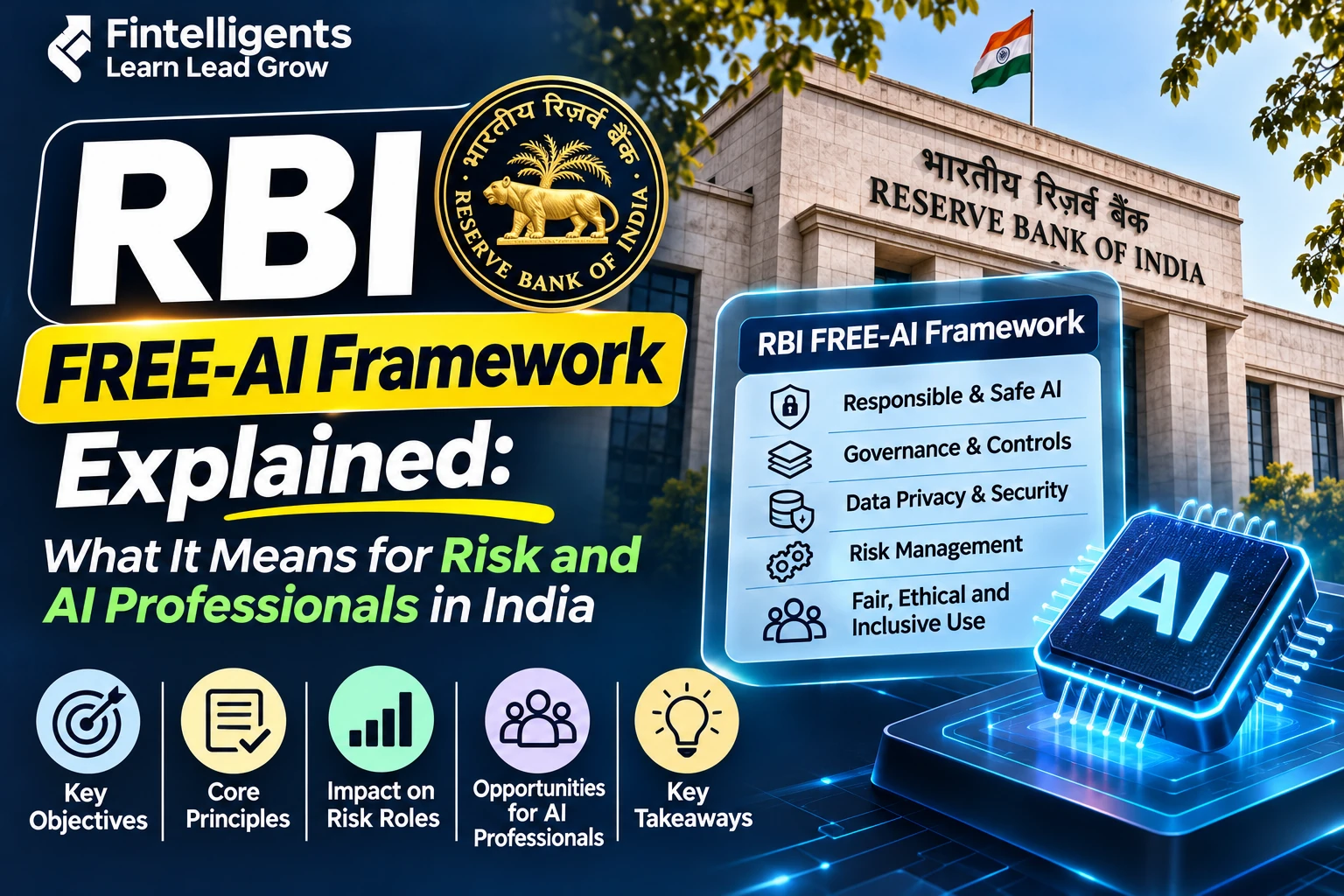
The Reserve Bank of India’s FREE-AI framework is one of the most significant regulatory interventions in AI governance in Indian banking since the introduction of CIBIL-based credit scoring requirements. For professionals working in or preparing for careers in risk management, financial technology, and AI governance in Indian financial services, understanding the FREE-AI framework is no longer optional. It is quickly becoming a baseline expectation.
This guide explains what the RBI FREE-AI framework is, what its principles cover, and what it means in practical terms for risk and AI professionals in India in 2026.
What Is the RBI FREE-AI Framework?
The Reserve Bank of India issued the FREE-AI framework as a set of responsible AI governance principles specifically designed for the Indian banking and financial services sector. The acronym FREE-AI stands for Fairness, Reliability, Explainability, Ethics, Accountability, and Inclusiveness – with AI referring to artificial intelligence, the subject the framework governs.
The framework was developed in response to the rapid adoption of AI-driven systems in Indian banks and financial institutions, covering use cases from credit scoring and fraud detection to customer service automation and regulatory compliance. The RBI observed that the pace of AI adoption was significantly outrunning the governance frameworks within individual institutions, and that a sector-wide set of principles was needed.
The FREE-AI framework is currently a guidance document rather than a mandatory regulatory requirement, but the RBI has signalled that formal compliance requirements may follow in subsequent supervisory circulars. Several large public and private sector banks have already begun incorporating FREE-AI principles into their AI governance frameworks.
The Principles of FREE-AI
Fairness
The fairness principle requires that AI systems used in banking must not discriminate against customers on the basis of protected characteristics. For credit decisioning models, this means monitoring for disparate impact across demographic groups and conducting regular fairness audits. Indian banks with significant retail lending portfolios using AI-driven credit scoring are particularly affected.
Reliability
Reliability addresses the consistency and robustness of AI systems under varying conditions. Models must perform reliably not only under normal market conditions but also under stress scenarios. Banks are expected to maintain detailed model documentation and to conduct regular backtesting and stress testing of AI-driven decisions.
Explainability
Explainability is widely considered the most operationally challenging of the principles for Indian banks. It requires that AI-driven decisions – particularly those that adversely affect customers, such as credit denials – must be explainable in terms a non-technical person can understand. This directly challenges the use of black-box machine learning models in high-stakes financial decisions.
The push for explainability is driving significant interest in explainable AI (XAI) tools and techniques, and creating demand for professionals who understand both the technical aspects of model interpretability and the regulatory context in which explanations must be provided.
Ethics
The ethics principle goes beyond existing legal requirements and asks institutions to consider the broader societal impact of their AI deployments. It includes guidance on data privacy, consent, and the handling of sensitive personal information by AI systems, linking to India’s broader digital personal data protection framework.
Accountability
Accountability requires that institutions designate clear ownership of AI systems at the board and senior management level. This is not purely a technical requirement – it is a governance requirement. Banks must be able to identify who is accountable for an AI system’s decisions and what oversight mechanisms are in place. This is driving demand for professionals who can bridge the gap between technical AI development and institutional governance.
Inclusiveness
The inclusiveness principle addresses AI accessibility and the risk that AI-driven financial services may systematically exclude segments of the population that are underrepresented in historical data. For Indian banks serving rural and semi-urban customers, this principle has significant implications for how alternative data is used in credit assessment.
What FREE-AI Means for Risk and AI Professionals
The practical implication of the FREE-AI framework for professionals in Indian financial services is that AI governance is becoming a distinct and valued skill set. Banks and financial institutions that have historically siloed AI development within technology teams are now recognising that risk management, compliance, and audit functions need staff who understand both the technical and regulatory dimensions of AI.
Professionals who can audit an AI model for fairness, document its performance for reliability requirements, translate its outputs into explainable terms for regulators, and sit in accountability structures at the board level are genuinely scarce in India right now. That scarcity is reflected in compensation: AI governance and model risk management roles in Indian banking are among the fastest-growing and best-compensated functions in the sector.
For the broader context of why AI risk expertise is becoming central to Indian financial services careers, Why Risk and AI Will Be the Most Important Skill in FinTech by 2026 gives the full picture. For candidates interested in GARP’s formal AI risk certification and how it maps to the FREE-AI framework, RAI October 2026 Registration: Fees, Deadlines and Guide is worth reading.
The relationship between FREE-AI principles and traditional risk management frameworks is also worth understanding. AI vs Traditional Risk Management: What Future FRMs Must Know covers the overlap and distinction.
For structured preparation in AI risk and governance concepts that are directly relevant to the FREE-AI framework, the Risk and AI certification at Fintelligents builds exactly the skill set Indian banks are now looking to hire. Professionals with the FRM who want to add an AI risk dimension should explore FRM Online Classes alongside the RAI certification.
Frequently Asked Questions
Is the RBI FREE-AI framework mandatory for Indian banks?
Currently, the FREE-AI framework is a guidance document rather than a mandatory regulatory requirement. However, the RBI has indicated that supervisory expectations will increase and that formal compliance requirements may be introduced. Several large banks have proactively aligned their AI governance frameworks with FREE-AI principles.
What does FREE-AI stand for?
FREE-AI stands for Fairness, Reliability, Explainability, Ethics, Accountability, and Inclusiveness. The AI suffix refers to artificial intelligence, the subject the framework governs.
Which AI use cases in Indian banking are most affected by FREE-AI?
Credit scoring and lending decision models, fraud detection systems, customer service automation (chatbots and IVR systems), and regulatory compliance monitoring tools are the highest-priority use cases. These are the areas where FREE-AI compliance expectations are most likely to be tested by regulators first.
How does FREE-AI relate to India’s Personal Data Protection framework?
The FREE-AI framework is complementary to India’s Digital Personal Data Protection Act. The ethics and inclusiveness principles specifically reference data privacy and consent requirements. Banks must ensure their AI governance frameworks address both simultaneously.
What skills do I need to work in AI governance at an Indian bank under the FREE-AI framework?
The most valuable combination is model risk management knowledge, regulatory knowledge of what FREE-AI and related RBI guidelines require, and communication skills to translate technical findings into governance-level accountability structures. The GARP RAI certification builds this combination explicitly.