Blog
RAI Course Duration: How Long Does It Take to Complete?


A candidate studying 8 to 10 hours a week needs about 10 to 16 weeks (roughly 3 to 4 months) to prepare for the Risk and AI (RAI) Certificate. GARP, the Global Association of Risk Professionals, estimates an average preparation time of 100–130 hours. The exam itself is a single sitting of 80 multiple-choice questions in four hours.
So the RAI course duration is really a planning question: how many hours can you give each week, and which exam window do you want to aim for? This guide works through both, with a month-by-month plan, a timeline for the April 2027 window, and straight answers on whether RAI is self-paced and what the minimum time looks like. If you are new to the certificate, start with what the RAI certification is and why it matters for risk professionals.
How long is the RAI course?

Quick answer: GARP’s average preparation estimate for RAI is 100 -130 hours. At 8 – 10 study hours a week, that is about 10–16 weeks. Add the exam window and the four to six weeks GARP takes to release results, and the full journey from starting to study to holding the certificate is typically four to six months.
RAI is a certificate programme, not a classroom course with a fixed start and end date. GARP publishes study hours rather than a calendar length, and the calendar is set by the exam windows. That is why you will see different answers online: “100–130 hours”, “three months” and “six months” can all be right for different candidates.
RAI duration at a glance
| Item | What GARP states (checked 10 Nov 2026) |
| Average preparation time | 100–130 hours (GARP’s estimate; varies by candidate) |
| Exam format | 80 equally weighted multiple-choice questions |
| Time allowed | 4 hours |
| Delivery | Online proctored through Pearson VUE, or at a Pearson VUE test centre |
| Exam windows | April and October each year |
| Upcoming windows | 3–11 April 2027 and 2–10 October 2027 |
| Early registration opens | 1 December (April exam) and 1 May (October exam) |
| Results | Within four to six weeks of the exam window closing |
| Work experience | None required |
GARP’s fee page lists the early and standard registration dates by exam window. Dates and fees can change, so confirm them on the official GARP site before you commit.
How many months does it take to complete the RAI course?
The table below is simple arithmetic on GARP’s 100–130 hour estimate. It is not an official GARP study plan, but it shows how your weekly hours decide the calendar.
| Hours you can study per week | Weeks needed (100–130 hours) | Approx. months | Who this suits |
| 5 | 20–26 | 5–6 | Full-time professionals with limited weekday time |
| 8 | 13–16 | 3–4 | Working professionals with steady weekends |
| 10 | 10–13 | 2.5–3 | Most working candidates with a clear target date |
| 15 | 7–9 | About 2 | Final-year students or professionals on a lighter workload |
| 20 | 5–7 | About 1.5 | Full-time focus; see the minimum-time note below |
Two things stretch the timeline in practice. The first is a gap in background: if you come from finance and have not worked with machine learning concepts, the Tools and Techniques material takes longer. The second is revision. Plan the last two weeks for the practice exam and weak areas, not for new content.
Is the RAI course self-paced?
GARP does not label RAI as self-paced or instructor-led. What it does say is that registered candidates get access to the RAI curriculum on GARP Learning, receive a Practice Exam, are given a suggested weekly study schedule and are advised not to leave preparation to the last minute. In practice, that means you study at your own pace.
The flexible part is your study schedule. The fixed part is the exam: you must sit it within the April or October window you registered for, and you choose your date and time inside that window. You can reschedule until 48 hours before the start of your exam, subject to availability and only within the same window.
Some candidates prefer structure on top of that. Fintelligents’ RAI programme is built around 50+ hours of lectures with a question bank and mock papers, so you are not working through the syllabus alone. Whether that is worth it depends on how you learn.
What is the minimum time required to complete the RAI course?
GARP does not state a minimum. The practical floor comes from two rules: you must register and schedule your exam at least 48 hours ahead, and you can only sit it in an April or October window. If you already know the subject well and can study around 20 hours a week, 5–7 weeks of preparation is arithmetically possible.
That said, GARP explicitly discourages last-minute preparation, and some exam questions share a scenario. Treat five to seven weeks as a ceiling for strong candidates with a free calendar, not a target for everyone.
RAI timeline: enrolment to certificate (April 2027)
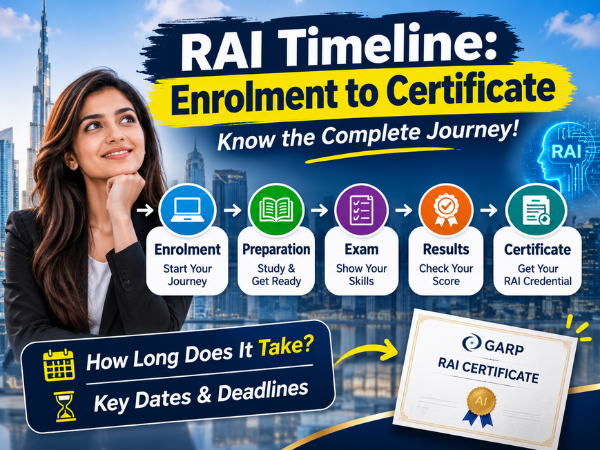
Here is how a realistic path looks if you aim for the April 2027 window. Dates come from GARP’s published schedule; the study phases are our suggestion.
- 1 December 2026: Early registration for the April 2027 exam opens. Early registration is USD 100 cheaper than standard registration for each candidate type, and, because registration includes GARP Learning access, it lets you start studying sooner.
- December 2026 to March 2027: Study phase. About 16–17 weeks sit between early registration and the exam window, which fits the 8-hours-a-week path in the table above.
- 1 February 2027: Standard registration opens for the April window.
- 3–11 April 2027: Exam window. Choose your slot and test format (remote or test centre). Registration and exam-day logistics are explained here.
- Roughly 9–23 May 2027: Results, which GARP says are posted within four to six weeks of the window closing.
Can you complete RAI in one year?
Yes, comfortably. GARP runs two exam windows a year, so even a candidate who starts from zero today has time for a full preparation cycle and a second attempt window within twelve months.
If plans change, GARP allows one deferral of your registration to the next exam window (the deferral deadlines are 1 April for the April window and 1 October for the October window, and a deferral fee applies). Candidates who do not pass, or who register but do not take the exam, can register for the next administration at a reduced one-time retake fee. After that one cycle, they must register again and pay the full fees.
What decides how long your RAI preparation takes?
Four factors matter more than anything else.
- Your background. RAI is open to candidates regardless of their background, and GARP says no work experience or coding is needed. The mathematics sits at roughly an advanced undergraduate or introductory graduate level, so quantitative comfort helps.
- Weekly hours. A steady 8–10 hours beats occasional long weekends.
- Exam window. Early registration gives you more calendar, not more content.
- Preparation style. Reading GARP’s curriculum alone, or adding lectures and mock papers, changes how quickly weak areas show up.
The curriculum covers five topics: AI and Risk (introduction and overview), Tools and Techniques, Risks and Risk Factors, Responsible and Ethical AI, and Data and AI Model Governance. It also includes case studies and practitioner videos.
A sample 14-week RAI study plan
This plan assumes about 8 hours a week (112 hours in total, inside GARP’s range). It is Fintelligents’ illustration. The split across topics is not based on any GARP weighting.
| Weeks | Focus | What to do |
| 1–2 | AI and Risk: introduction and overview | Learn core AI terms and where AI risk fits into enterprise risk |
| 3–5 | Tools and Techniques | Work through the machine learning concepts slowly; this is where non-technical candidates need the most time |
| 6–8 | Risks and Risk Factors | Study model, data, operational and regulatory risks with the case studies |
| 9–10 | Responsible and Ethical AI | Fairness, transparency, explainability and accountability |
| 11–12 | Data and AI Model Governance | Controls, oversight and governance frameworks |
| 13 | Practice Exam | Take it under timed conditions and list the weak topics |
| 14 | Revision | Revisit weak topics; do not start new material |
Want a plan built around your own schedule? Tell us your target exam window and weekly hours, and a Fintelligents counsellor will map your RAI timeline. Explore the RAI programme or speak with a course counsellor.
Does the RAI duration change by country?
No. GARP’s exam windows, study-hour estimate and exam format are the same for every candidate, wherever they are. What changes is practical: your time zone, whether you sit the exam online or at a Pearson VUE centre, and local taxes on the fee (GARP quotes fees in US dollars and excludes VAT/GST and other taxes).
Candidates in India can plan around the same April and October windows as candidates in the USA, UK, Canada, Hong Kong, the Netherlands, Singapore, China, Australia and the UAE. If you are comparing career context in specific markets, read our guides on RAI certification in the USA and RAI career opportunities in the UAE.
Is the time investment worth it?
RAI is an awareness-and-governance certificate for people who work with, manage or oversee AI in a risk context. It is not a licence, and GARP’s pages do not state an expiry period for it, although holders are encouraged to log 10 CPD credits a year. Whether 100–130 hours is worth it depends on your role: risk, compliance, audit and model-governance professionals will find the content closest to their daily work. We would not put a salary figure on it, because no reliable, comparable data exists yet for this newer certificate.
Conclusion: planning your RAI course duration
The RAI course duration comes down to 100–130 hours of preparation, spread over the weeks you can realistically study, and then aimed at the April or October window. For a working professional studying 8–10 hours a week, that means about three to four months of preparation and a total of four to six months until the result.
Pick the exam window first, count backwards, and register early if you can. If you want structured lectures, a question bank and a counsellor to check your plan, Fintelligents can help you set the timeline. Book a free demo class or speak with a course counsellor to get started.
FAQs
GARP estimates an average preparation time of 100–130 hours for the RAI Certificate. At 8–10 hours a week, that works out to roughly 10–16 weeks, or three to four months. The exam is a single four-hour sitting, and results arrive four to six weeks after the exam window closes.
A working candidate studying 8–10 hours a week needs three to four months of preparation, then wait four to six weeks for results, so four to six months overall. Studying five hours a week stretches this to five or six months, while 15–20 hours a week can bring preparation under two months.
GARP does not describe RAI as self-paced or instructor-led. Registered candidates access the curriculum on GARP Learning and prepare on their own schedule, but the exam must be taken inside the April or October window they registered for. So your study pace is flexible; the exam date is not.
Plan for 100–130 hours, which is GARP’s average estimate. Divide that by the weeks left before your exam window: with 16 weeks left you need roughly 6–8 hours a week, and with 10 weeks left about 10–13. Reserve the final one to two weeks for the Practice Exam and revision.
GARP does not set a minimum. The firm rules are that you schedule at least 48 hours before the exam and sit it in an April or October window. A well-prepared candidate studying about 20 hours a week could finish in five to seven weeks, but GARP discourages last-minute preparation.
Yes. GARP offers two exam windows a year, in April and October, so you can prepare, sit the exam and, if needed, use a deferral or retake within twelve months. Registering early for the April window leaves about four months to prepare, which suits most working professionals.
GARP states that no work experience is required to sit the exam, and coding is not required either. The maths level is comparable to an advanced undergraduate or introductory graduate course. Candidates from any background can register, so the main variable is the time you can commit each week.
GARP offers RAI in April and October. The next windows are 3–11 April 2027 and 2–10 October 2027. Early registration for April 2027 opens on 1 December, and standard registration opens on 1 February. Check GARP’s official fee and exam pages before planning, as dates and fees can change.
GARP says results are accessible within four to six weeks of the exam window closing, and you receive an email when they are posted to your candidate portal. The result is pass or fail, with quartile feedback comparing you to other candidates. Passing candidates receive an electronic certificate and a digital badge.