

Blog
SCR Certification: Who Can Take It, What It Costs and How to Pass

The SCR certification is the Sustainability and Climate Risk Certificate awarded by GARP, the Global Association of Risk Professionals. You earn it by passing one exam: 80 multiple-choice questions in four hours, offered in April and October. GARP’s published pages list no degree requirement, no work-experience requirement and no minimum age, so a finance degree is not a formal condition. The fee for the April 2027 window runs from USD 525 to USD 750 depending on membership status and when you register, plus taxes.
If you are choosing between SCR, FRM and other credentials, or wondering whether you can attempt it from a non-finance background, the sections below cover the exam as it stands for the 2026-27 cycle. Where something is not published by GARP, the article says so instead of guessing.
What is the SCR exam?
The SCR exam tests whether you understand how climate change and sustainability issues turn into financial risk, and how organisations measure and manage that risk. It is a certificate exam, graded pass/fail. GARP launched it in 2022, and its program page reports around 14,000 candidates and 7,000 certificate holders since then.
In plain terms, the exam asks questions like these: How does a physical climate event hit a bank’s loan book? What is a transition risk? How do scenario models work? What does a credible net-zero plan contain?
The SCR certification is GARP’s Sustainability and Climate Risk Certificate. It requires passing a single 80-question, four-hour exam, available in April and October, taken online or at a Pearson VUE test centre. GARP recommends 100 to 150 hours of preparation.
SCR exam details at a glance
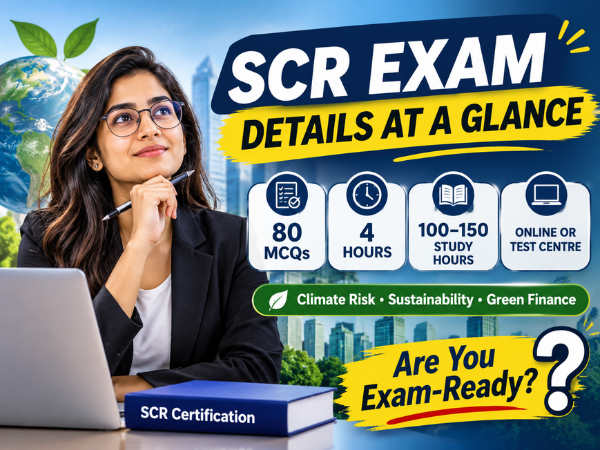
| Item | Detail (GARP, as of Nov 2026) |
| Awarding body | GARP |
| Format | 80 multiple-choice questions, equally weighted, including one multi-part case study |
| Duration | 4 hours |
| Result type | Pass/fail, with quartile feedback comparing you with other candidates |
| Delivery | Online (Pearson VUE OnVUE) or Pearson VUE test centre |
| Windows | April and October each year |
| Recommended study time | 100 to 150 hours |
| Results | On the GARP portal 4 to 6 weeks after the exam window closes |
| Study access | GARP Learning, official SCR Exam Book, two full-length practice exams |
Some training websites, including older copy on parts of the Indian market, quote different question counts or a three-hour limit. GARP’s own current pages say 80 questions and four hours, so use those figures.
SCR exam eligibility: do you need a finance degree?
GARP’s SCR pages do not list any educational, experience or prerequisite-exam requirement. Anyone can register for an exam window.
That is the formal position. The practical one is a little different. The syllabus uses ideas from finance and risk, such as green bonds, portfolio exposure and scenario analysis. A reader with no finance background can still pass, but should plan extra time for the finance vocabulary on top of the climate science.
SCR for non-finance candidates
People from engineering, environmental science, law, policy, sustainability reporting and consulting regularly look at SCR as a way into climate-finance roles. If you are in this group:
- Start with the climate and sustainability chapters, which you may find familiar.
- Spend your first two weeks on finance basics: what a bond is, how banks lend, what “exposure” means.
- Budget towards the upper end of GARP’s 100 to 150 hours.
- Use practice questions early, because the exam rewards applying concepts to a case rather than recalling definitions.
This split of effort is our editorial guidance, not a GARP statement.
How to get SCR certification without a finance degree
- Register for an April or October window on the GARP website.
- Collect the official study materials that come with registration.
- Fill finance-vocabulary gaps first, then work through the ten syllabus areas.
- Take both full-length practice exams under timed conditions.
- Schedule the exam (online or test centre) at least 48 hours ahead.
- Sit the exam and check results on the GARP portal.
SCR exam age limit
GARP’s SCR pages do not publish a minimum or maximum age, and that is true for candidates in India as well. There is no separate age limit for Indian students. The rules are the same everywhere: register, pay, schedule and sit the exam.
SCR exam fees in USD and Indian rupees
GARP prices the exam in US dollars. The fee depends on who you are and when you register.
| Candidate type | Early registration | Standard registration |
| FRM, RAI or ERP holder | USD 525 | USD 625 |
| Individual GARP member | USD 550 | USD 650 |
| Non-member | USD 650 | USD 750 |
Other points from GARP’s fee page:
- Fees exclude taxes such as GST or VAT, which are added at payment based on your location.
- Wire or ACH payments carry an extra USD 50 processing fee.
- Retake fee: USD 300, usable once, in either of the next two exam windows.
- Registration includes six months of free GARP Individual Membership for candidates who have not previously received it from another GARP programme.
- All fees are subject to change.
In Indian rupees: GARP does not publish an INR price. Take the USD fee, multiply it by the exchange rate on the day you pay, then add your card or bank charges and GST. For example, the non-member early fee of USD 650 should be converted at the day’s rate. For a deeper breakdown, see our guide to GARP SCR fees for Indian candidates.
MID-ARTICLE CTA Not sure whether SCR fits your background? Fintelligents’ SCR programme walks you through all ten syllabus areas, with a question bank and live support. Explore the SCR Certification Programme
SCR exam dates and registration deadlines
| Exam window | Exam dates | Early registration | Standard registration |
| October 2026 | 17 to 25 Oct 2026 | Closed | Closed |
| April 2027 | 17 to 21 Apr 2027 | 1 Dec 2026 to 31 Jan 2027 | 1 Feb to 31 Mar 2027 |
| October 2027 | 16 to 20 Oct 2027 | 1 May to 31 Jul 2027 | 1 Aug to 30 Sep 2027 |
All deadlines are 11:59 pm US Eastern Time, which falls on the following morning in India, so do not leave payment to the last hour. The scheduling window stays open until two days before the exam end date, and GARP asks for bookings at least 48 hours in advance. If you are reading this in November 2026, the realistic target is the April 2027 window, with early registration opening on 1 December.
SCR exam syllabus
GARP lists ten topic areas. It does not publish weightings on the public pages, so be wary of any site quoting exact percentages.
| # | Topic | What it covers, in simple terms |
| 1 | Foundations of Climate Change | The science and the main drivers of warming |
| 2 | Sustainability | Core sustainability concepts and frameworks |
| 3 | Climate Change Risk | Physical and transition risks and how they reach businesses |
| 4 | Sustainability and Climate Policy, Culture and Governance | Regulation, board oversight and organisational culture |
| 5 | Green and Sustainable Finance: Markets and Instruments | Green bonds, sustainability-linked products and markets |
| 6 | Climate Risk Measurement and Management | Tools to quantify and control climate-related exposures |
| 7 | Climate Models and Scenario Analysis | How scenarios are built and used in stress testing |
| 8 | Net Zero | Targets, pathways and credibility of commitments |
| 9 | Climate and Nature Risk Assessment | Biodiversity and nature-related risk alongside climate |
| 10 | Transition Planning and Carbon Reporting | Corporate transition plans and emissions disclosure |
Many candidates find the scenario analysis and risk-measurement chapters the most demanding, because they move from concepts to applied reasoning. That is an observation about the content, not an official difficulty ranking.
How long does it take to prepare?
GARP recommends 100 to 150 hours. Here is how that can look over twelve weeks:
| Weeks | Focus | Hours per week (approx.) |
| 1 to 2 | Finance and risk basics (non-finance candidates) or climate foundations (finance candidates) | 8 to 10 |
| 3 to 8 | Work through the ten syllabus areas, one practice set per chapter | 9 to 12 |
| 9 to 10 | Case-study practice and weak areas | 10 |
| 11 to 12 | Two full-length timed practice exams, then revision | 10 to 12 |
Adjust the plan to your schedule. Working professionals often prefer a longer runway of 14 to 16 weeks.
Is SCR certification worth it?
What works in its favour
- It is a recognised credential from GARP, the body behind the FRM.
- Climate and sustainability risk now sits in the risk, compliance, strategy and reporting functions of banks, insurers, asset managers and consulting firms.
- A single exam with no prerequisites keeps the entry barrier low.
- Remote proctoring makes it accessible from India, the UAE, Singapore, Hong Kong, the UK, the USA and other countries.
What to keep in mind
- It is a certificate, not a licence, and by itself it does not guarantee a job.
- Fees are in dollars, so exchange rates matter for Indian candidates.
- Hiring demand varies by country, sector and the regulatory push in that market.
- GARP does not publish a pass mark or pass rate on its programme pages. Treat any pass-rate figure on a website as dated unless it names a year and source.
SCR recruitment and career outlook for 2027
We cannot honestly give you a verified “sustainability and climate risk recruitment 2027” hiring number, and neither can most sites. What can be said is that the roles where SCR is most relevant include climate risk analyst, ESG risk associate, sustainable finance analyst, risk and compliance associate, and transition planning or sustainability reporting roles in financial institutions.
SCR vs FRM vs RAI: which should you pick?
| SCR | FRM | RAI | |
| Awarding body | GARP | GARP | GARP |
| Focus | Climate and sustainability risk | Broad financial risk management | Risk and AI |
| Structure | One exam | Two-part exam | See GARP for current structure |
| Best for | Professionals moving into climate and ESG risk | Those targeting core risk roles | Risk professionals working with AI |
| Fee holders’ discount | Not applicable | Not applicable | FRM, RAI and ERP holders pay the lowest SCR fee |
SCR and FRM work well together. FRM builds the base in market, credit and operational risk. SCR layers climate risk on top. Read our comparison of top finance certifications for 2026 for a wider view.
SCR certification by country
The exam is the same everywhere. What changes is payment, tax and local demand.
- India: Pay in USD plus GST. Deadlines close on the next morning IST.
- USA: Read our SCR certification guide for the USA and the eligibility, cost and career path guide.
- Singapore: See the SCR certification in Singapore page.
- UAE: See SCR certification in UAE.
- UK, Hong Kong, Canada, South Africa, Malaysia, Netherlands, China, Kenya: Remote proctoring through Pearson VUE means you can sit the exam from any of these countries, subject to local test-centre availability.
Conclusion
The SCR certification is one of the more accessible ways to build credible knowledge in climate and sustainability risk. GARP asks for no formal prerequisites, the exam is a single four-hour paper, and you can sit it online. The real work is the 100 to 150 hours of preparation, and non-finance candidates should add time for finance basics.
Your next step depends on where you are today. If you are early in the decision, compare SCR with FRM. If you are decided, mark 1 December 2026 for early registration for the April 2027 window and build your study plan backwards from 17 April.
7. FAQs
1. What is the SCR exam? The SCR exam is GARP’s Sustainability and Climate Risk Certificate exam. It has 80 multiple-choice questions, including one multi-part case study, and lasts four hours. It tests how climate change and sustainability affect financial risk, and passing it earns you the SCR Certificate.
2. What is the SCR exam eligibility? GARP’s public SCR pages list no degree, work-experience or prerequisite-exam requirement. Anyone can register for an April or October exam window. In practice, basic finance and risk knowledge helps, so candidates from other fields should allow extra preparation time.
3. Is there an SCR exam age limit? GARP does not publish an age limit for the SCR exam on its public pages. That applies to candidates in India too. Confirm the latest rules in GARP’s SCR Candidate Guide before you register, since terms can change.
4. Can I get SCR certification without a finance degree? Yes, based on GARP’s published rules, because no finance degree is required. Learn finance basics first, then cover the ten syllabus areas and practise with timed mock exams. Plan toward the upper end of the recommended 100 to 150 study hours.
5. How much does the SCR exam cost in Indian rupees? GARP charges in US dollars: USD 525 to USD 750 depending on membership and registration timing, plus GST or VAT. There is no official INR price. Convert the USD fee at the exchange rate on payment day and add bank charges.
6. What is the SCR exam syllabus? GARP lists ten areas: foundations of climate change, sustainability, climate change risk, policy and governance, green and sustainable finance, risk measurement and management, climate models and scenario analysis, net zero, climate and nature risk assessment, and transition planning and carbon reporting.
7. When is the next SCR exam? The October 2026 window has closed. The next is 17 to 21 April 2027. Early registration runs 1 December 2026 to 31 January 2027, and standard registration runs 1 February to 31 March 2027. Deadlines are 11:59 pm US Eastern Time.
8. How long does it take to prepare for the SCR exam? GARP recommends 100 to 150 hours. Finance professionals may need the lower end, while candidates from non-finance backgrounds should plan for more. A 12 to 16 week study plan is common for working professionals.
9. Is the SCR certificate worth it? It can be worthwhile if you want to move into climate risk, ESG risk or sustainable finance roles. It is a credential from GARP, not a job guarantee, so check demand in your target country and sector before deciding.
10. What happens if I fail the SCR exam? You can retake it at a reduced fee of USD 300, once, in either of the next two exam windows, as stated on GARP’s fee page. Candidates also receive quartile feedback to see how they performed relative to others.